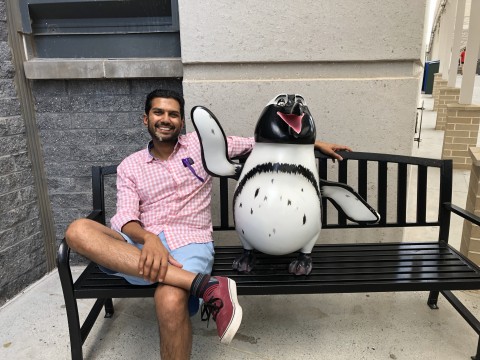
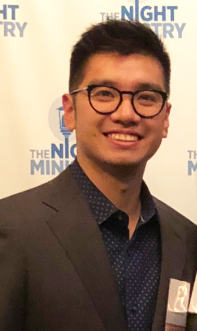
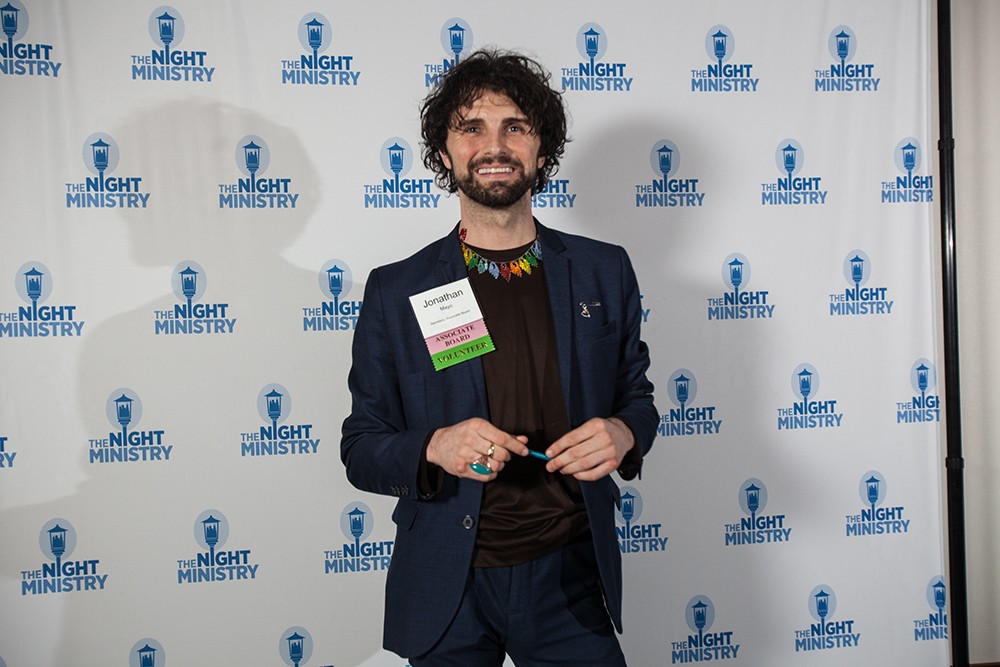
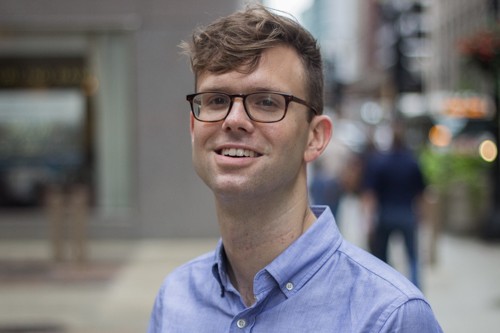
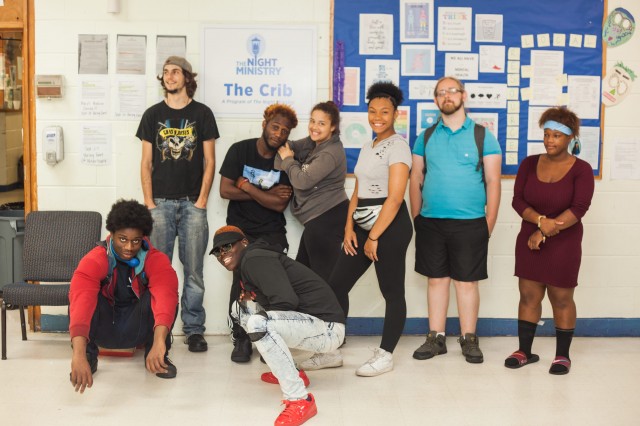
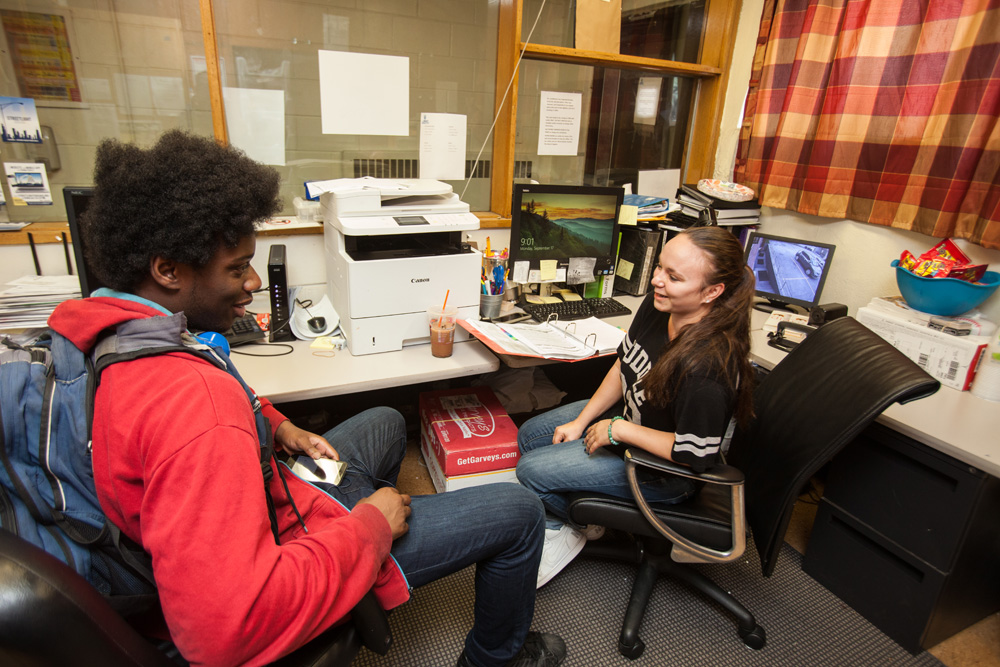
When Nonso Achebe joined The Night Ministry’s Storytelling Committee as a volunteer, it marked a meaningful full-circle moment—especially for Anthony Monterroso, his former mentor from The Night Ministry STEPS program (Successful Transitions Effectively Preparing for Self Sufficiency Program), the precursor to our current Pathways program.”His success doesn’t surprise me one bit.” Anthony remarks. “Everyone on our team knew Nonso was going to make it.”
The reunion was totally natural for both Anthony and Nonso. The two fell into conversation about the world, the environment, Nonso’s accomplishments, and his current pursuits. Now working toward a degree in human resources, Nonso is building on the foundation he established during his time in STEPS.
Anthony sees a bright future ahead. “His lived experience and his deep understanding of social justice will be his greatest assets in HR,” he explained. “He’ll bring a perspective that can’t be taught in a classroom.”
What stands out most to those who know Nonso is his genuine care for others and his unwavering commitment to making a difference. His journey from STEPS resident to community volunteer embodies the resilience and potential that The Night Ministry works to nurture every day.
As Nonso continues to pursue his goals, his story serves as a powerful reminder of what’s possible when young people receive the right support at the right time.
Help The Night Ministry give the gifts of hope and warmth this holiday season with a drawstring bag! Distribution begins the week of December 15! Drawstring backpacks should be approximately 14″ x 16″. Simple nylon backpacks are fine. Most clients prefer dark-colored backpacks. All items must be new. Please be respectful of our diverse client base, keep backpacks secular, and omit any notes or cards.
Schedule your drop-off between Monday, November 24, and Wednesday, December 10 by clicking here and THANK YOU for your support!
Each backpack should include the following:
– Winter Hat – Pair of Warm Gloves – Pair of Adult Socks – Keychain Flashlight – Hand & Toe Warmers – Assorted Candy – Full-Size Deodorant – Travel-Size Lotion – Lip Balm – Bath/Body Wipes – Toothbrush – Travel-Size Toothpaste
Special Note:
• Please consider donating $5/$10 gift cards to Dunkin’ or McDonald’s in addition to the backpacks.
Each backpack should include the following:
– Winter Hat – Pair of Warm Gloves – Pair of Adult Socks – Keychain Flashlight – Hand & Toe Warmers – Assorted Candy – Full-Size Deodorant – Travel-Size Lotion – Lip Balm – Bath/Body Wipes – Toothbrush – Travel-Size Toothpaste
Frequently Asked Questions
How does The Night Ministry use these backpacks? We distribute hundreds of backpacks to individuals who receive services from our Health Outreach Bus, Street Medicine initiatives and at specific CTA stations where we serve.
Why are only dark-colored clothing items in adult sizes requested?
Over 80% of our clients are adult men who prefer dark-colored hats and gloves because they hide stains better.
Why should you focus on quality over quantity?
We want our clients to receive high-quality gifts that are more likely to last through the winter and provide warmth in severe temperatures. It would be most beneficial to give them gifts that can handle daily wear and tear, such as waterproof insulated gloves, thick beanies, and warm socks
A Winter Storm Warning is in effect for Cook County from 9 PM tonight (11/9) through noon Monday (11/10). Lake effect snow may significantly impact Monday morning conditions.
For organizations serving unsheltered individuals, please share these warming resources:
24/7 ACCESS:
SPARC (Shelter Placement and Resource Center) – 2241 S Halsted St | 312-748-5728 Open 24/7 for single adults seeking shelter placement, meals, laundry/showers, and overflow beds
Chicago Police District Stations – Available 24/7 for warming and shelter connections
MONDAY, NOV 10 (9 AM – 5 PM): Six DFSS Community Service Centers will be open as warming centers:
Englewood Center – 1140 W. 79th St
Garfield Center – 10 S. Kedzie Ave
MLK Center – 4314 S. Cottage Grove
North Area Center – 845 W. Wilson Ave
South Chicago Center – 8650 S. Commercial Ave
Trina Davila Center – 4312 W. North Ave
ADDITIONAL OPTIONS: All six DFSS Senior Centers (8:30 AM – 4:30 PM), plus Chicago Park District facilities, Chicago Public Libraries, and City Colleges are available for warming relief.
Our Youth 4 Truth members recently had the incredible opportunity to attend the “A Way Home America” conference, an experience that left us inspired and energized for the work ahead.
A Way Home America continues to be a leading force in shaping policies that support unhoused individuals and amplifying the voices of those who need it most. This year’s conference brought together advocates, service providers, and youth from across the country.
One of the conference highlights was hearing from Symone, a Night Ministry alum, who delivered an eloquent and passionate speech on collaborative models for youth care. We were also proud to see our own President & CEO, Carol Sharp, present at the conference, on Mobilizing for Collective Action, sharing insights for bold, community-led change and drawing from her own lived experience.
The networking opportunities were invaluable, connecting our team with similar organizations nationwide and building relationships that will strengthen our collective impact. We’re especially grateful to the “A Way Home America” team, who provided meals for our clients at The Crib for two days—a generous gesture that exemplifies the spirit of collaboration that makes this movement so powerful.
As we return from the conference, we’re filled with renewed commitment to our mission and gratitude for partners like “A Way Home America” who stand alongside us in this critical work.
Click here to learn more about our Youth for Truth cohort.
Jan Rotter carefully arranges paintbrushes and colored pencils on the table in the lounge at West Town, The Night Ministry’s interim housing facility for youth ages 14–21, preparing for another afternoon with the young people she’s come to know and love. It’s a ritual she’s repeated countless times during her 20-year tenure as a volunteer.
A former art instructor and day camp director for the Chicago Park District, she took a sabbatical to raise her three children. When the kids got older, Jan was eager to find an outlet for both her time and her creative side. She volunteered at numerous organizations and explored several opportunities, but it wasn’t until she connected with The Night Ministry that she truly felt there was an opportunity to really get to know unhoused youth better.
It was serendipitous. Her art skills and nurturing manner were a perfect fit, and she felt that she was making a real difference. “Although they can stay up to 120 days at West Town Open Door Shelter, most youth are there only several days, sometimes weeks, & occasionally months before they’re placed in more permanent housing,” Jan reflects, “but for that time, I try to help create some stability and, through art, provide an outlet for their creativity.”
“I try to help create some stability and, through art, provide an outlet for their creativity.”
Given her love of art and creative expression, it’s no surprise that Halloween is Jan’s favorite holiday. She and her husband, Jerry have hosted their legendary “Rotten Rotter’s Halloween Party” for many years and have raised thousands of dollars for youth programming at The Night Ministry. With the donations, she has been able to get supplies for art projects and essential items such as duffle bags and backpacks. She has even taken them on some fun outings to see what Chicago has to offer.
“My favorite outings have included attending plays at the Steppenwolf Theatre and concerts by the Black Ensemble. They get to experience things they’ve never had opportunities to before.”
She recognizes the stress felt by the youth she encounters at West Town. She is non-judgmental, kind, and has an easy-going nature that makes it easy for them to talk with her when they need someone who will listen.
The staff thinks she is amazing and loves her energy, creativity, and what she brings to the program. “Jan’s boundless energy wraps around the weary and provides a calm presence that transforms despair into dreams through her art. We are so lucky to have her share her gifts with our youth,” says Felitha Jones-Patterson, Director of Youth Programs at The Night Ministry.
Jan hopes that in some small way, she has helped each of the young people she has encountered while on their path to stable housing and a better future.
“I remember going to the Peggy Notebaert Nature Museum, and the girl at the reception desk recognized me,” Jan recalls fondly. “She was a former client from West Town, and there she was, doing great, working at a museum. It really meant a lot—I loved seeing that.”
Bertha DePriest first learned about The Night Ministry more than two decades ago while on vacation in Argentina, in a conversation with a couple she met and is still friends with Gordon and Paula Addington. The name itself piqued her curiosity, and when she returned home, she encouraged her church to get involved. Soon, her congregation was preparing evening meals and delivering them to The Night Ministry’s Health Outreach Bus. This experience opened her eyes to the struggles faced by many unhoused people in Chicago.
A Senior Art Director at Spiegel until her retirement in 2000, Bertha always believed in putting her resources to work where they could make a difference. “Uncle Sam doesn’t need more of our money,” she often said, reminding others that charitable giving could provide both impact and tax benefits. Living by that principle, she became a donor to The Night Ministry, drawn to the organization’s direct and compassionate service. Becoming a Beacon of Hope felt like a natural next step. As a monthly donor, she appreciates the ease and consistency, knowing her support reliably reaches those who need it.
“You usually end up giving more, and you never forget,” she explained with a smile.
Bertha hopes her contributions help expand The Night Ministry’s reach, ensuring that more people become aware of and support its vital work. With her twin sister by her side, she recently celebrated her 95th birthday—still filled with the same passion for community, generosity, and faith that first inspired her journey.
Become a Beacon of Hope Thanks to the recurring contributions from our Beacons of Hope, The Night Ministry can continue to be a light for so many of our unhoused and impoverished neighbors in Chicago. With their steady support, we can put more resources into the life-saving services and programs that many people need to survive. Click Hereto learn more and sign up.
At 6’4, Seth Hilton stands tall with a warm smile and a funny but important clarification, “No, I’m not related to the Hiltons,” he laughs, referring to the family hotel empire. What Seth lacks in inherited wealth, he makes up for in determination, creativity, and an unexpected gift that emerged during one of the most challenging times the world has faced.Seth, 22, began his journey to The Crib when his desire for independence at 19 led to couch-surfing and then to homelessness. But rather than viewing this as a setback, Seth saw it as a fresh start.
“I didn’t see it as the end of something,” Seth says. “I saw it as the start of figuring out who I am and what I can do. Every day felt like a chance to build toward something better.”
The pandemic brought an unexpected revelation. Unable to visit a barber, Seth decided to cut his own hair and discovered he was a natural. What started as a necessity became a passion, eventually switching from his studies in architecture to obtaining his professional barber certification.
Now, Seth has transformed his newfound skill into a gift for his fellow Crib residents. Every other Friday, you’ll find him offering free haircuts, understanding that sometimes a fresh cut can be the confidence boost someone needs for a job interview or simply to feel better about themselves.
“Getting a haircut can make such a difference,” Seth explains.”There are so many ways it can be empowering for people.”
With encouragement and support from Anthony Monterroso, The Crib’s Manager of Youth Engagement Services, Seth has already taken his first major step toward independence—he has a part-time job and it currently looking for more opportunities as an independent barber. His routine-driven approach keeps him focused on his ultimate goals: to have stable housing, financial security, and one day, open his own barber shop and be able to offer jobs to people who are trying to be better.
“Everyone has something going on in their life,” he reflects. “If I can make them smile, for me that’s great.”
Like his favorite video game, Minecraft, Seth is building his life one block at a time, on his own terms, proving that sometimes the most unexpected path can lead to the most meaningful destination.
Seth Hilton gives a young man a haircut at The Crib in perpetration for the start of a new job.
Israel stresses that for people living with addiction, recovery is more complicated than just getting clean. There’s a crucial mental component that must be addressed—a psychological shift that needs to happen before real change can occur. “You have to get to the root of what went wrong, what led to the decisions that eventually resulted in addiction and the slow decline: loss of jobs, loss of housing, loss of self-worth.”
“Jessica (referring to Jessica Stokes, TNM Case Manager) has truly transformed my life,” says Israel. His face lit up as he shared how she helped him attain a place to stay. “She goes the extra mile to ensure she can give you the hope and resources you need to be an effective member of society.”
He wants people to understand that organizations like The Night Ministry make a real difference, and all the many case managers and support staff who have helped him along the way. “They truly care about people and help with their personal difficulties, without judgment.”
For Israel, it feels different this time around. His infectious smile, newfound enthusiasm for life, and personal spiritual connection are authentic. He’s stepping up as a volunteer and looking forward to the next chapter of his life as an example of what’s possible and how lives can turn around in the best possible way.
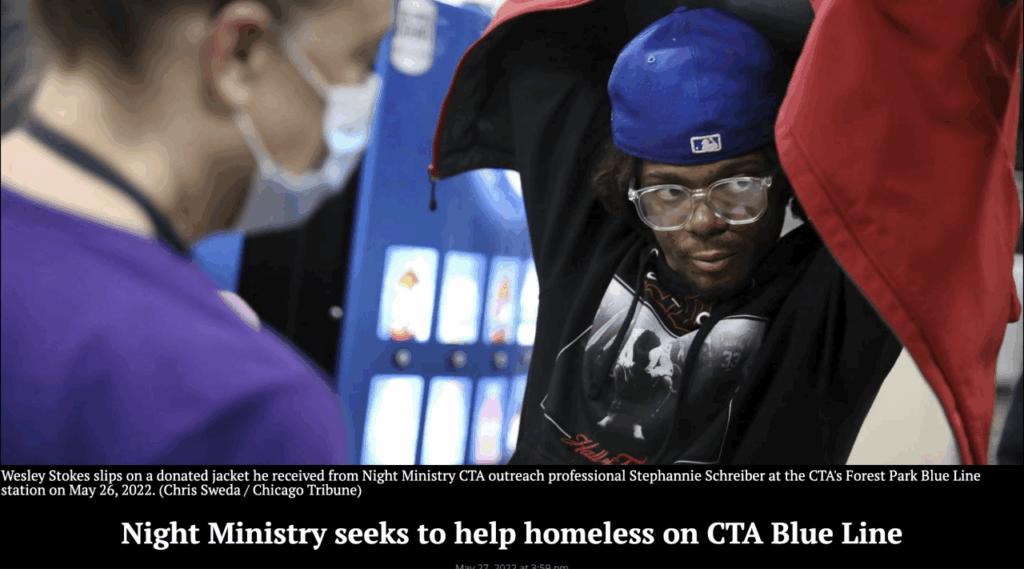
Twice a month at our Forest Park Blue Line outreach, Loyola optometrists volunteer their expertise to provide essential eye care to those experiencing homelessness and extreme poverty.
From vision screenings and glaucoma testing to distributing free reading glasses, these amazing professionals are helping our community members and making a significant difference.
Thank you to Loyola’s volunteer optometrists for bringing compassion and care to where it’s needed most.
Loyola Ophthalmology is part of the Loyola Street Medicine Team, which partners with The Night Ministry’s Outreach and Health programs.
CMS is an umbrella organization that encompasses the SM chapters at Loyola, UIC, the University of Chicago, and Northwestern Medicine.
Loyola Medicine officially became a chapter within the CSM in October 2021 and was established to provide quality healthcare and resources to individuals experiencing homelessness while maintaining an environment of dignity and respect.
When The Night Ministry launched Youth 4 Truth (Y4T) in 2016, the goal was both transformative and straightforward: to create a space where young people in its housing programs could speak for themselves and shape the services they rely on. Nearly a decade later, the program is thriving, now under the leadership of Michelle Thomas, Client Development Specialist, who manages Y4T along with two other advisory boards.
Michelle began her journey with The Night Ministry in 2017 as part of the Youth Outreach Team. Her natural passion and drive have carried her into a leadership role where she now oversees three advisory groups designed to elevate the voices of those with lived experience of homelessness. Alongside Y4T, she leads a statewide Youth Advisory Group, funded by the Illinois Department of Human Services, and a Client Advisory Board for adults who access services through The Night Ministry’s outreach and health programs. For Michelle, these boards are platforms of empowerment. Participants are compensated for their time and expertise, an intentional recognition of the value of their lived experiences. “Being able to offer cash stipends demonstrates to participants that their voice is powerful, their expertise is valuable, and that they are worth investing in,” she explains.
The results have been profound. Michelle recalls one young mother who arrived in Chicago with her two-year-old daughter after being turned away from her family home. Through Y4T, she found her voice, setting goals in public speaking and advocacy. Months later, she stood before policymakers in Washington, DC, sharing her story with confidence and conviction. “She didn’t hold back,” Michelle says. “It was awe-inspiring.” The work is about building a movement. Whether speaking at national conferences or connecting youth across Illinois, she believes incorporating client voice is no longer optional—it’s essential.
“Giving clients a platform and a sense of agency has been a game-changer,” Michelle says.
As she looks ahead, Michelle’s vision is to maintain momentum, break down barriers, and provide opportunities that enable participants to grow both personally and professionally. For her, the voices of those who have lived the struggle hold the key to lasting solutions.
The Night Ministry’s Associate Board will host the 11th Annual Night Lights Gala on Thursday, October 30, from 5:30 p.m. to 9:00 p.m. at Marshall’s Landing, 222 West Merchandise Mart Plaza. Guests will enjoy an evening of celebration, networking, and community while raising vital funds to support The Night Ministry’s health outreach programs and services for individuals experiencing homelessness and poverty.
Since its inception, the Night Lights Gala has raised close to $1 million to advance The Night Ministry’s mission. This year’s event will continue that tradition of impact, bringing together supporters dedicated to helping Chicago’s most vulnerable neighbors access compassionate care.
“The Night Lights Gala represents the power of community and the belief that every person deserves dignity, health, and hope,” said Duncan Reilly, President of The Night Ministry’s Associate Board. “We are proud to bring together Chicagoans who share our commitment to supporting those who too often go unseen.”
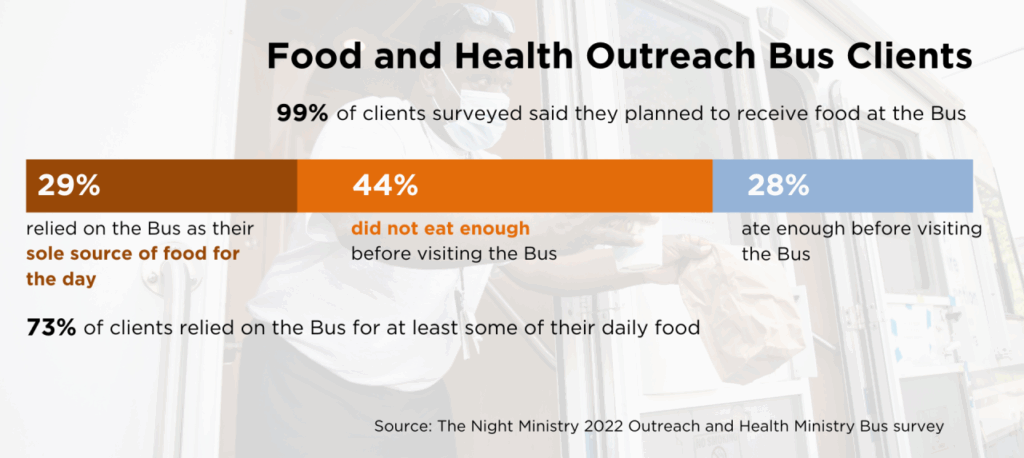
The Night Ministry’s Health Outreach Program provides free lifesaving care through its Health Outreach Bus and Street Medicine teams, which bring medical services, food, and essential supplies directly to people where they live — whether on the streets, under viaducts, or in encampments. Each year, these programs connect thousands of individuals with critical care, resources, and pathways to housing and stability.
The Night Lights Gala will feature cocktails, hors d’oeuvres, entertainment, and opportunities for guests to learn more about the organization’s transformative work.
Tickets are on sale now. Early bird tickets are $100 until September 30, after which general admission prices will apply. To purchase tickets and learn more, visit https://onecau.se/nightlights2025
Time
October 30, 2025, at 5:30 pm – 9 pm
Location
Marshall’s Landing, 222 West Merchandise Mart Plaza
The potential deployment of the National Guard has heightened anxiety and fear across Chicago. For our unhoused neighbors, increased military presence can be particularly unsettling, exacerbating the already immense challenges they face daily. The feeling of insecurity and potential for further marginalization adds another layer of complexity to their struggle for survival.
At The Night Ministry, our mission remains unchanged: to provide human connection, housing, and health care to those who need it most. During this time, we will continue to deliver our human-centered, trauma-informed outreach programs and services across the city with a safety-first approach to protect our staff and our unhoused neighbors. We are equipping them with information and resources, including reminders about their rights, safety tips, and connections to legal and mental health support services.
We are also in collaboration with our city and state officials, as well as our community partners, to stay informed and to align and coordinate efforts to respond to needs in an ever-changing environment, steadfastly and fiercely advocating for their safety, well-being, and fundamental rights.
The Night Ministry stands alongside our unhoused neighbors and will support them in navigating these uncertain times with the compassion and dignity they deserve.
Each day, whether on sidewalks, under viaducts, and in shelters, The Night Ministry’s Advanced Practice Registered Nurses (APRNs) are on the frontlines, providing health care and other vital services to some of Chicago’s most vulnerable residents. In honor of Illinois Association for Free & Charitable Clinic Month, we celebrate them for their unparalleled compassion, dedication, and service.
“These APRNs aren’t just providers, they’re lifelines for many people in need in our community,” said David Wywialowski, Director of Outreach and Health Ministry. “They meet our clients exactly where they are, physically and emotionally, and provide care that says, ‘You matter. You are not forgotten.'”
For many experiencing homelessness or extreme poverty, The Night Ministry’s APRNs are the only consistent connection to medical care. Their work extends far beyond stethoscopes and blood pressure cuffs. They remember names, track down clients in encampments, and follow up when no phone number or address exists. This is intentional, relational healthcare at its most human level.
What sets them apart isn’t only their clinical excellence but also their presence. They understand the power of dignity and treat every encounter as an opportunity for healing.
Wywialowski added, “Our APRNs are deeply attuned to our clients’ needs. Their empathy, skill, and consistency help bridge the gap between survival and wellness. They embody the spirit of our mission of delivering not just healthcare, but humanity.”
For the second consecutive year, The Night Ministry hosted a delegation from Mission Australia, (who are they and what do they do). The visit provided an opportunity for The Night Ministry to update the organization on its programs and services, learn more about their initiatives, and foster valuable cross-cultural dialogue about addressing homelessness and extreme poverty.
In addition to the exchange of ideas and information, they rolled up their sleeves, preparing close to 200 sandwiches for The Night Ministry’s outreach team to distribute throughout the community. Their hands-on participation demonstrated a genuine commitment to our shared mission of serving those in need.
“For Mission Australia, our collaboration with The Night Ministry is an opportunity to learn, reflect, and grow. By sharing insights and embracing our common challenges, we deepen our understanding of service delivery and strengthen our commitment to those we support,” stated Ben Carblis, Deputy Chief Executive Officer of Mission Australia.
“This partnership reminds us that compassion knows no borders—and through mutual learning and united purpose, we can create lasting change in the lives of the people we serve.”Allison McCann-Stevenson, The Night Ministry’s Vice President of Programs and Services, reflected on the collaboration: “Having Mission Australia return for a second year shows the strength of our partnership.
Their fresh perspectives and willingness to jump in and help exemplify the spirit of service we share across continents.”This collaborative interaction highlighted the global nature of compassion and community service, proving that geographic boundaries shouldn’t limit our collective impact in supporting society’s most vulnerable members.
August is Free and Charitable Clinic Month, and The Night Ministry is proud to highlight the transformative impact of our health outreach programs serving Chicago’s most vulnerable populations. Our dedicated street medicine teams exemplify the spirit of charitable healthcare by bringing vital medical services directly to those who need them most.
Every year, our health outreach teams provide direct healthcare to over 5,000 individuals while making meaningful contact with more than 20,000 people experiencing homelessness or extreme poverty. Whether stationed at CTA stops on Wednesday (Howard Red Line) and Thursday (Forest Park Blue Line) evenings, operating from our outreach bus, or making regular rounds throughout the city in our street medicine vans, our teams meet people where they are with compassion and clinical expertise.
By providing accessible, free healthcare services, our programs save the healthcare system well over $1.7 million annually by helping people avoid costly emergency room visits. This preventive approach not only reduces healthcare costs but also ensures individuals receive appropriate, timely care in a dignified setting.
Our work demonstrates that healthcare is a fundamental right, not a privilege. During Free and Charitable Clinic Month, we invite you to join our mission of bringing healthcare directly to those who face the greatest barriers to access. Together, we can continue expanding these vital services throughout our community.
If you’re interested in supporting our health outreach programs, please visit www.thenightministry/donate to learn how you can make a difference.
Funding will support Health Outreach Bus program serving Chicago’s most vulnerable populations
(CHICAGO, IL – August 7, 2025) – The Night Ministry announced today that it has received a $20,000 grant from SC Johnson to support its Health Outreach Bus program, which delivers essential medical care and community support to individuals and families experiencing homelessness and extreme poverty across Chicago.
The organization’s specially designed Health Outreach Bus operates as a mobile medical clinic, featuring a fully equipped nurse’s office that brings basic healthcare services directly to underserved communities five days per week, and connects with over 30,000 individuals annually.
The program serves as a critical healthcare access point for Chicago’s most vulnerable residents.
“This grant allows us to continue providing vital services to community members who often have nowhere else to turn,” said David Wywialowski, director of the health outreach Program. “Our Health Outreach Bus frequently serves as the only source of healthcare for individuals experiencing homelessness, while also providing life-saving supplies, hygiene kits, food, and water.”
The mobile healthcare initiative addresses significant barriers to medical care faced by Chicago’s unhoused population, including transportation challenges, lack of insurance, and limited access to traditional healthcare facilities.
SC Johnson’s grant will help sustain the program’s operations and ensure continued access to healthcare services for hundreds of individuals throughout the year.
###
About The Night Ministry:
Founded in 1976, The Night Ministry is a Chicago-based organization whose mission is to provide human connection, housing support, and health care to those who are unhoused or experiencing poverty. With an open heart, we compassionately accept each individual as they are and work alongside them to advocate for their immediate physical, emotional, and social needs while affirming our shared humanity. Learn more at www.thenightministry.org.
(Chicago, IL – July 16, 2025) The Night Ministry is proud to announce it has received a $100,000 grant from The Chicago Community Trust (the Trust) in support of its ongoing efforts to serve thousands of individuals experiencing homelessness and poverty throughout Chicago.
For more than 39 years, the Trust has been a steadfast partner in The Night Ministry’s mission to provide compassionate, judgment-free care to some of Chicago’s most vulnerable residents. This grant builds upon the long-standing relationship and shared values of dignity, equity, and community.
“Partnerships like the one we share with the Trust are more critical than ever as we face a rising number of individuals experiencing homelessness alongside shifts and reductions in federal and state funding,” said Carol J. Sharp, President and CEO of The Night Ministry. We are deeply grateful for their continued partnership as we work to ensure that our unhoused neighbors are not forgotten and have access to the resources necessary to thrive.”
The funding will help The Night Ministry to meet people where they are, providing a wide range of vital services that include, but are not limited to, mobile outreach, street medicine, transitional housing, youth programming, and case management.
To learn more about the work of The Night Ministry, please visit www.thenightministry.org
The Night Ministry is a Chicago-based organization whose mission is to provide human connection, housing support, and health care to those who are unhoused or experiencing poverty. With an open heart, we compassionately accept each individual as they are and work alongside them to advocate for their immediate physical, emotional, and social needs while affirming our shared humanity.
At 21, Alexandra jingles her house keys with a butterfly keyring—a reminder of her mother, who loved butterflies. The keys represent something profound: after years of instability, she finally has a place to call home.
Alexandra’s journey came to an abrupt and heartbreaking stop when, at 16, her mother died at the hands of gun violence. The love and relative stability her mother had given her were gone. With no real connection with her father, Alexandra spent the next several years going from house to house, couch surfing, and eventually becoming homeless.
It was her teacher, Ms. Guthrie, who suggested The Night Ministry as a solution. Alexandra was hesitant at first—her experience with shelters hadn’t been great—but her face now lights up at the mention of The Crib. “It’s the best – clean, organized, they feed you, and the people are so nice and attentive. They made it all so easy, and they took the fear away.”
From The Crib to the Interim Housing program at West Town, and finally to her current home in North Lawndale through the Scattered Housing program, Alexandra’s path to stability moved remarkably quickly. After just four months, she had her own set of keys and a sense of real hope.
Now enrolled in culinary school at Kennedy King College with a part-time job at Limelight, a high-end catering company, Alexandra is exploring her passions while keeping her options open. Though she loves to cook, she’s considering vocational training in carpentry or welding—something practical but still artistic.
Her apartment reflects her creative spirit, decorated with original artwork and her unique style. But what strikes you most about Alexandra is her genuine warmth and infectious smile. Despite everything endured, she has a mission: “I just really want to make everyone smile.”
“Being homeless is very depressing; it takes a toll on you mentally,” she acknowledges, serious for just a moment before her characteristic joy returns. To young people facing similar struggles, she offers this wisdom: “It’s ok to be you. Never base yourself on what you have and what you don’t have. I’m unapologetic about who I am, I just live and celebrate the small things.”
Friends often invite her out, but Alexandra prefers spending time at home—the place she loves most. “Life is like chutes and ladders,” she reflects, “it’s a long way up and a short slide down, you just need to keep climbing up.”
(CHICAGO, IL — July 25, 2025) The Night Ministry strongly opposes the recent Executive Order, “Ending Crime and Disorder on America’s Streets,” which directly targets the communities that we serve and abandons the approaches that have been seen to improve people’s lives.
Our mission is grounded in supporting our unhoused neighbors with proven, compassionate, trauma-informed, and evidence-based programs and services that help them achieve healthy, stable lives. The executive order undermines our human-centered approach and voluntary care model, which is designed to honor the dignity and humanity of those we serve.
By prioritizing federal funding for communities that criminalize homelessness and forcing people facing mental health and substance use challenges into treatment, this Executive Order’s framing and directives conflict with everything we know to be true: that housing and health care are human rights, that harm reduction saves lives, and that our clients, people experiencing homelessness and poverty, deserve dignity, not criminalization.
We will continue to advocate for our unhoused neighbors fiercely and stand firmly against policies that undermine their human rights. Together with our elected officials in Chicago and Illinois, as well as our trusted partner organizations, we are committed to responding thoughtfully and strategically to minimize service disruptions, maximize support, and uphold the core values and principles that guide our work.
###
About The Night Ministry:
Founded in 1976, The Night Ministry is a Chicago-based organization whose mission is to provide human connection, housing support, and health care to those who are unhoused or experiencing poverty. With an open heart, we compassionately accept each individual as they are and work alongside them to advocate for their immediate physical, emotional, and social needs while affirming our shared humanity. Learn more at www.thenightministry.org.
Homeless and pregnant, Julie found herself facing an overwhelming and uncertain future. The situation became even more daunting when her mother, upon learning of Julie’s pregnancy, forced her out of the house. During this tumultuous time, Julie confided in her high school English teacher, who, understanding the gravity of her situation, connected her to a social worker at The Night Ministry—a lifeline that would help guide her through this difficult chapter.
“I had support, and a family. I’m always going to be grateful. They gave me a lot of opportunities.” Five years later, she still thinks about what would have happened if she hadn’t walked through our doors.
“The Night Ministry doesn’t understand how much they helped me. It makes me emotional to talk about. Experiencing homelessness for the first time in my life, I felt ashamed. Little. Everyone made sure I didn’t feel that way.” Julie said the staff was supportive and understanding from the moment she did her initial intake. She never felt uncomfortable.
Julie finished high school and one semester of college before her son was born. Our staff helped Julie prepare for her very first job at Family Dollar with workforce development programs and mock interviews. The team also helped Julie, and her son moved into more stable housing. During her time at The Night Ministry, she joined staff members Candace Musick and Michelle Thomas at a Runaway Homeless Youth Conference in Florida where she provided a strong personal testimony. It helped her find her voice. Today, her life looks very different. Julie is married to a supportive husband, and they have a one-year-old daughter together. She currently works at Lawndale Christian Health Center as a Registration Representative with flexible hours that allow her to be present for her children. Julie loves her job, the people, and working in the community. While she plans to finish her education in the future, she remains connected to The Night Ministry, serving as a part-time Resource Coordinator. Julie has also reconciled with her mother.
Candace calls Julie one of the most powerful people she has ever met. “She never backed down from being a fully present mother or pursuing her goals. She has a vision for her life, and it’s coming to fruition,” says Candace.
For more than four decades, Carter-Westminster United Presbyterian Church has stood as a steadfast pillar of support for The Night Ministry’s mission to serve Chicago’s unhoused. The Skokie-based congregation, led by Rev. Stuart Barnes Jamieson, has woven service into the fabric of its identity, consistently providing 200 sack suppers each month for our Outreach and Health Program.” The sandwich ministry, as we call it at Carter-Westminster, has become an important part of our ministry church life,” Rev. Jamieson shared with a smile. “Our members enjoy the opportunity to ‘give back’ by helping to make the sandwiches every month.”
Dedicated church members, Elio Sidan and his late wife, Zenaida, have carried forward this legacy of service. For years, the couple embodied the church’s commitment, providing care for their neighbors experiencing homelessness and poverty by volunteering at local pantries, and on The Night Ministry’s health outreach bus. Even as her health declined, Zenaida continued to organize volunteers and prepare meals—her determination inspiring a new generation, including her granddaughter, Alicia, to join in the work. “Zenaida was one of a kind,” Elio says. “She truly helped so many people in the community.” Elio honors his wife’s memory by continuing the monthly preparation and delivery of the sack suppers, each one containing sandwiches, chips, fruit, and pastries. These meals offer immediate relief to unhoused individuals in neighborhoods such as Pilsen, New City, South Shore, and at various encampments throughout Chicago, offering nourishment and human connection.
As the unhoused population and their needs continues to grow, collaboration and support from community-based organizations are essential. Carter-Westminster’s unwavering partnership not only reflects a powerful model of sustained community action but also a living legacy of compassion and care that continues to feed both body and spirit. The Night Ministry is extremely grateful for this lasting partnership that helps us offer hope, dignity, and sustenance to Chicago’s most vulnerable residents
“I knew I was going to be a good dad,” Chris says with a reminiscent grin as he recalls the moment he found out he was going to be a father at just 16 years old. “I was nervous, but kids have always kind of loved me” he continued. Now, at 22, he is a proud father of three and is determined to create the stable, fulfilling life he always envisioned for his family. With the support of The Night Ministry, Chris is pursuing his GED and dreams of continuing his education. Whether in business management, culinary arts, or youth counseling, Chris approaches the future with passion and a belief that his possibilities are endless.Chris and his four siblings grew up on Chicago’s West Side, facing housing instability and periods of homelessness throughout their childhood. About a year ago, Chris found himself at a crossroads—without a stable place to live but with an unrelenting determination. Chris’ friend Tavion introduced him to The Night Ministry, and from that moment, Chris’ life began to change.
Through The Night Ministry’s Pathways Program, which provides long-term housing and intensive life skills coaching, Chris began laying the foundation for a brighter future. He was connected to The Dovetail Project, a program designed to empower young Black and Brown fathers with the skills and support they need to succeed as parents and community members. Reflecting on the program, Chris shares, “It’s more like a program for young adults,” highlighting the invaluable life skills the program offers such as credit-building education and job training. Chris’ journey has not been without its challenges. From navigating the complexities of young parenthood to coping with the loss of a close friend, Chris has faced moments of doubt and hardship. He found solace and strength through the support of The Night Ministry staff. “They really care,” Chris emphasizes. “They don’t have to show up for us, but they do.” Chris hopes to give back by working with youth in the future. “I want people to know it gets better and you’re really not alone.”
Chris’ story brings attention to an often-overlooked issue: the need for resources and programs for young fathers. Initiatives like The Dovetail Project fill a critical gap by empowering young men to become active, engaged parents and leaders in their communities. “It’s up to us to break the cycle,” Chris says. With his determination and the support of The Night Ministry, he is building a life rooted in stability and hope for his children.
Chris’ journey is a testament to the power of community and the impact of programs like Pathways and The Dovetail Project. As one of the thousands of young people served by The Night Ministry each year, his story is a powerful reminder of how dedicated resources and compassionate support can transform lives, break generational cycles of instability, and pave the way for brighter futures in Chicago.
Did you know that more than 68,000 Chicagoans have no permanent place to call home? To put that number in context, that is more people than can fit in Soldier Field. You have the power to make a difference in the lives of our vulnerable neighbors by joining me in supporting The Night Ministry on Hope for Homes Day on July 17.
For nearly half a century, The Night Ministry has been helping our neighbors who are unhoused or experiencing poverty stay alive and thrive. We are participating in Hope for Homes Day to raise critical funds to help us put an end to homelessness.
With homelessness rising in Chicago, the organization’s mission to provide human connection, housing support, and health care has never been more needed. Please join us in this effort by signing up as an ambassador or donating on July 17th.
For more information, please follow the link below, or reach out to David Dodd, Director of Marketing and Communications, at davidd@thenightministry.org or 773-506-7742.
Securing stable housing is at the heart of Alan’s vision. Having a place of his own means safety, independence, and a foundation from which he can take bold steps toward success. And maybe when that day comes, he will return to the soccer field, not just as a player, but a man who turned struggle into strength.
At just 19 years old, Shanyah has faced some extraordinary challenges. But with resilience, she is charting a new course for her life—one marked not by the hardships she’s endured, but the future she is determined to build. A participant in The Night Ministry’s Pathways program, Shanyah is studying to become a registered nurse while embracing the stability and support that are helping her thrive.” You are the only one who can change things for you. You need to do what’s best for you,” says Shanyah with a wisdom that belies her years. ” No one will do it for you, that sounds harsh, but it’s true.”
After being forced from her home, she endured homelessness, living in her car and facing deep uncertainty. She even spent a brief period in jail. But through it all, she remains determined and focused. Now, with a roof over her head and a community around her, Shanyah is learning essential life skills she did not receive growing up. From navigating life with roommates to managing a busy schedule, she’s developing the tools she needs to succeed. She’s even discovered a love for maintaining her space, taking pride in her independence.
” I really don’t know where I would be without the housing support from The Night Ministry.”
She gratefully credits her progress to the support of The Night Ministry staff, especially Tamara, and the encouragement of her former West Town roommate. Her greatest motivation? Her younger sister Azariyah. She is determined to be the best example for her.
Shanyah dreams of completing school, securing a stable job, and eventually owning her own apartment—a beautiful penthouse downtown where she can show off her newly acquired cooking know-how by preparing a meal while hosting friends and family.
With homelessness reaching record highs in the United States and in Chicago, The Night Ministry stands committed to providing the evidence-based services and resources that help our vulnerable neighbors survive and overcome their current life circumstances.
The U.S. Department of Housing and Urban Development’s 2024 Point-in-Time Count shows a nearly 20% jump in the number of individuals living in shelters or outside. The count, conducted last January, found more than 770,000 individuals experiencing homelessness across the country, the highest number since the federal government began conducting the annual census in 2007.
The Chicago Coalition to End Homelessness 2024 Estimate of People Experiencing Homelessness reports that more than 76,000 of our neighbors were either living in shelters or on the streets or staying temporarily with others. The number, which reflects data from 2022, has steadily risen over the past three years. And within that estimate, the number of individuals experiencing homelessness in shelters or on the streets grew more than 30% from the prior year.
Guided by data and evidence-proven practices, The Night Ministry continually evolves its programs to address our unhoused neighbors’ complex challenges. In response to the growing number of unsheltered individuals, this month we are expanding our outreach to tent encampments by deploying our Health Outreach Bus to these sites three days a week. To address in the ongoing housing shortage in Chicago, we are piloting community-based housing models that pair unstably housed young people with roommates for apartment living coupled with support from The Night Ministry. As we began our strategic planning for the coming years, we will continue to build upon services that provide tangible improvements in the lives of those we serve.
Thank you for standing with The Night Ministry as we work together to solve the homelessness crisis and ensure that all our neighbors have access to the resources to stay alive, stabilize, and thrive.
Samuel Paler-Ponce. Estimate of People Experiencing Homelessness in Chicago, IL (2024). Chicago Coalition to end Homelessness. Available at https://www.chicagohomeless.org/estimate
Want to read more stories like this? Be sure to join our email community!
According to the Illinois Department of Public Health, people experiencing homelessness are nearly 40 times more likely to die from cold exposure compared to the general population. With winter nearly here, The Night Ministry is gearing up to help our unhoused neighbors survive another season of snow and cold temperatures.
“Inclement weather poses life-threatening risks for unhoused individuals, including hypothermia, frostbite, and other serious cold-related injuries affecting the extremities and face,” says Derek Ma, Nurse Practitioner at The Night Ministry.
“Repeated cold exposure can also worsen chronic health issues like heart and lung disease, weaken the immune system, and increase vulnerability to infections and chronic pain,” Ma says.
The Night Ministry helps clients connect with housing throughout the year, which is critical for keeping individuals healthy and alive year-round. During inclement weather, staff help those who are unhoused stay as safe as possible. While performing well-being checks, outreach staff look for signs of cold-related health conditions, offer education on preventing such injuries, and encourage clients to access warming centers and emergency shelters. In cases of severe illness, arrangements are made to transport clients to hospitals for further treatment.
In addition, The Night Ministry provides clothing and other material resources to help clients protect themselves from the cold. Between January and March of this year, staff distributed 345 winter coats, 310 blankets, 7,200 pairs of socks, and 86 tents.
As The Night Ministry’s Health Outreach Services Manager, Juan Roca has seen how those resources make a difference. On a snowy night last January, he encountered a client at the CTA Forest Park Blue Line stop who was in immediate danger of developing cold-related health conditions.
“He was completely wet, and he was shaking,” Roca recalls, “and we were able to give him dry clothing, including a winter coat, boots, and socks. Can you imagine what would have happened if we didn’t have those items for him? He would have spent the entire night in wet clothing without protection from the elements.”
Here’s How You Can Help
You can provide relief for our unhoused neighbors during the winter with donations of the following:
Adult Winter Hats
Adult Warm Gloves
New Adult Hoodies (size large & above, dark colors preferred)
Kay’Chanel was 16, expecting a child, and experiencing housing instability when she came to stay at The Night Ministry’s shelter for pregnant and parenting mothers. Now, 14 years later, she is a successful entrepreneur who credits the organization with helping her realize her dreams.
“It wasn’t what I expected,” Kay’Chanel recalls about her first impression of the shelter. “I thought there would be bunk beds with people sleeping on top of each other. Instead, I had my own bed and closet. It was very nice.”
Staying at the shelter was a transformative experience for Kay’Chanel. She found role models among the staff, including Felitha Jones-Patterson and Phyllis Murphy, who are still with the organization today.
“They changed the trajectory of my life,” she says. “Coming from where I came from, I didn’t see anyone besides my mother with a job. But Felitha and Phyllis were always at work before they had to be there. They were always prompt and very organized.”
Sharing household responsibilities, interacting with other residents and staff, and receiving assistance in managing her finances provided a structure that helped her achieve her goals.
“I didn’t always like it, but now I definitely appreciate it because to be successful, you need structure,” she says.
Having overcome the obstacles she faced as a teenager, Kay’Chanel encourages young people with similar challenges to “keep an open heart.”
“Don’t let it harden you,” she advises. “Sometimes, when you grow up in survival mode and don’t have a lot of money, you want to hold on to everything you get. But the more you release and open your hands, the more will come in. The more you help others, the more they will help
Yolanda has a generous spirit. Even when she was struggling, living under a bridge by the Chicago River, she looked out for those around her, sharing resources like the BBQ meals she grilled.
“You need something to eat? Come around here, and I’m going to feed you,” she recalls telling her neighbors she shared an encampment with. “When I was growing up, my mom always said you treat people like you want to be treated.”
With help from The Night Ministry, Yolanda moved into her apartment in February. But she endured over two years on the streets before that. She had been employed as a live-in caretaker but lost her housing after her client passed away.
Living outside took a toll on Yolanda’s health, as she faced barriers to treating her high blood pressure, asthma, and other chronic conditions. Winter was especially tough.
“I didn’t want to get out of my tent because it was so cold. I’d be so warm in my little spot under the sleeping blankets that I’d lay there and miss my appointments. Sometimes, I’d go maybe a month or two without medication,” Yolanda says.
Connecting with The Night Ministry’s Street Medicine Team proved a turning point. She started working with Case Manager Sylvia Hibbard to find housing, and the team helped her survive in the meantime.
“For a whole year, they took care of me, made sure I was safe, made sure I ate, made sure I had clothes on my back,” she says.
Today, Yolanda enjoys having a safe and stable place to live. “I can sleep in the bed, open the refrigerator to get something to eat, soak in the bathtub,” she says. “It’s so wonderful.”
Congratulations to The Night Ministry’s Associate Board! They raised more than $107,000 to support Chicago’s unhoused young people at the Night Lights event held at Marshall’s Landing on Thursday, October 10. Proceeds from the event will benefit The Crib, our overnight shelter for young adults. Last year, The Crib provided safe shelter and support to more than 230 youth experiencing homelessness.
Thank you to all Night Lights attendees and supporters. We are grateful to our Night Lights sponsors, including IMC, our Star of the Night Sponsor. Special thank you to our Night Lights Chair, Ralitza Todorova, and our speakers: Duncan Reilly, Associate Board President; Anthony Monterroso, Manager of Youth Engagement Services; and Alexis Jones, our guest speaker.
The Associate Board supports engages the community through volunteering, fundraising, networking, and advocacy opportunities targeted toward young professionals. Learn more and get involved.
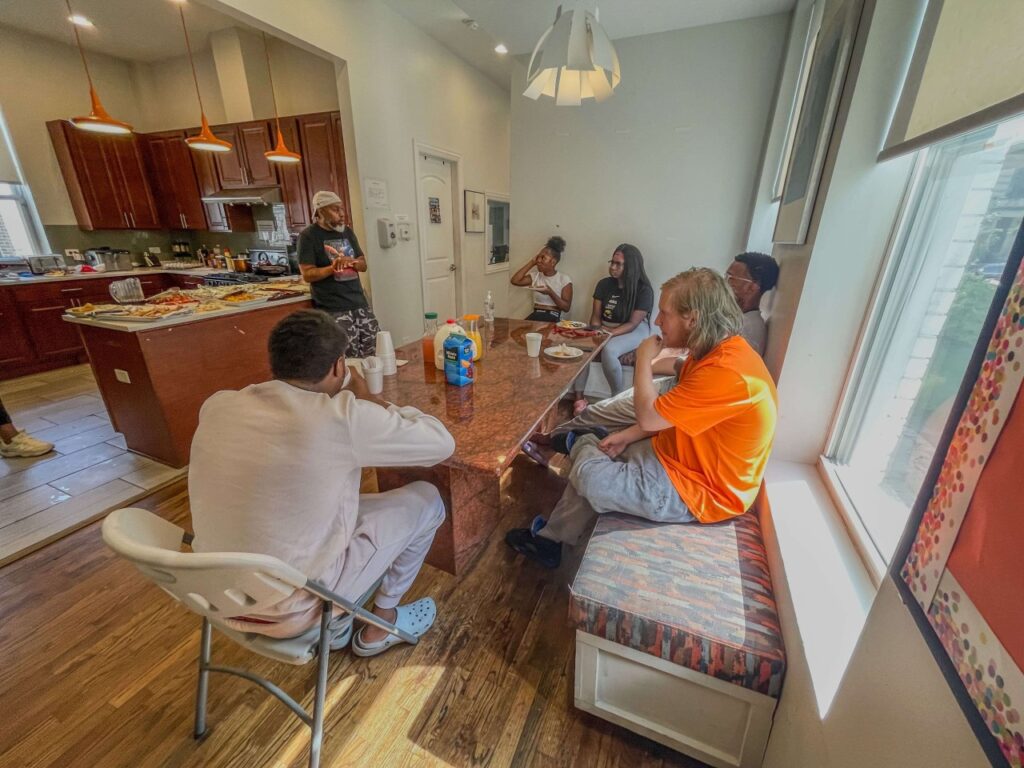
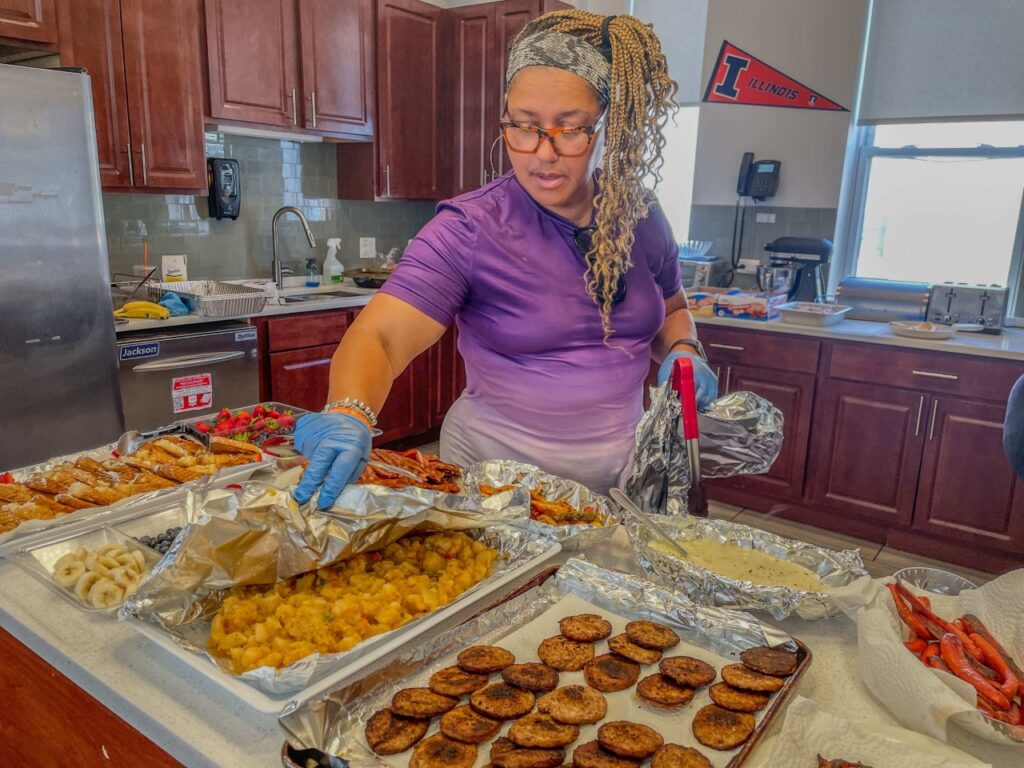
It’s 10 a.m. on a beautiful Sunday in September, and residents of The Night Ministry’s Pathways Transitional Living Program for young adults have gathered for a special brunch to mark a momentous occasion. After weeks of planning and anticipation, today, they are making a giant stride on their paths to greater stability: moving into apartments.
“We are embarking on something new,” Pathways Supervisor Henry Merrill tells the group. “You’ll be more independent. There are more responsibilities. There’s more learning to do. But we are here to help you.”
The move for the group of ten, who have all experienced homelessness, comes as The Night Ministry fully transitions Pathways from a shelter to a community-based housing model. Until now, the program has provided housing for up to eight young people in a classic greystone building in Chicago’s North Lawndale neighborhood, with two other program participants living in a nearby apartment.
Now, the organization has rented and furnished apartments in two buildings where program participants will live with roommates. Young people will continue to receive case management support and links to resources while they work toward greater self-sufficiency. The combination of independent living and supportive services has proven successful in launching youth into a stable and thriving future.
Silvono came to Pathways last fall. He first experienced housing instability in his teens and says he is ready for the move.
“I’m excited to have a place of my own. I have a lot of goals I want to set for myself when I move into my new place.”
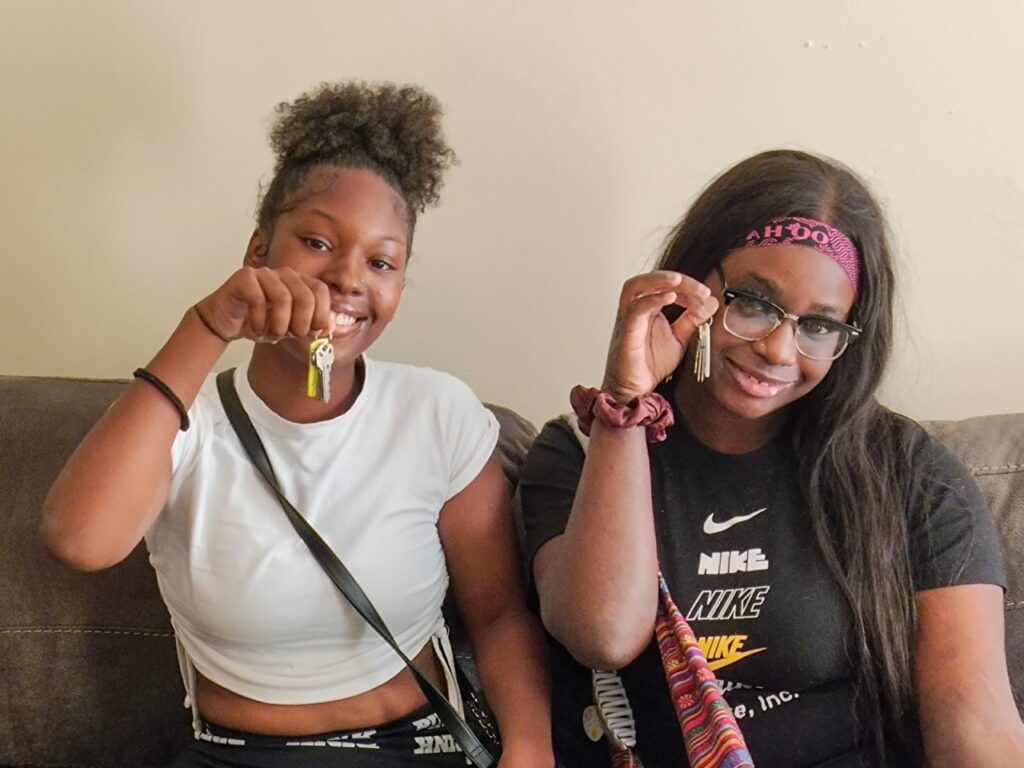
Throughout the day, Pathways participants join program staff in moving belongings from the greystone to a volunteer squad of vehicles and into their new homes. After a hard day’s work, the afternoon is capped with another memorable moment: the tenants opening gift boxes containing their apartment keys.
With the transition, The Night Ministry will no longer occupy the building that housed the shelter, which belonged to Old St. Patrick’s Church in Chicago. The Night Ministry is grateful to the church for its partnership in serving the North Lawndale community.
In fulfilling our mission to serve Chicago’s unhoused residents, The Night Ministry regularly conducts outreach among the individuals living in Gompers Park on Chicago’s Northwest Side. Our Street Medicine Team and Health Outreach Bus visit the site to offer critical resources such as free health care and case management services. The latter includes housing assessments to start individuals on pathways to stable housing.
We believe that the challenges faced by our unhoused neighbors, including those residing in the Gompers Park encampment, are varied and complex. The Night Ministry’s services, coordinated with the City’s Department of Family and Support Services, are designed to provide and connect our clients with the most appropriate resources to help each client survive, obtain greater stability, and thrive.
The Night Ministry also recognizes that homelessness impacts the whole community. The discussion surrounding Gompers Park underscores Chicago’s affordable housing and homelessness crises. We face not only a shortage of affordable homes but also gaps in resources available to assist unhoused individuals in becoming stable. Evidence shows that, for most individuals exiting homelessness, housing coupled with supportive services such as case management and links to resources like food, employment, and health care assistance greatly improves their chances of remaining stably housed. While coordination among the City of Chicago and nonprofits such as The Night Ministry has opened new housing opportunities for many of our vulnerable neighbors, further investment in supportive housing programs is required to create significant movement in our collective efforts to end homelessness. We hope and ask that conversations such as the one surrounding Gompers Park spur further discussions and action around sustainable housing opportunities for all Chicagoans.
If you would like to support The Night Ministry’s work to assist our unhoused neighbors living in Gompers Park and across the city, please make a donation today.
We are heartbroken by the murder of four of our fellow citizens on the CTA’s Blue Line on Monday. We join the victims’ families, friends, and the entire community in mourning the senseless loss of their lives.
Everyone, regardless of their housing status, has the right to live their life in safety. The heinous act of violence is painfully relevant to The Night Ministry, as many of the individuals we serve utilize public transit for shelter and we provide outreach at the Blue Line’s Forest Park station.
Over and over again, a shocking crime like this week’s raises questions and a search for solutions. How could this have happened? What can we do to prevent it from happening again? The fact is that our unhoused neighbors are far more likely to be victims of lethal violence than those of us who are stably housed. While immediate steps regarding security can be taken to mitigate this risk, the real remedy lies in solving the homelessness crisis we face.
Just as everyone has the right to safety, everyone has a right to housing. Ensuring that all members of our community have stable housing is how we save lives. So, as we discuss what can immediately be done in the wake of this tragedy, let it motivate us to come together to implement the solutions to homelessness that we know work in the long term. It will involve cooperation, concerted efforts, and overcoming challenges, but, unless we take these steps, we will continue to lose lives.
Did you know that grabbing lunch on Tuesdays in Chicago’s Irving Park neighborhood can benefit The Night Ministry?
For the last four years, JT’s Genuine Sandwich Shop on North Elston has supported our mission with a generous one-dollar donation from every sale of their delicious Breaded Pork Tenderloin sandwich on Tuesdays.
“I appreciate everything The Night Ministry does for our neighbors,” said JT’s owner, Chris Cunningham.
Chris fulfilled a lifelong dream in 2019 when he opened JT’s, which Chicago Magazine recently named one of the 50 best restaurants in the city.
“When we started to think about organizations that we as a restaurant and business could support, The Night Ministry was one of the first ones that I thought of,” said Chris. “And the tenderloin is one of our better sellers.”
Chris vividly remembers learning about The Night Ministry’s mission to assist our unhoused community members when he provided a hot meal with Bethany United Church of Christ alongside the Health Outreach Bus.
“Serving the meal on the streets, having real conversations and connection with the clients, and seeing the services you were provided made a lasting impact on me,” he said.
In addition to supporting The Night Ministry’s mission, the JT’s Tenderloin Tuesday donation also helps expose the restaurant’s customers to the agency’s work.
“People who are familiar with The Night Ministry appreciate it, and everyone I talk to about what The Night Ministry does is also impressed.”
Chris’s culinary skills benefit the community in other ways. Every summer, he and his neighbors raise money for the Irving Park Community Food Pantry by selling homemade BBQ sandwiches at the Independence Farmers Market.
“We get as much of the ingredients as we can donated from our vendors,” he said. “Beyond any other costs, 100% of the sales proceeds go to the pantry. If someone happens to leave us a tip, we’re also donating that to the pantry.”
You can get your pork tenderloin sandwich by visiting JT’s at 3970 North Elston Avenue, ordering online at jtsgenuine.com, or calling 773.754.7729.
By Denishe Medeline Mberi, Graduate of The Night Ministry’s Youth Housing Programs and Social Media Influencer
On February 14, 2020, I wrote the following:
“My life is falling apart. I feel anxious yet look calm, I feel sad yet tell everyone otherwise. I know that I am broken, but I can’t seem to find the glue to put myself back together. I want to put myself back together, but I don’t know where the pieces go. I’m blindly walking into my future with no guidance, but even though I am afraid of the consequences, I am excited about the future.”
I am a 22-year-old Atlanta native who recently transitioned out of The Night Ministry. The excerpt above was a journal entry I made four months before the world was put on hold by the COVID pandemic. I was a 19-year-old depressed college student who had just been released from a psychiatric ward. I remember it as if it were yesterday.
After I was released, I quickly found out that there were no resources to aid me in transitioning back to my old life. The only thing I received was medication that I couldn’t afford and two sessions with the school’s only guidance counselor.
Shortly after, I got into some fights which led to my suspension and homelessness. The lack of resources at my school had unknowingly set me up for failure. After months of couch surfing, I ended up at the Night Ministry.
I remember the first day I got there. I had just gotten off work and sat down on the stiff gray couch in the living room. One of the workers walked up to me and asked me how my day was. At that point, I was 20 and it was the first time someone had genuinely asked me if I was okay. After that interaction, the Night Ministry took me took me under their wing and put me around a group of adults who cared about my future and overall growth.
As I navigated my journey with the Night Ministry, I was introduced to the concept of therapy and given tools to manage my mental health. I attended group sessions where I found solace in shared experiences and began to understand that I wasn’t alone in my struggle. The Night Ministry became my haven, providing me with the support and resources I desperately needed.
Thank you, Candace Musick, for being my first mentor. Michelle Thomas for co-creating a safe space for people who were often ignored. Henry Merrill for being the father figure I always wanted. Tamara Jamison and Tracy Walker for helping me while I was going through some of the hardest moments of my life. And Allison McCann-Stevenson and Carol Sharp, for being the representation of successful Black women.
Four years later, I successfully transitioned out of The Night Ministry’s Pathways Program with my own apartment, a solid social circle, a profound relationship with God, and a deep love and admiration for myself that will stand the test of time. Today, I finally understand why I was excited about my future all those years ago.
The Night Ministry is among the Chicago organizations that have been conducting outreach with the residents of the tent encampment at Roosevelt and Desplaines that the City of Chicago closed on July 17, 2024.
The City requested our help with this process as The Night Ministry has established relationships with many of the encampment residents through the services provided by our Street Medicine Team.
Our efforts have included:
Prior to this date, educating encampment residents about the closure and shelter/housing options available to them.
Completing Coordinated Entry Assessments with residents to connect them to stable housing opportunities.
Assisting residents with obtaining documents needed to access housing, such as IDs, Social Security Cards, and birth certificates.
Providing transportation from the encampment to the shelter provided by the City at the Tremont Hotel.
Encampment residents will continue to receive support to obtain permanent housing while living at the shelter. The City is planning an accelerated moving event next week to expedite the process of connecting individuals with stable housing.
“The Night Ministry supports efforts to coordinate housing services for our city’s unhoused neighbors and streamline pathways to permanent housing,” said Carol J. Sharp, President & CEO of The Night Ministry. “We understand there are questions about housing arrangements for unhoused individuals who had been staying at the Tremont before the arrival of the encampment residents. This underscores the urgent need for adequate funding for stable housing for all of Chicago’s residents and for us to come together as a community to end homelessness.”
Last month, the U.S. Supreme Court decided that laws criminalizing sleeping in public spaces do not violate the U.S. Constitution, even when individuals are unhoused and their communities do not have sufficient shelter capacity.
The Court announced this decision less than 10 days after the City of Chicago released the results of its 2024 Point-in-Time Count which, on one night in January, found more than 1,600 of our neighbors living unsheltered on the streets of Chicago.This represents a 65% increase over 2023’s Point-In-Time Count number.
Criminalizing homelessness is a cruel, inhumane solution that does nothing to solve the problem. We are encouraged to hear Chicago’s new Chief Homelessness Officer, Sendy Soto, tell the Chicago Tribune that unhoused Chicagoans have nothing to fear from this ruling and that Chicago intents to prioritize housing-focused solutions to homelessness. However, we know that this ruling will embolden communities in other parts of Illinois and our neighboring states to fine or arrest those who have no choice but to sleep outdoors and pass other laws that criminalize homelessness.
Today, The Night Ministry is more committed than ever to provide human connection, housing support, and health care to youth and adults in Chicago who are unhoused or experiencing poverty. Last year, we supported more than 200 youth and adults as they moved into their own apartments or transitioned into more safe and stable housing. Our nurse practitioners and medical partners completed 2,350 health assessments, healing the conditions created or exacerbated by the traumatic experience of homelessness.
1) Learn about current attempts to criminalize homelessness in states bordering Illinois. If you hear your local elected officials proposing these “solutions,” speak up! If you live in one of these states, demand that your state prioritize housing-focused solutions to homelessness.
2) Support federal legislation that offers real solutions to youth homelessness and helps individuals connect to services:
It was our privilege to honor those who have made a lasting contribution to the mission of The Night Ministry and our community at our annual Gala on May 23.
Lamplighter Award
Chicago Transit Authority
The Lamplighter Award symbolizes an unwavering commitment to our mission and to those we serve. Since the fall of 2020, the recipient of the Lamplighter award—the Chicago Transit Authority—has collaborated with The Night Ministry and the City of Chicago to bring human connection, housing support, and health care to unhoused individuals sheltering on the Red and Blue line trains.
The CTA’s support allows The Night Ministry and our partner organizations to connect with our vulnerable neighbors at public transit stations, helping them address their basic needs for health care, food, and clothing, and assisting them in obtaining stable housing. The CTA Outreach Program makes a very real impact on the lives of many Chicagoans. Since its inception, we have distributed more than 50,000 meals to unhoused individuals and prevented more than a thousand trips to the emergency room.
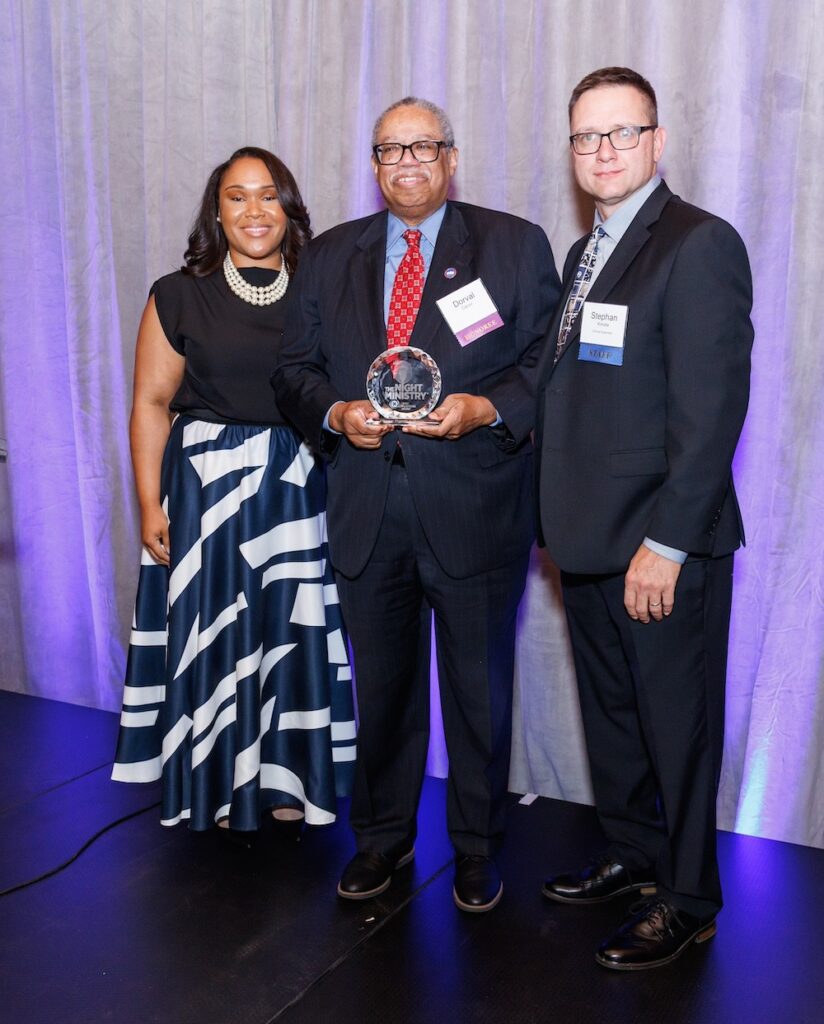
Award accepted by CTA President Dorval Carter, Jr.,
Beacon Award
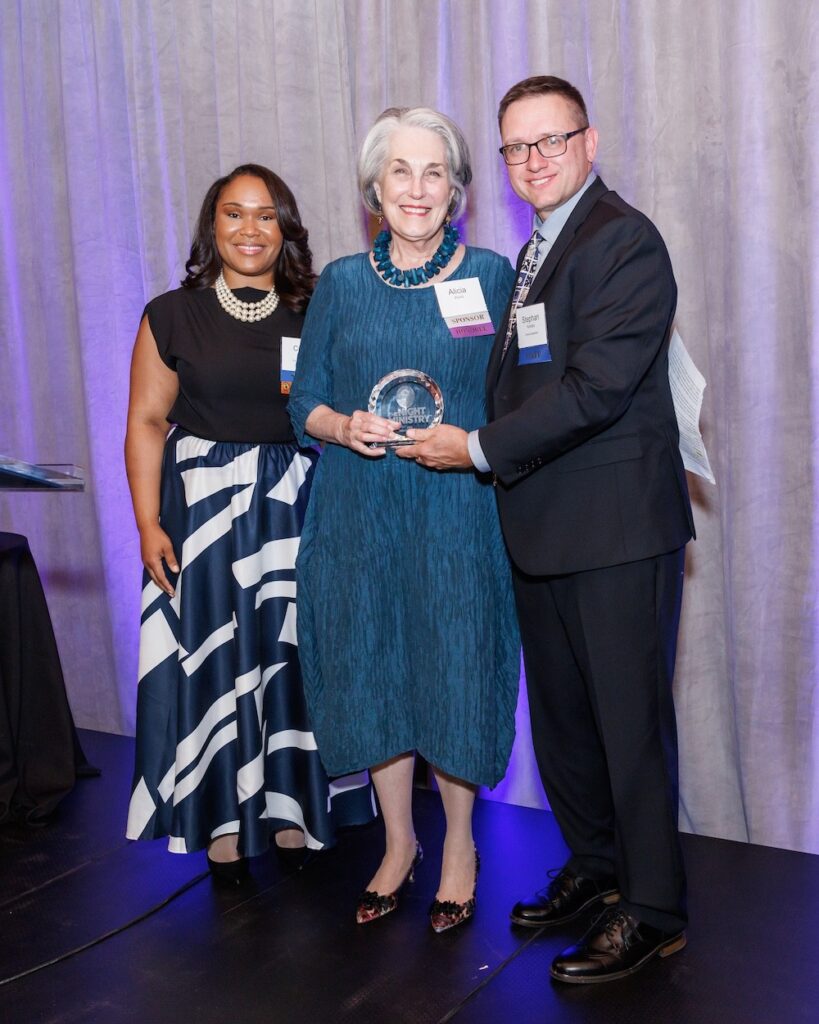
Alicia Pond
The Beacon Award is a symbol of extraordinary generosity and dedication to The Night Ministry’s mission. It is with great honor that we bestow this award to our friend, Alicia Pond.
Alicia has demonstrated her deep commitment to the community by providing exceptional leadership and unwavering support for The Night Ministry. Through her many years of service on our Board of Directors, including several as Board Chair, and as a steadfast ambassador of our mission, Alicia has advanced the agency’s critical work, underpinning our ability to connect with our vulnerable neighbors and help them improve their lives.
During her tenure as Board Chair, Alicia played a pivotal role in the success of an $8.7 million capital campaign that laid the foundation for the expansion of services The Night Ministry has implemented in recent years. This transformational campaign facilitated the relocation of the agency’s headquarters and The Crib overnight shelter to our Bucktown facility, driving growth in our programs and enabling us to deepen and broaden our impact in the community.
Legacy of Light Award
Rev. Barbara Bolsen
The Legacy of Light award honors the memory of our dear colleague, Rev. Barbara Bolsen and her impact on The Night Ministry, those whom we serve, and the City of Chicago.
Barb was one of The Night Ministry’s earliest Youth Outreach Workers and helped launch weekly street outreach events for young people in Lakeview. Often dressed in a clergy collar, Barb was a fixture on the nighttime streets and quickly became a trusted advocate for unhoused young people, many of whom identified as LGBTQ+.
During her 23-year career at The Night Ministry, in each of her roles, Barb stood with the communities she served, moving elected officials and leaders to address the challenges our vulnerable neighbors faced. Barb worked to end hate crimes in Lakeview, urge the City of Chicago to investigate police misconduct against young gay and transgender youth, and preserve Single Room Occupancy (SRO) buildings as affordable housing opportunities.
Barb’s legacy is richly woven into the programs and the culture of The Night Ministry and her kindness, compassion, and service have brightened the lives of those whom we serve.
Experience The Night Ministry’s impact on the lives of our unhoused neighbors.
The Night Ministry is a beacon of hope for Chicago’s most vulnerable residents. Experience how our staff, volunteers, and supporters come together to provide human connection, housing support, and health care to members of our community who are unhoused or experiencing poverty, helping them stay alive and empowering them to improve their lives.
Thank you to all of our friends who joined us on May 23 at Lighting Up the Night! Because of you, we raised $347,000 in support of our mission to provide human connection, housing support, and health care to those who are unhoused or experiencing poverty.
We were proud to present Illuminating a Path to a Better Tomorrow at Lighting Up the Night. The video highlights the transformative power of your support for The Night Ministry. Watch again and share with your networks!
Jason struggled with homelessness and addiction on Chicago’s streets for nearly two decades. Today, with help from The Night Ministry and a substance use treatment program, he has found permanent housing, stability, and hope.
“It means everything to me, having a place. I have the basic necessities. When you’re homeless, you don’t have a bathroom or a refrigerator. You can’t lay down on your couch, or turn the fan on, or wash your clothes. Now I have that. This is a new start for me,” he said.
Jason moved to Chicago from Louisiana to be with family in the wake of the devastation brought by Hurricane Katrina but soon found himself without a stable place to call home. For years, he lived among encampments on Lower Wacker, one of many locations regularly visited by the agency’s Street Medicine team, which provides medical care, survival and harm reduction supplies, food, and more to individuals living without shelter.
“The Night Ministry looked out for and cared about us. They were the only people who would come around when it was zero below,” he said.
Receiving treatment for his addiction helped Jason stabilize. But before that point, the harm reduction supplies like sterile syringes offered by The Night Ministry helped him and others who used drugs stay as healthy as possible.
“When they started with harm reduction, you didn’t have people sharing needles anymore. You don’t see as many infections from what I see now and what it used to be years ago.”
Street Medicine, like the agency’s other health outreach programs, is well-known across Chicago’s unsheltered population for their reliability and forthrightness, something Jason values deeply.
“If they didn’t have what we needed, they’d tell us exactly when they’d return and that they’d bring it for us — and they always did.”
Jason especially values his relationship with staff members Stephan Koruba, Clinical Supervisor, and Sylvia Hibbard, Street Medicine Case Manager, who helped him get back to stability and continue to provide support.
“Sylvia got me my insurance and my Link card, which allows me to access food assistance. Stephan picked me up and took me to most of my doctor appointments,” he said. “The Night Ministry supports me like a family. They didn’t give up on me.”
It is with a heavy heart that we share the news of the passing of Rev. Tom Behrens, the Founding President and Former CEO of The Night Ministry. Tom’s vision, dedication, and unwavering commitment to serving our community’s most vulnerable members left an indelible mark on our organization and the city of Chicago.
As we mourn the loss of Tom and keep his family and loved ones in our thoughts, we also celebrate his remarkable legacy. Tom’s passion for helping others, particularly our unhoused and marginalized neighbors, inspired all who knew him. As the organization’s first employee, he laid the foundation of compassionate service that still anchors The Night Ministry today. And as our Founding President and Former CEO, Tom provided visionary leadership for decades that deepened and widened our impact in Chicago.
In 1976, a coalition of diverse congregations hired Tom to perform outreach to individuals on the streets of Chicago at night in response to loneliness, poverty, and homelessness in the community. As Tom told the Chicago Sun-Times in 1977, it was his job “to be present to them, to be available, to listen.”
As Tom pioneered street outreach in Chicago by holding office hours from the trunk of his car and visiting bars and all-night diners, the encounters he had raised his awareness of gaps in the availability of services to Chicago’s unhoused population, specifically in the areas of shelter for youth and health care. And as his awareness grew, he took action.
In the late 1980s, Tom played a key role in successfully advocating for the passage of new state legislation allowing nonprofits to operate group shelters for unhoused youth, which had been prohibited in Illinois. As a result, the landscape of youth services in the state changed dramatically as opportunities became available for unhoused, runaway, and at-risk youth to access safe shelter. The Night Ministry launched its first youth shelter, with 16 beds, a few years after the legislation was enacted. Today, across several Youth Programs, we provide shelter, supportive services, and critical resources to hundreds of young people and their children each year.
Tom also oversaw the launch of The Night Ministry’s Outreach & Health Ministry Program in the early 1990s, when the organization outfitted a recreational vehicle to offer mobile healthcare services to individuals who struggled to access more traditional means of care, such as clinics or physicians’ offices. Initially focused on Chicago’s North Side, today our Health Outreach Program brings free medical care, case management, and resources like food and clothing to neighborhoods across the city and even to public transit, serving thousands of people each year.
Tom’s tireless efforts transformed countless lives and set the standard for compassion and advocacy in The Night Ministry’s work. His spirit will continue to guide us as we carry forward his mission of providing human connection, housing support, and health care to those who are unhoused or experiencing poverty.
I started at The Night Ministry in 1998 as an intern, and I never left. And though I have been here for a quarter century now, it feels like time has flown by.
Over these past 25 years, I have witnessed how, at The Night Ministry, we continue to find new ways to fulfill our mission to provide human connection, housing support, and health care to our unhoused neighbors. And I have been touched time and again by the relationships I have built here with clients, coworkers, supporters, and volunteers, as we have shared the joys and griefs of our lives together.
Over the years, I have held many roles at the agency. I worked as an Outreach Minister, providing hospitality and a listening ear to visitors of our Health Outreach Bus, which brings free medical care and supportive services directly to neighborhoods across Chicago. Then I worked as our HIV Testing Coordinator, providing free HIV testing and education. And in 2014, I became Director of our Outreach and Health Ministry Program, a role I continue to hold today.
There have been so many incredible experiences over the years and too many stories to share. Through it all, what has made the work so rewarding has been The Night Ministry’s terrific community: our staff, supporters, and volunteers. I have witnessed countless times how we have come together to help our clients.
In my time as Director, my team and I expanded the services of the Health Outreach Bus to new days, times, and neighborhoods. We also launched Street Medicine, which provides health care, support, and more to individuals living in encampments, growing the program from a few hours of outreach a week to multiple days a week.
Side by side we also started health outreach on public transit, at first bringing backpacks full of medical and survival supplies directly onto trains. Today, CTA Outreach is a successful program, bringing medical care and more to unhoused riders weekly at two end-of-the-line subway stations.
This work continues to be so very meaningful. I hope for all of us in The Night Ministry community that we continue to find inspiration in each other.
Last fall, Kimberly opened her life up to a video crew from WTTW, Chicago’s PBS station, for a documentary series about homelessness told through the lives of those who are experiencing it.
She is well poised to do so. As a member of Youth 4 Truth, The Night Ministry’s leadership program for young people, Kimberly has a passion for advocacy and is willing to speak out about her experiences as an unhoused young mother. She learned about the series, called FIRSTHAND: Homeless, when the documentary producer visited a Youth 4 Truth meeting.
“When the FIRSTHAND crew said that there was an opportunity to talk about homelessness and bring more awareness, I knew that I had to tell them how hard it is being a single mother, homeless, and living in shelters,” she explained. “And I wanted to speak for their kids too. When they’re out on the streets, they’re so much more vulnerable.”
Kimberly lost her housing after becoming pregnant while attending nursing school. She initially slept in her car or stayed temporarily with other people. Following the birth of her daughter Jasmine, who is now two, Kimberly moved Jasmine and herself between shelters, seeking safety and stability. Throughout that time, seeing her child experience homelessness was deeply challenging.
“Imagine if you were a kid and you didn’t know where you were going to sleep at night or where your next meal would be coming from,” she said. “Unhoused kids haven’t even had a chance at life yet, and they’re already going through so much.”
These days, Kimberly and her daughter are in permanent housing, where they can finally enjoy the safety and stability of a home. She hopes that she can be a lifeline to other young, unhoused parents by participating in the series.
“I decided to participate in FIRSTHAND for a bigger purpose: I wanted to put everything out there and be as vulnerable as I could because it might help somebody who is going through the same thing,” she said. “Maybe I could show them that there’s still hope in the world.”
Adalina now has a home of her own. But the 20-year-old knows what it is like to experience housing instability.
In recent months, she has stayed temporarily with family and friends and in shelters and housing programs, including at The Crib, The Night Ministry’s emergency overnight shelter for young people, as well as its short-term youth housing program, Interim.
“The transition between all these situations was challenging. It was an eye-opening experience,” she said.
Adalina now lives in a studio apartment in the South Side, which she gained through her participation in a Rapid Rehousing event, an intervention designed to quickly move individuals out of homelessness, hosted and co-organized by The Night Ministry and social services organization All Chicago.
Despite the challenges of living on her own, she has found it rewarding.
“Being housed alone gives me more opportunity to be self-reliant. I’m finding that I can handle adult responsibilities,” she said.
During her time with The Night Ministry, Adalina found a sense of stability in the staff members she relied on, and that helped her grow into greater independence. “What’s most important to me are the connections I made here and the self-discovery that I had. I gained so much knowledge from speaking to all these people, and it makes me feel privileged. They make me feel optimistic about being of service to others.”
And that optimism has inspired her continued service in Youth 4 Truth, The Night Ministry’s leadership program for young people. Now participating in her second session, Adalina has presented in meetings with the Board of Directors, helping provide youth feedback at the highest levels of the agency.
Her experience of homelessness has stressed upon her the importance of speaking out. “It drives me to do stuff like Youth 4 Truth and community organizing, even though the experience is hard to talk about. It challenges me to do things that I wouldn’t expect myself to do, and I think that’s a challenge that I like taking on,” she said.
One decision. One decision has the power to shift the trajectory of your life.
When I was two years old, I experienced housing insecurity. For approximately five years, my sister and I navigated Chicago, traveling from a foster home located on the South Side in the Englewood neighborhood to visit my biological mother on the city’s North Side.
One decision.
We were fortunate to have been placed with a family who utilized resources — like those The Night Ministry provides — to support our journey and our ability to reunite with our mother. My one decision to be the first in my family to earn a college degree and commit to a career in support of communities who face similar challenges, is how I arrived here at this impactful agency.
Each day, across Chicago, over 65,000 people are seeking support as they navigate homelessness. Fortunately, The Night Ministry is here to deliver that assistance. Our mission to provide human connection, housing support, and health care to those who are unhoused or experiencing poverty is achieved as we work alongside our clients to advocate for their immediate physical, emotional, and social needs while affirming our shared humanity.
Last year, The Night Ministry served approximately 4,500 people through our Outreach and Health Ministry Program and over 600 people across our Youth Programs. We made over 40,000 outreach connections with unhoused, precariously housed, and medically vulnerable individuals.
As we look to the future, we will continue to deepen our impact, by expanding our mental health services and transitional housing options and by investing in innovative practices to support our most vulnerable communities.
I am honored to serve as The Night Ministry’s President & CEO. However, I would not be here if it were not for committed and caring community members like you. Your one decision to support our work, whether through giving, volunteering, or both, is vital. I hope you will continue to support our efforts—because your contribution can change a life.
This summer, The Night Ministry launched a Client Advisory Board for those served by its Outreach and Health Ministry Program, which brings health care, supportive services, and resources directly to people who are unhoused. Client Advisory Board members are recipients of the program’s services who wish to provide feedback and gather information on helpful local resources to share with their peers and the agency.
The group meets weekly with Client Leadership Development Specialist Candace Musick, who also co-runs Youth 4 Truth, the agency’s leadership program for Youth Programs participants.
“When there are projects going on or program expansions that impact our clients, they should have a voice at the table. That’s why we established the Client Advisory Board: to make sure those served by our Outreach and Health Ministry Program are feeling heard and that our services are translating in the way that we want them to,” explained Musick.
Each member adds value through their individual insight and perspective. “They come from such different backgrounds and bring such a variety of life experiences that each participant is coming at the problem of homelessness from a unique angle. When they share the knowledge they’ve gained from lived experience, it will have a vital impact on how we serve Chicago’s unhoused citizens,” said Case Manager Stephannie Schreiber, who helped refer many of the group’s members.
Members determine the types of projects they would like to take on. And they are paid an hourly rate for their time, expertise, leadership, and service to the agency. The Night Ministry also provides them with referrals to other paid opportunities and helps them build job skills.
“We’re trying to get something done. We’ve got a bunch of ideas: big, small, and everything in between,” said Marshall, a member of the Advisory Board and a client of The Night Ministry’s CTA program, which serves individuals who ride the city’s public transit for shelter.
“They feel a commitment and a sense of responsibility to getting their ideas off the ground. They’re drawing upon their own experiences, good and bad, to help other people that are in situations like what they’ve been through so that they don’t have to figure things out on their own,”
The residents of Parenting with Purpose, The Night Ministry’s housing program for young mothers and their kids, have long benefited from the agency’s partnership with the Association House High School, a free, non–traditional education program based in Humboldt Park. The school provides a path to graduation for 16- to 21-year-olds facing educational barriers.
The program’s young mothers face competing needs to care for their children, study, and make an income while also experiencing challenges like the high cost of childcare and often mismatched schedules between school, work, and day care. Association House High School has designed their Family Literacy Program to meet these complexities head on while also meeting the social and developmental needs of their children.
“The goal of the Family Literacy Program was to address barriers that our students have,” said Jemina Lyle, School Culture & Climate Coordinator at Association House. “The program helps our young parents understand the reality of parenting but also gives them support and it prepares them for the future.”
Parenting students can enroll their children aged 6 weeks to 5 years old in on-site childcare and early childhood education while they work towards their degree and even pursue paid internships.
“It’s all in the same building, so when they go to school, their kids go with them,” said Case Manager LaChania Conwell. “It eliminates the systemic barriers that many young mothers face and helps them not get discouraged when pursuing their education.”
Classes are small and the mothers are able to interact with their kids throughout the day. This approach allows them to strengthen their academic learning and parenting skills simultaneously.
“During most of the activities for the kids, the moms are involved. When I was there, they had many reading sessions for us together at the library. Now my daughter actually loves books,” said Constance, a former Parenting with Purpose resident who graduated from Association House this year.
Now a college student, she found numerous benefits from her time in the program. “They offer you plenty of resources. I was able to make money through an internship there, go to class, get credits, and do activities with my child. If that’s not a helping hand, I don’t know what is.”
On October 5, 2023, we gathered together for Night Lights, the annual gala hosted by The Night Ministry’s Associate Board, at Marshall’s Landing in Merchandise Mart.
Thanks to the generosity of our supporters, the event raised more than $90,000 for two of our shelter programs: Interim Housing, which offers short-term housing for young people, and Parenting with Purpose, which offers long-term housing for young mothers and their children.
We wish to extend a special thank you to our wonderful Associate Board, our sponsors, including Spotlight Sponsor Compassion United Methodist Church, and Lighthouse Sponsors IMC Trading and Spaulding Ridge. We are also deeply grateful to our guests, staff, and volunteers for making this such an impactful night.
The strength of The Night Ministry’s three Outreach and Health Ministry Programs is their ability to tailor their approaches to better help Chicago residents who are unhoused or experiencing poverty. The Health Outreach Bus, Street Medicine Team, and CTA Outreach Program each serve unique populations with distinct circumstances and, because of those distinctions, tailor services to best address the varying needs of their clients. All three programs bring services directly to clients and allow them to decide which services they want to access, increasing the scope and impact of the programs.
Surveys conducted by the Learning and Impact Department with Outreach and Health Ministry clients confirm the individuals served within each program have diverse living situations. Staff within each program understand these distinctions and tailor services to meet the needs of each individual client.
Almost all clients of the Street Medicine Team are unsheltered, living outside. The team’s first step when working with a new client is often to provide a tent, which both increases the client’s safety and ability to stay in one location until a more permanent housing solution is found. The Street Medicine team provided about 60 tents to clients in the previous fiscal year. Similarly, CTA Outreach clients are overwhelmingly unhoused, but use Chicago’s transit system to seek shelter, which is why The Night Ministry conducts outreach at public transit stations. Most Bus clients are housed; however, their housing is often unstable, and they access the services the Bus offers, such as food and hygiene supplies, to help meet their basic needs.Clients within each program also have distinct health care needs. Because most CTA and Street Medicine clients report not accessing any medical treatment outside of the care offered by The Night Ministry or relying on the emergency room for critical circumstances, they are more likely to have complex medical conditions that require immediate attention. Bus clients are more likely to receive care from a clinic, but a large percentage still report using the emergency room or not seeking care of any kind. The Night Ministry’s medical professionals work to understand the individualized needs of each client and provide the highest standard of care possible.
By Henry Merrill, Pathways Transitional Living Program Supervisor
At The Night Ministry’s Youth Housing Programs, we are in the unique position of helping young people who are unhoused find a home with us, while we support them in finding a more permanent home of their own.
The program I supervise, Pathways Transitional Living, provides up to two years of stable housing, either in our residence in North Lawndale or in nearby apartments. The things that I find in my own home—security, love, acceptance, and support—are the very same things the staff and I want represented at Pathways. I let our residents know that once they enter the Pathways door, they are safe. As they face the day-to-day grind that our young people experience, the staff are here to lend an ear and provide support. Pathways is a place to make a soft landing.
Residents have a lot of stake in the game at Pathways because it is their home. We host house meetings where all of us—the young people served by the program and the staff—talk and listen to each other. Our residents hang out together. They look out for each other and stand up for each other. That kind of supportive environment is the solid foundation we work so hard to build at Pathways.
Karim, a longtime resident of Pathways, made a successful transition from Pathways to independent living this year. One day before he moved, Karim let me know he truly appreciated everything that The Night Ministry had provided for him, that he had learned so much about being independent and about being the best he could possibly be, and that the relationships he had created with staff and residents had helped him grow and motivate him.
That’s the experience that I want every Pathways resident, and every young person who The Night Ministry serves to have. I want our young people to go out and say, “Hey, when I was part of that program that Henry ran, it was off the chain. And I know if I need support in the future, The Night Ministry will be there for me.”
It is with deep sadness that we inform you that Barbara (Barb) Bolsen, The Night Ministry’s former Vice President of Strategic Partnerships and Community Engagement, passed away on Wednesday, August 16.
Barb joined The Night Ministry in 1997 after leaving a 20-year career in journalism and graduating from Chicago Theological Seminary. Barb once told us that she arrived at The Night Ministry to do work that would engage her heart, as well as her head.
Barb was one of The Night Ministry’s earliest Youth Outreach Workers—the Youth Outreach Team office inside The Crib is named in her honor—and helped launch weekly street outreach events for young people in Lakeview. Often dressed in a clergy collar, Barb was a fixture on the nighttime streets and quickly became a trusted advocate for unhoused young people, many of whom identified as LGBTQ+.
During her 23-year career at The Night Ministry, in each of her roles, Barb stood with the communities she served, moving elected officials and leaders to address challenges The Night Ministry’s participants faced. As a leader within Lakeview Action Coalition (now ONE Northside), Barb worked on issue campaigns to end hate crimes in Lakeview, investigate police misconduct against young gay and transgender youth and youth of color, and preserve Single Room Occupancy (SRO) buildings as affordable housing opportunities.
Barb played a major role in innovation and expansion at The Night Ministry, notably the development of The Crib overnight emergency shelter for young adults and the relocation of The Night Ministry’s administrative headquarters and The Crib to 1735 N. Ashland.
When Barb retired in 2020, she said, “I think the program that in some ways became really close to my heart was The Crib, and possibly that’s because I started as a youth outreach worker and I remained specially connected to that part of The Night Ministry. Being in the position to help develop the new space for The Crib was sort of like coming full circle. It makes me really happy.”
Barb’s legacy is richly woven into the programs and the culture of The Night Ministry. Her pursuit of social justice survives through scores of colleagues who served alongside her and young leaders she mentored at The Night Ministry, our partner organizations, and in congregations across Chicago.
Please join us in remembering and celebrating Barb’s impact on The Night Ministry and those whom we serve.
Since launching in 2020, the Flexible Housing Pool for Youth, a collaboration between the Center for Housing and Health and other Chicago nonprofits, has helped 325 unhoused young adults access permanent housing through rent subsidies and supportive services. The Night Ministry plays a key role in the program by offering ongoing case management to nearly a third of the program’s participants.
“Our goal is to give our clients the best shot they can have at sustaining their own housing,” said Steven Dougherty, The Night Ministry’s Flexible Housing Program Manager.
The Night Ministry’s involvement has grown from a caseload of 20 households when the program launched, to 95 currently. Five Housing Case Managers lead the charge, offering extensive in-person support, including through apartment visits. Staff are in contact with their clients multiple times per month.
Housing Case Managers must be on their toes, as every day brings new needs and requests. They may be helping one client apply for public benefits, accompanying another to visit food pantries, and helping yet another navigate landlord-tenant relations, all while being on call for whatever additional needs may arise.
“We are, for a lot of our clients, the only supportive adult that they have,” Housing Case Manager Maya Rudder shared. “We do our best to promote them being independent, but they also know that if they fall short, they still have somebody looking out for them.”
The program’s clients have a 92% housing retention rate, which means that the vast majority of program participants remain stably housed. And that level of security and stability is vital to helping them grow. With The Night Ministry’s support behind them, residents have a chance to reach beyond meeting just their survival needs.
“We work with people at a very exciting stage of their lives when they are developing, growing, and learning a lot about themselves,” said Housing Case Manager Brianna Bueltmann.
Fellow Housing Case Manager Bridget Thomas elaborated further: “We see clients go from not knowing where they’re going to sleep at night, to signing a lease, being happy, and starting to accomplish goals.”
After a national search, human services leader Carol J. Sharp has been named President & Chief Executive Officer (CEO) of The Night Ministry. Sharp assumed her responsibilities on August 14, 2023.
A Chicago native, Sharp brings a deep passion for serving marginalized communities. Throughout her career, she has been dedicated to enhancing the living, learning, and earning potential of under-resourced and underrepresented youth and young adults. Her unwavering commitment to mobilizing evidence-based resources that provide access has empowered future leaders to achieve beyond the limitations imposed by their community influences.
“Carol is a visionary and collaborative leader with a powerful commitment to The Night Ministry’s mission and values,” said Michael Borromeo, Chair of The Night Ministry’s Board of Directors. “Her role as President & CEO is the culmination of her personal and professional path and the opportunity to provide deeper impact in the lives of those who are unhoused or experiencing poverty.”
Before joining The Night Ministry, Sharp held influential leadership positions at Youth Guidance, Girls Inc. of Chicago, and Perspectives Charter Schools. Under her leadership, she has played a pivotal role in shaping organizational operations, cultivating donors and partnerships, and championing the design and implementation of comprehensive program strategies that have supported youth in healthy living, academic achievement and life skills development.
She has also served as Senior Director of College Counseling & Community Partnerships at the Chicago Scholars Foundation, where she played an integral role in facilitating educator and youth development programs and leading a collaborative of attuned organizations striving to improve graduation rates for first-generation college students.
“The Night Ministry continues to serve as a cornerstone for our collective approach to bridging gaps across Chicago’s unhoused communities,” Sharp said. “As President & CEO, I have a great deal of appreciation and pride to be working with our passionate and dedicated team to advance the organization’s legacy.”
Sharp holds a Master of Public Administration & Nonprofit Mission-Driven Management from the Illinois Institute of Technology and a Bachelor of Arts from American InterContinental University. She remains an active member of the American Society for Public Administration and has previously served as Past President of the Chicago Chapter.
Sharp assumed her responsibilities as President & CEO of The Night Ministry on August 14, 2023.
The Night Ministry engaged Kittleman & Associates in Chicago to conduct a search for its President & CEO. Kittleman & Associates is a national executive search firm that specializes in the recruitment of CEOs for tax-exempt nonprofit organizations, public charities and philanthropic organizations. Kittleman recruits leaders for the entire nonprofit sector including human services and organizations serving unhoused populations; health care; foundations; and advocacy organizations. For more information, visit https://www.kittlemansearch.com/.
Finding a stable place to live, getting enough to eat, and receiving health care when they need it – these are the everyday concerns of many of the community members who visit The Night Ministry’s Health Outreach Bus, according to a recent survey from the agency’s Learning and Impact department.
The Bus travels to Chicago neighborhoods with disproportionate rates of homelessness and poverty, providing health care, food, and supportive services. By checking in with those served by the program each year, Learning and Impact gathers vital data that helps The Night Ministry ensure that the Bus continues to fulfill the agency’s mission.
“The survey helps us find out from the clients themselves which of the services we offer they access and if they’re being utilized ideally at the different stops,” said Lead Case Manager Mirella Rodriguez. “By learning more about who clients are and what they experience, we can spot trends that help us adjust services.”
While the majority of Bus visitors have some form of housing, over 40% of respondents shared that their housing situation is not stable, meaning they may be close to falling into homelessness. Most have at least one precarious housing factor such as not having a lease. Rodriguez helps eligible individuals apply for more permanent housing, along with benefits like SNAP, a federal program that provides monthly funds to low-income households to purchase food.
The Bus also offers meals at each of its stops. Hunger is a concern for 70% of Bus visitors, and all visitors report accessing food when they visit the Bus.
Though most visitors have health insurance through Medicaid or Medicare, approximately 20% shared they have no health insurance. Many reported chronic health conditions, including high blood pressure, diabetes, and arthritis. The Bus’s medical professionals step in to fill in the gaps in their care, offering basic medical treatment at no cost.
The survey indicates that Bus visitors face income challenges. The vast majority were either unemployed or only worked part time.
“There are so many barriers our clients face when it comes to employment,” Rodriguez said. “A lot of our clients don’t have access to transportation, which makes it very hard to travel to areas with better job prospects. And, if they stay in a shelter or with friends or relatives, they may need to be home by a certain time, which doesn’t easily fit into employers’ schedules. Many don’t even have a place to wash up to get ready for work.”
Nearly three quarters of those surveyed identify as Black or African American and almost 20% as Hispanic or Latino, mirroring national disparities in income and housing inequities
Because the Bus brings services directly to neighborhoods, most visitors only needed to travel 10 minutes or less to receive its care and resources.
“We want to make our services as accessible as possible. Many of our clients, for various reasons, would not be able to get to us if we were not close by,” explained Damian Nelson, Director of Learning and Impact.
Most visit the Bus multiple times a month and 91% shared they trust the staff. Nearly all said they are satisfied or very satisfied with The Night Ministry’s services.
“It’s easier to build longer-term relationships with clients if we see them more frequently. It opens the door to get them engaged with services like case management and medical care, allowing us to serve them on a deeper level,” said Nelson.
This summer, staff, guests and members of The Night Ministry’s Board of Directors gathered for our annual Reap the Rewards lunch honoring employees who have demonstrated their dedication to our mission with 5, 10, 15 and 20 years of service.
Pictured (from back and left) are honorees Phyllis Murphy (Program Support Coordinator, 15 years); Christy Prassas (Vice President of Philanthropic Engagement, 20 years); Betsy Carlson (Director of Youth Programs, 5 years); Burke Patten (Communications Manager, 5 years); Damian Nelson (Director of Learning and Impact, 5 years); Tiffany Moore (Program Specialist II, 10 years); Devin Redmond (Residential Services & Training Coordinator, 10 years); Sarah Warner (Case Manager, 5 years); LaChania Conwell (Case Manager, 5 years); Alicia Stewart (Program Specialist, 5 years); Rutulia (Faith) Miller (Outreach Services Manager, 15 years); Jerome Boyce (Program Specialist, 15 years); Theresa Ross (Program Specialist II, 5 years); and Bridget Thomas (Case Manager, 5 years). The honorees not pictured are David Baumgartner (Program Specialist, 20 years) and Aisha Blackwell (Program Specialist, 5 years).
On June 7, 2023, more than 300 of our friends gathered with us for Lighting Up the Night: An Evening to Benefit The Night Ministry. During the event, members of The Night Ministry staff spoke about our the agency helps clients find a home. Thanks to the generosity of supporters, we raised more than $350,000 in support of our mission to provide human connection, housing support, and health care to those who are unhoused or experiencing poverty.
On a warm Monday afternoon, The Night Ministry’s Health Outreach Bus pulled up to a corner in the Roseland neighborhood, just as it does twice a week. But this day was a bit different. In addition to Bus staff providing their usual meals and supportive services to community members who were unhoused or experiencing poverty, team members from the agency’s Learning and Impact Department were on hand to gather feedback from Bus visitors
Learning and Impact gathers and analyzes data about The Night Ministry’s services, and an annual survey it conducts of Bus clients is an important part of the department’s work.
“The survey tells us if we’re offering the right services and if the Bus is visiting the right locations. It gives us a deeper sense of what our clients’ living situations are, what their employment needs are, and what their income situations are,” explained Learning and Impact Director Damian Nelson.
The department visited each of the Bus’s five stops over the course of the survey: Pilsen, New City, Humboldt Park, Roseland, and South Shore.
On that day in Roseland, a steady stream of people gathered by the stop despite the hot sun for food, conversation, and assistance. Most agreed to participate in the brief survey. Those who completed it were then given a gift card to a nearby restaurant.
But that was not why client Mitchell decided to participate. When asked why he had agreed to be surveyed, he shared that he wanted to express his gratitude for the ways The Night Ministry has helped him.
“Besides providing a meal when I can’t afford to buy my own, the case manager helped me sign up for housing,” he said. “I didn’t know how to do it, so I’m grateful that she helped me to do it and she put me on the waiting list for homes.”
As staff wrapped up their services after an afternoon at Roseland, they then prepared to journey to their next stop, South Shore, with Learning and Impact along for the ride.
On arrival, the Bus parked in a cool, breezy spot across from one of South Shore’s historic churches. An initial burst of visitors kept the Bus team, its volunteers, and Learning and Impact busy providing services and conducting interviews.
South Shore has long been a Bus stop, and the communal spirit there was palpable. Interviewers and guests enjoyed the comfortable scenery, and many guests opted to take their surveys in the grass under the shade of nearby trees. Several lingered to chat with staff as the sun slowly set, before The Night Ministry teams made their way home.
The data gathered at stops like Roseland and South Shore helps The Night Ministry make major decisions that positively affect the agency and its clients.
“In previous years, we’ve changed locations or what services we offer at different sites because of what we learned from the survey,” said Nelson. “Most importantly, it gives us a better understanding of who our clients are and how we can better serve them.”
Black students enrolled in Chicago Public Schools are at greater risk of being unhoused than their white and Hispanic classmates, with a one in four chance of experiencing homelessness during their time in the school system.[1] Students who are unhoused and identify as Black face an intersecting web of barriers that make it especially hard to get an education, which increases the risk of remaining or reentering homelessness as an adult.
“Students who are homeless face challenges enrolling in school, attending on a regular basis, and participating fully in school activities,” explained Barbara Duffield, Executive Director of SchoolHouse Connection. “They aren’t getting their basic needs met so it is harder to put energy into their studies or get support.”
As a result, unhoused students grapple with lower attendance rates, gaps in enrollment, decreases in their GPAs, and, among high school students, a lower likelihood of graduating. Lack of a high school education or a GED has been identified as the single greatest risk factor associated with youth homelessness.
To compound matters, Black students in Chicago are most often already at a disadvantage in public schools. According to the Metropolitan Planning Council, just under 80% of Chicago public schools are majority Black or Latino, and these mainly serve low-income students.[2] Schools in low-income areas receive less funding, and their students have fewer educational resources and larger class sizes among other limitations.[3]
Whether housed or unhoused, Black students also face higher rates of expulsion or suspension and a lower likelihood of being placed in a gifted program because of racial bias.[4] They also are more likely to face additional challenges that come with poverty.
“Black students move more than most because of housing instability and struggle with catching up even with lots of support from school staff,” said Allison McCann-Stevenson, Assistant Director of Long-Term Residential Services at The Night Ministry. “Lack of resources, clothing, food, transportation plus housing for the entire family makes for bigger hurdles for Black students to overcome.”
Despite these disparities, experts believe that the role education plays in homelessness is often overlooked.
“Education gets marginalized in conversations about homelessness as a support system and as a key part of getting out of homelessness,” said Duffield. “We’re not going to solve homelessness in Chicago or the nation unless education is brought into the conversation fully.”
Oral health issues are common among unhoused people and can lead to serious health consequences, such as exacerbating diabetes symptoms or negatively affecting heart health. Unfortunately, with its high cost and frequent need for multiple treatments, accessing dentistry is a struggle for many experiencing homelessness.
To help address these concerns, The Night Ministry’s CTA Outreach Program, which provides free health care, food, and more to community members who ride public transit for shelter, has been working with dental residents who are receiving their postgraduate training through Loyola University Medical Center.
Since the spring of 2021, residents have joined the agency at the Forest Park Blue Line ‘L’ station once a month, offering dental evaluations to unhoused individuals, performed under the guidance of professors.
“They do an inspection, document it in our electronic medical record, and then do a referral for further care,” said Stephan Koruba, Lead Nurse Practitioner at The Night Ministry.
“We try to get those who need treatment into the hands of someone who can take care of them long term, whether that’s with us at the Loyola Oral Health Center or with other clinics in the community,” said Dr. Martin Hogan, Assistant Professor of Dental Medicine at the Loyola Oral Health Center, who oversees residents’ work.
Because they normally work in more controlled clinical settings, conducting exams at the CTA offers the dental residents a unique opportunity to learn best practices for serving patients who are unhoused.
“It’s not a common thing for dentists to be out on the street doing outreach. They’re excited to be learning how to work with patients who have different challenges in a nontraditional environment,” said Koruba.
“Almost every resident has told me that their conversations with patients at the CTA have impacted their lives. They feel like they’re making a difference or like they want to help even more,” said Hogan.
Young people served by The Night Ministry are represented in “Unaccompanied,” an art exhibition and audio installation that captures the faces and voices of unhoused youth through large-scale portrait paintings and sound recordings.
The show’s artists, Kate Capshaw and Joshua-Michéle Ross, collaborated with The Night Ministry and other organizations that serve unhoused youth to invite young people to sit for portraits and talk about their lives. Capshaw also provided a stipend for individuals depicted in the show, including Kiesha and Sharday, two of The Night Ministry’s youth leaders, to travel to the exhibition opening at Georgia’s Columbus State University in February.
“We all got to know each other,” said Kiesha, who is a member of the alumni board of Youth 4 Truth, the leadership development program for young people served by The Night Ministry. “We met Kate, we talked to her, we hugged her.”
“The artists did a great job making this a very special time and experience for the people that were involved,” said Candace Musick, Youth Development Specialist at The Night Ministry. “It was a chance to reflect and share a human connection.”
In the painted portraits, visitors saw the young people’s expressive faces set against a simple dark background, and in the audio portion, they listened to their voices, as the young people responded to questions about their hopes, dreams, and more.
“The questions the artist asked didn’t dwell on the experience of homelessness, which allowed the listener to connect with the young people on a more human level,” said Tedd Peso, Director of Strategic Partnerships. “It gave you a sense of who they are as people rather than presenting a preconceived notion about what it is to be unhoused.”
The impact of the exhibit on the visiting young people was powerful. “It was amazing, something nobody would ever imagine. Our voices and our pictures are being heard and seen,” said Kiesha.
“I felt famous. I felt like I was a superstar. I loved being able to hear my voice and to have other people tell me what they heard when they listened to me. I felt like my voice mattered,” said Sharday.
All of us at The Night Ministry were deeply saddened to hear of the tragic loss of Kevin Powell last month. We mourn with his family and others who knew and cared for him. Mr. Powell, who was killed while utilizing Chicago’s public transit system, was one of the more than 65,000 Chicago residents who experience homelessness every year.[1]
Mr. Powell’s murder, along with the fatal attack on Joseph Kromelis last year, makes it abundantly clear that Chicago’s housing crisis is a matter of life and death. These shocking deaths underscore the urgent need for Chicago to both expand access to housing and widen the range of supportive service options available to some of our city’s most vulnerable residents: those who are unhoused or experiencing housing instability. The city of Chicago cannot tolerate violence against its unhoused residents, and indeed more can be done to protect their safety.
Homelessness is life-threatening, and every death of a neighbor experiencing homelessness is tragic and preventable. When people are forced by a failing system to live in public spaces, they are at greater risk for potentially fatal conditions such as cardiovascular disease, diabetes, hypertension, and respiratory ailments. They are also more likely to be victims of crime. These aforementioned illnesses, as well as serious injury due to accident or violence, are prevalent in the medical care that The Night Ministry provides to those living on the streets, in encampments, and on the CTA trains.
The capacity of Chicago’s shelter system was severely strained by the COVID-19 pandemic, and it has not recovered despite abatement of the public health crisis. This is certainly a factor in the increasing number of individuals who have been seeking refuge in public places, such as parks, the CTA and, until recently, O’Hare International Airport. But, even before the pandemic, the gap between the availability of shelter beds and the number of unsheltered Chicago residents was astronomically wide.
Simply increasing the number of available shelter beds, however, is not a solution in itself. Shelters do provide essential services by addressing residents’ immediate needs while connecting them to further services. But they are a stop gap measure, however necessary, in addressing homelessness. As a short-term solution to a housing crisis, shelters are not sufficient to address the long-term needs of unhoused individuals or the city’s housing crisis. Furthermore, many of the individuals served by The Night Ministry share with us their reluctance to go to a shelter. Lack of privacy, a sense of danger, strict requirements, distant locations, and short operating hours are a just a few of the valid reasons many of our clients will forgo attempting to find a bed at a shelter.
We believe that one of the best ways to keep people safe as they navigate our city is to provide robust services along with access to affordable, safe housing. Housing is a human right, as is the right to safety and security, and the two are interconnected.
We need to preserve existing affordable housing and slow the rising rental costs and gentrification that pushes people out of their homes. We need to create more long term and permanent housing programs that offer a wider range of options and supports and that are developed in consultation with the people they serve. In addition to ensuring immediate safety and security for those seeking shelter in public spaces, we need to strengthen the scaffolding of our service system to equip service providers to meet varied challenges that individuals face, exacerbated by homelessness, such as health care.
There are many such impactful programs currently operating in Chicago, but we need an exponential increase in their numbers in a city where an increasing number of individuals lack a permanent place to call home. To achieve that, we need to bring meaningful and dedicated resources to bear, such as the funds that would be generated by the Bring Chicago Home ordinance, an estimated $163 million dollars annually dedicated to homelessness services by restructuring the Real Estate Transfer Tax. Chicago’s current city council denied voters the opportunity to vote on this proposal in February’s election, but the city’s new mayor and city council members have an opportunity to pass this important legislation.
We realize that the broad solutions we are advocating do not address the immediate and individual safety needs of our unsheltered community members. But unless we remedy the underlying issues that prevent every Chicagoan from remaining housed, we will continue to rely on insufficient solutions and mourn additional senseless deaths.
[1] Samuel Carlson, Scott Hulver, Julie Dworkin (September 2022). Illinois State of Homelessness Report (2022). Chicago Coalition for the Homeless. Available at www.chicagohomeless.org/estimate.
People experiencing homelessness, unhoused youth included, often face significant challenges when it comes to finding employment such as lack of access to transportation to and from interviews, no permanent address to write on applications, no funds for interview attire, possible prejudice from employers, and more.
To support their ability to obtain work, The Night Ministry hosted a job fair in March for unhoused young adults at The Crib, the agency’s overnight shelter for young people, in partnership with Central States SER/SERCO, a Cook County-based workforce education and development organization.
“We wanted to bring employment opportunities to the young people we serve. We know how hard it is to go online, apply for a job, and wait for an answer,” said Anthony Monterroso, Manager of Youth Engagement Services.
On the day of the event, 18 employers came to the shelter to discuss job opportunities, provide applications, and talk them about the benefits of employment with their organizations. Among those present were Rush University Medical Center, BMO Bank, Amazon, and the Chicago Police Department. The jobs on offer included baker, bank teller, police officer, and crossing guard.
“There was something here for everybody. The job opportunities were very diverse,” said Monterroso,.
Young people from across The Night Ministry’s Youth Programs attended, including Nicholas, who learned about the fair while staying at The Crib. When asked why he was attending, he shared he was underemployed. “I only worked 8 hours last week and that’s kind of been the trend. Honestly, I was trying to get another job,” he said.
Fellow client Montrevia was looking for a new position too. Though also employed, she was hoping to find a role with greater stability and had prepared for the day’s event with help from The Night Ministry staff, including Monterroso. “He helped me create my resume. He also told me what documents I would most likely need,” she said. “He just gave me ways to be more comfortable and just be myself instead of being nervous or scared to apply.”
Some of the young people attending also took part in a career preparation day, hosted one month prior by The Night Ministry and designed to help them get ready for the job fair. During Career Prep Day, clients met with staff, volunteers, and members of The Night Ministry’s Associate Board for resume building tips, mock interviews, and professional headshots.
Because of the career prep day and the job fair, many clients received multiple invitations to interview for positions.
“It was a refreshing experience for the young people to see that there are individuals out there that are not only looking to hire, but that care,” said Monterroso. “The employers were very open to conversation with the young people. They were very accommodating, warm, kindhearted, very willing to listen, and maybe even give them opportunities.”
In the U.S., health disparities run along racial lines, with Black Americans continuing to experience poorer health outcomes than white Americans overall.[1] Poor health can negatively affect many areas of life, including by contributing to financial instability that may lead to housing loss. In this article, the fourth in our series exploring the intersection of race and homelessness, we delve into this vital topic.
According to the Office of Minority Health at the U.S. Department of Health and Human Services, heart disease, stroke, and cancer are just a few of the illnesses Black Americans are at higher risk for. Young Black individuals are also more likely to have conditions generally associated with older age brackets like high blood pressure and diabetes.[2]
“There are very few diseases where a genetic link for African Americans has been proven or even suggested by the data,” said Bobby Watts, CEO of the National Health Care for the Homeless Council. “The reasons are the same as those that largely drive the health of everyone in this society. It’s what we call the social determinants of health: access to clean water, clean food, good education, good jobs, good housing. African Americans experience all of those at reduced rates.”
Not only are Black Americans more likely to experience numerous health conditions, but they are also less likely to receive adequate treatment for them.
“There are lots of ways that the racism and bias within the health system provides poor care to African Americans. A number of studies have shown that African Americans presenting with the same symptoms as white Americans will receive different diagnoses. Those who get the same diagnosis will often get different treatments,” Watts continued.
Poor health causes many to face challenges maintaining employment. Individuals may need to take time off or lose their ability to work, and therefore could experience job loss. Because Black Americans face major health concerns with greater frequency, they have a higher likelihood of experiencing such complications with employment. Additionally, medical expenses may take up a larger percentage of spending among Black households because they are already more likely to be facing poverty.
“African Americans have about 1/13th of the household wealth white Americans do due to numerous systemic factors, so, in that situation, if you fall upon hard times, you won’t be able to maintain your housing because you don’t have a financial buffer,” said Watts.
For those who do become unhoused, health issues are likely to compound.
“The condition of homelessness is hazardous to one’s health and it makes it harder to receive treatment or receive it in an effective way. That’s where health care for the homeless programs like The Night Ministry and those that the National Health Care for the Homeless Council supports intervene,” said Watts. “That’s the cycle that we are breaking. And hopefully when we do our work best, we’re also helping people get linked to housing, which we know is what they really need.”
By Kyanna Johnson, Lead Street Medicine Outreach Professional, and Yoela Tepper, Substance Use Specialist
As members of The Night Ministry’s Street Medicine Team, we see firsthand the damage to human lives caused by encampment sweeps—the removal by municipal authorities of personal property from an outdoor space where unsheltered individuals have gathered to live.
In a typical sweep in Chicago, the City will post notices announcing the date of a sweep. On that date, the Department of Streets and Sanitation will arrive at the encampment and begin removing items. This oftentimes includes property used for shelter, such as a tent, that is not occupied at the exact moment of the sweep, as well as personal items that are not being literally held onto by an individual when the dump trucks arrive.
Sweeps interfere with health care. Life-saving medications for conditions like asthma, diabetes, and depression, treatments for substance use, and harm reduction supplies are lost. So are documents containing dates of medical appointments and directions for getting to clinics and offices. These disruptions to an individual’s ability to manage their health conditions can have debilitating and even deadly consequences.
Sweeps set individuals back in getting connected to critical services and resources. Important documents are discarded during sweeps, including identification cards, social security cards, and other papers required to get housed, find work, and secure benefits like food assistance. We often work for weeks or even months to help individuals obtain these documents. After a sweep, we have to start that lengthy process all over again.
Sweeps disrupt the ability of individuals to stay connected with service providers like The Night Ministry. Phones and phone numbers are tossed away, creating barriers to communication. This challenge is compounded if a client is unable to return to an encampment area following a sweep. The time it takes us to locate them, if we are able, is time we could have otherwise spent directly assisting them on a path to greater stability.
Sweeps are essentially evictions. Just as eviction from a house or an apartment adversely affects any community member, they extract a heavy toll on our neighbors living in encampments.
In the first week of 2023, The Night Ministry debuted its brand-new Health Outreach Bus on Chicago’s streets, bringing free health care, food, and other resources to neighborhoods with high rates of homelessness and poverty.
The new vehicle includes helpful features such as exterior illumination and secure and refrigerated storage for medications. The Bus also has multiple entrances, which help facilitate increased confidentiality for health care patients and case management clients.
2023’s Bus replaces a 2013 model worn out from years of wear and tear. A second new Bus is currently in production and will be ready later this year.
“We really used it till its last mile, until it finally would not work anymore. The new vehicle is built much more solidly, so it’s going to be more durable on the streets of Chicago,” said David Wywialowski, Director of Outreach and Health Ministry. “We based the current design on what worked and what didn’t in the previous one. The Health Outreach Program team was part of the design planning.”
In addition to its special features, the new Bus is shorter in length and height than its predecessor, a response to staff requests.
“The old Bus was not drivable in many areas of Chicago because it was so big,” said Lead Outreach Minister Juan Roca. “The new bus is a little bit smaller. It can be driven anywhere.”
And it offers a great experience for clients too. “The medical exam space has its own separate entrance, and it is quiet and free from interruptions, creating a therapeutic environment,” explained Nurse Practitioner Summer Kee.
The new vehicle allows staff to continue to provide services in a way that demonstrates how much The Night Ministry values those it serves.
“Offering clients the dignity and respect to be seen in a professional office is very important to us. They might be hesitant for any number of reasons about why they’re not going to a clinic on their own, but they trust us and our staff,” said Wywialowski. “We are proud to offer them a mobile health office that is as professional as any brick-and-mortar clinic.”
When you picture a shelter, you likely do not imagine a modern space with an open concept, a view of Chicago’s skyline, a spacious kitchen, and plenty of natural light. But, after several months of renovations, The Night Ministry’s Parenting with Purpose program, which provides up to 21 months of housing for pregnant and parenting young mothers and their children, has all these features and more.
The renovated space, located on the fourth floor of the Open Door – West Town facility, was designed by Wheeler Kearns Architects, the same firm which renovated the Bucktown building that now houses The Night Ministry’s headquarters and The Crib emergency overnight shelter for young people.
Program staff and residents are pleased with the changes.
“Before it had dim lighting and was very sectioned off. It wasn’t open and inviting,” said La Donna Peppers, Program Supervisor for Parenting with Purpose. “There were two kitchens. Now there’s one. Where the other was, we opened it up into a seating area and meeting space.”
Prior to the renovations, young people did not spend much time in common areas, but that has changed, explained program resident Lameisha. “Now that it’s renovated, we’re out here more,” she said.
Peppers agreed. “It brings us together, working more collaboratively and spending more time on our floor – all of those good things. It’s such a warm happy feeling when you go up there, to see the clients and the staff from the program congregating. They’re coming together in that space, sitting, enjoying each other, having conversations, or just hanging out.”
The main living space now contains features like mobile furniture, built in shelves for children’s books and toys, recessed lights, and seating along the windows so residents can enjoy views of the city.
“This beautiful space, it sets the tone, it sets the atmosphere, the presence,” said Peppers. “It doesn’t feel like you’re in a shelter at all, and that’s the biggest thing.”
The renovations at the West Town facility also include a new conference room and a visitation room for residents to meet with family and friends, both on the building’s first floor.
As the year comes to a close, we are looking back at memorable milestones and accomplishments at The Night Ministry in 2022.
Parenting with Purpose Settles into Its New Home
Parenting with Purpose provides long-term, supportive housing for up to eight pregnant and parenting young mothers and their children. The private bedrooms for each resident and their families received cozy makeovers this year. And the program’s shared kitchen, dining and living areas were renovated to make them more family friendly. Read more about the bedroom makeovers.
Photo: A child in a renovated bedroom at the Parenting with Purpose program.
Health Outreach Bus Adds Roseland Stop
The Health Outreach Bus began bringing medical care, food and supportive services to residents of the Far South Side neighborhood of Roseland in 2022. The number of community members served regularly in Roseland increased steadily over the year as word spread about the Bus in the neighborhood. In 2023, the Bus will expand its presence in Roseland to twice-weekly visits.
Photo: Lead Outreach Minister Juan Roca (right) provides a meal to a Health Outreach Bus visitor in Roseland.
Celebrating Prom and Graduations at Youth Programs
A number of young people served by our Youth Housing Programs attended their high school proms this past year. And several also claimed their hard-earned high school diplomas.
“Our clients are proud of themselves, and we are proud of them too!” said Felitha Jones-Patterson, Assistant Director of Early Intervention Services.
Photo: On-Call Supervisor Charnika Williams (left) and Assistant Director of Early Intervention Services Felitha Jones-Patterson (right) send a resident of the Youth Housing Programs off to prom.
Partnerships Strengthen Services on the CTA
By collaborating with partners, The Night Ministry increased access to services for unhoused individuals who seek shelter on public transit. Loyola Street Medicine, Legal Aid Chicago and ShowerUp are just a few of the organizations that regularly join The Night Ministry during outreach on the CTA to provide medical care, legal assistance, showers and more. Read more about our CTA outreach in the Chicago Tribune.
Photo: An outreach vehicle from The Night Ministry at the CTA Blue Line station in Forest Park.
Good Neighbor Guide
The Night Ministry published a Good Neighbor Guide to stop the perpetuation of myths about homelessness and to help prepare community members to engage their unhoused neighbors with respect, kindness and solidarity. Access the Good Neighbor Guide.
New Health Outreach Bus
As the year came to a close, we welcomed the first of two brand-new Health Outreach Buses. The custom-built vehicles will replace our current Bus, which has been on the streets for nearly a decade.
The new Buses are built to better withstand the wear and tear of Chicago’s roadways and weather. They also have private rooms for medical consultation and treatment and enhanced space for our case managers to meet one-on-one with clients.
Stabilizing Young People in Apartments
Through the Youth Flexible Housing Pool, The Night Ministry supports young adults who had been unhoused but are now living in their own apartments. With our help, nearly all of the 75 young people served by us through the program remained housed this past year.
Meanwhile, our new Pathways Transitional Living Program provided stable apartment-living for four young people throughout the year, in addition to the dormitory style housing the program offers for up to eight youth in our North Lawndale residence.
Photo: The members of The Night Ministry’s Youth Flexible Housing Pool team, who help unhoused young people stabilize in apartments.
Becoming an Anti-Racist Organization
Guided by our Racial Equity Task Force, The Night Ministry progressed on its commitment to becoming an anti-racist organization this year. Work is underway on achieving key goals in the areas of our accountability to clients and communities of color, shared power and decision making within the organization, pay equity and human resources policies, philanthropic engagement strategies and cultural competency.
Making progress on becoming an anti-racist organization is also embedded in the strategic plan we launched this year, Advancing Equity and Expanding Impact.
Saving Lives with Harm Reduction
Our harm reduction efforts, which include providing the overdose-reversing drug naloxone, sterile syringes and links to treatment, have been saving the lives of clients who use drugs and those with substance use disorder.
By sharing information and resources with the Chicago Department of Public Health, Chicago Recovery Alliance and the West Side Opioid Taskforce, we saw a decrease in the overall number of drug overdoses on Chicago’s West Side during most of 2022.
In addition, our Substance Use Specialist Yoela Tepper has been providing clients with kits that rapidly test the contents of drugs available on the streets. The kits identify substances such as the extremely potent opioid fentanyl, which is often a factor in overdoses.
Photo: Substance Use Specialist Yoela Tepper prepares a harm reduction kit for clients of The Night Ministry.
Promoting Health among Youth with Rush University
The Night Ministry teamed up with medical students from Rush University to mount a health fair for residents of our Youth Housing Programs. Fair attendees learned about navigating the health care and health insurance system, sexual and reproductive health and the intersection of health and race.
The Night Ministry’s Street Medicine Program provides free health care, food, survival supplies, and supportive services to unsheltered individuals across the city. To stay informed on the program’s progress and about its clients, the agency’s Learning and Impact Department conducts an annual Street Medicine Survey.
The survey aims to identify who the program serves, what their needs are, and how successfully Street Medicine is meeting those needs.
“It gives us a way to get the stories that we know our Street Medicine clients experience into a concrete written form. It also gives clients the opportunity to tell us what’s going well and what they still need help with,” said Learning and Impact Analyst Casey Tkacz, who led the survey.
This year’s survey found that nearly 9 in 10 of those served were staying outdoors; of these, 20% had no protection from the elements, such as a tent. Other respondents shared they were staying temporarily with others or in shelters. Most of those surveyed had been living outside for more than one year, and a substantial portion shared they had been unsheltered for three years or more.
Job loss and family conflict were the most common reasons cited for losing housing. Other factors included substance use, issues with a landlord or with housing, and release from incarceration.
Survey results showed that Street Medicine is reaching individuals of many backgrounds. 40% of respondents identified as white, 24% as Hispanic or Latino, 16% as Black, 8% as Native American, and the remaining 12% as another race or ethnicity.
“It’s good to see that we’re reaching the diverse population that I know we’re serving among folks living on the street. The data really reflected that, especially because we’ve been focusing a lot more on the West Side and South Sides of the city,” Lead Street Medicine Outreach Worker Kyanna Johnson explained.
More than 75% of respondents identified as male, a percentage in line with national statistics, and of a median age of 47.
“I’m surprised by the median age,” Johnson continued. “But being on the street ages you so much that unless somebody is telling you outright how old they are, it’s really hard to tell.”
Most respondents were living with at least one health condition. More than half were experiencing depression and over 50% have dental issues. Arthritis, high blood pressure, alcohol abuse and asthma were other commonly reported health challenges.
For regular treatment of these conditions, approximately a third shared they visited a clinic or a health center, about a third visited the emergency room, and just over 20% said they did not receive health care. The remaining percentage relied mainly on other services.
The survey found that Street Medicine is filling the gaps in their care, with 81% sharing that they received care from The Night Ministry’s medical professionals. And clients rely on the program for other services too.
The vast majority received food, water, clothes, and hygiene supplies from the Street Medicine Program. Over half also accessed case management services and obtained harm reduction supplies like clean syringes and Narcan, an anti-overdose medication.
Interestingly, the survey found that more clients were receiving harm reduction supplies than shared that they used drugs.
“They’re not taking these items only for themselves,” said Tkacz. “That means safe supplies are being disseminated beyond the people we interact with. Even if we don’t contact everyone on the street, we know that our clients are offering them to people within their communities.”
Community is at the heart of Street Medicine’s service too, and it shows, as 92% of respondents shared they trusted the team’s staff.
Every year since 1990, on December 21, the longest night of the year, a National Homeless Persons’ Memorial is held to bring attention to the tragedy of homelessness and to remember our unhoused friends who have paid the ultimate price for our nation’s failure to end homelessness.
This is also a day to remember all those who work to help and work to end homelessness. Thank you to all staff of The Night Ministry for your part in this this important work.
We gather today, to mourn those who have departed from us. We pray for all those who are unhoused and no longer share their presences with us, that they can now rest and have complete joy and peace. Today we aim to comfort one another as we say good-bye to family, friends, and neighbors. We are sad for this loss and together we dry our tears and look for hope.
Even in our sadness, we also give thanks. We give thanks for the blessings of those who are gone that we remember today. We give thanks for the good works that were done in them and through them. We also give thank for workers and volunteers, for every person who was a blessing to a person without a home, be they social workers, health care providers, police, politicians, clergy, cooks, or simply kind friends.
We gather to stand against poverty, illness, war and homelessness. We look forward to the day when homelessness is ended. We look forward to the day when all are healed and there are no poor among us.
Today we remember and honor those who have died while living on the streets or who have been unhoused and were connected with The Night Ministry’s services. We lift them up in prayer. Bless us this day as we bring to light the precious memory of those who were homeless who now are in eternal rest.
We remember: James. Robert. Carlos. Brittany. And Rolena.
Our friends are no longer with us on earth, but their spirit lives within our memories. We know they are not forgotten. May their memory stir in us a greater compassion for those who are still experiencing homelessness. May their memory ignite within us a greater desire to confront the injustices that lead to homelessness.
We remember: Ron. Frank. Danny. And Juan.
Bless the memory of those we remember today. Bless us, too. May love take root in our hearts and guide us through the holidays and into the new year. Give us eyes of compassion as we look at each person.
We remember: Tiffany. Tommie. And Juan.
Thank you for spending part of your day with us for this important memorial. Tonight, will be the longest night of the year. As the night recedes and the days will get longer, may we share the light of hope with our neighbors, may we abide in divine peace, may we walk together in memory of those no longer with us, and may we embrace the comfort of the Spirit who is forever in our company and forever our refuge. Go in peace.
During the pandemic, Case Managers from The Night Ministry’s Health Outreach Program had few options for locations where they could meet clients to fill out applications for housing, public benefits, and identification cards. That is, until May 2021 when the agency began providing case management to clients once a week at the Chicago Public Library’s Harold Washington Library Center. The benefits of the offering were so great that Lead Case Manager Mirella Rodriguez and Street Medicine Case Manager Sylvia Hibbard have kept it up and running ever since.
“Though we have housed a lot of clients through our Health Outreach Program, we’ve further expanded their housing opportunities by being at the library,” said Hibbard.
Unhoused individuals do not have a permanent address and may not have a phone number, so it can be hard for the Health Outreach Case Managers to locate them. When applications for housing, benefits, and other support require follow-up meetings with Rodriguez and Hibbard, these complications can lead to lost opportunities—which is where the library comes in.
“If a client gets matched with housing, we have usually about a week to come up with all the documents for the application. That is not a very long time,” Hibbard continued. “By having a set location each week where we can meet with them, we are greatly upping the chances of them getting housed.”
“Harold Washington is a great resource,” added Kyanna Johnson, Lead Street Medicine Outreach Worker. “Clients can be inside in the winter and meet with our Case Managers in person. Other organizations are also here throughout the week so clients can get further services.”
These other services include assistance from organizations such as Legal Council for Health Justice, which provides legal services to unhoused people, and Thresholds, which offers housing and other assistance to individuals with mental health or substance use challenges.
Last month, we shared news with you about a leadership transition at The Night Ministry. I am following up on that announcement to reconfirm the agency’s commitment to its mission. Just as we have done for decades, The Night Ministry will continue to provide human connection, housing support and health care to those who are unhoused or experiencing poverty in Chicago. We are so grateful to have you as a partner in this mission.
While our Board of Directors undertakes a thoughtful and deliberate search for a new President & CEO, I am humbled and honored to step into the role on an interim basis. My experience as the agency’s Senior Vice President has well prepared me for this opportunity. Over the past eight years, I have led the strategic development of our programs, ensuring that our services—through growth, innovation and partnerships—continue to have meaningful impact in the community and remain relevant and beneficial to the populations we serve.
I am joined in leadership by my colleagues on The Night Ministry’s Executive Team: Vice President of Philanthropic Engagement Christy Prassas, Chief of Staff Traci Rivera and Vice President of Operations Terri Sharpp. Together they have years of service at The Night Ministry and bring vast and diverse experiences with organizational leadership to the agency. Along with our committed and engaged Board of Directors, we are keeping The Night Ministry focused on its mission and on moving forward with critical strategic initiatives such as our current strategic plan and our commitment to anti-racism.
Transitions can be challenging. But transitions are also opportunities to reaffirm values, take stock and grow. As we approach nearly 50 years of serving our vulnerable neighbors, The Night Ministry remains committed to deepening and broadening its impact and dedicated to being a critical component in our city’s safety net.
Thank you for your ongoing support of The Night Ministry during this transition period and beyond.
The holidays are an important and busy time at The Night Ministry. Every year, staff, clients, donors, and volunteers join in seasonal traditions of giving and celebrations that elicit joy, provide comfort, and strengthen connections.
“The fact that we’re able to do this for people means something,” said Stephanie Cascio, Resource Coordinator at The Night Ministry. “Maybe life is hard for them, or they don’t have a ton of things to look forward to, so the holidays become a special time of year.”
Some traditions stretch back decades, like gifting holiday stockings to individuals served by The Night Ministry, which are filled with essentials such as socks, gloves, tissues, and deodorant. Others are newer and more program specific, such as providing backpacks to those the Street Medicine Team assists, individuals living in encampments across the city.
Each year, The Night Ministry receives donations of holiday gifts, carefully selected to suit the needs of clients. For example, children who come with their families to the Health Outreach Bus, which serves communities with high rates of homelessness and poverty, receive presents based on their age group. There are even gifts for Spanish-speaking children, such as Spanish language versions of popular kids’ books.
Young parents who are served by the agency’s Youth Programs can even make special requests for the presents their children would like.
“When we give our clients gifts that are thoughtfully chosen, we express our values of treating people respectfully and meeting them where they are,” Cascio explained.
In addition to donating gifts, friends of The Night Ministry play a vital role in the holiday celebrations too. This year, volunteers will help out at the special celebrations held at agency’s Youth Programs and at Health Outreach Bus stops. During celebrations at the Bus, for example, they will assist in passing out stockings and gifts and serving special meals.
A message from Kiantae Bowles, Chair of the Board of Directors | November 10, 2022
Dear Friend,
It is with mixed emotions that I announce the departure of our President & CEO, Paul W. Hamann. After more than twenty years of service to The Night Ministry, Paul has decided that this is the most advantageous time to step away from the Organization and focus on the next chapter of his career. His last day with the Organization will be November 18, 2022.
Paul has led The Night Ministry to an exciting point in its history and has positioned it for further growth, as we continue to innovate our programming and develop new approaches to serving members of the community who are unhoused or experiencing poverty.
Please join me in thanking Paul for his service and in recognizing him for his leadership and role in the Organization, having accomplished so much during his tenure as President & CEO of The Night Ministry. Some of these accomplishments include:
Several successful capital campaigns that raised critical funds to support the expansion of the organization and its mission, including a campaign for a new Health Outreach Bus and the recent Campaign for The Night Ministry;
An increase in the size of the Organization, more than doubling its annual operating budget to its current $11 million;
An increase in programming that had included the addition of 37 beds nightly available for homeless youth, the start of the Youth Flexible Housing Pool, and implementation of Youth Diversion services;
An increase in services to adults who live on or are exposed to the streets, including the implementation of the CTA Project and Street Medicine;
The start of The Night Ministry’s efforts to better track data and to use it to improve programs. Under Paul’s leadership, the Learning and Impact Department (originally called Mission Fulfillment) was begun;
The move to The Night Ministry’s Bucktown headquarters, which positioned the organization to continue broadening its reach and deepening its impact in the community;
The relocation of The Crib overnight shelter to a new facility that allows for more comprehensive services and provides a more dignified experience for guests;
Leadership through the COVID pandemic, which protected the safety of staff, clients, and volunteers while maintaining the operation of the organization’s services during uncertain times;
The implementation of several strategic plans, including our current plan: Advancing Equity and Expanding Impact.
And, under his leadership, The Night Ministry moved forward on its commitment to becoming an anti-racist organization.
Your support of The Night Ministry’s mission, and the relationships you have built with us over the past two decades, have played an important role in the realization of these milestones. I want to thank you for your deep engagement with us and for your care for those whom The Night Ministry serves.
The Night Ministry’s Board of Directors will begin a search for a new President & CEO. In the meantime, our Senior Vice President, Erin Ryan, will serve as interim President & CEO. I am confident in the ability of Erin, the Executive Team, and the Board to lead the organization during this transition period and beyond.
Thank you for your ongoing support of The Night Ministry’s mission.
The Lower West Side neighborhood of Pilsen has long been a hub of Mexican and Latino culture in Chicago. Today it’s also well-known for its restaurants, historic buildings, and vibrant arts scene.
Yet, many of its residents struggle with homelessness and poverty. The Night Ministry’s Health Outreach Bus stops in Pilsen twice a week, offering them free health care, food, supportive services like connections to housing, and hospitality from staff and volunteers.
In this article, the fourth in our series spotlighting neighborhoods we provide services in across the city, we’ll share what makes Pilsen such an important part of Chicago as well as some of the major concerns facing its residents today.
Pilsen has long been a community of immigrants. Early residents were mainly German and Irish, followed by Czechs, who named the neighborhood after the Bohemian city of Plzen.[1] The Czechs made a major impact on the area’s appearance and organization. Much of its current architecture and dense urban planning traces back to these Central European immigrants.[2]
By the 1960s, Pilsen was attracting increasing numbers of Mexican immigrants, many of whom had been displaced from their neighborhoods by highway construction and the city’s urban renewal projects. Soon they became Pilsen’s largest ethnic community. According to a report by researchers John J. Betancur and Youngjun Kim of the University of Illinois Chicago, the area’s demographic change from majority white to majority Latino led to the city classifying the area as one of ‘slum and blight,’[3] a term signifying that the living spaces in the community were “detrimental to safety, health, or morals.”[4] Such a classification led to community disinvestment, among other negative outcomes for residents.
Despite the challenges they’ve faced, Pilsen’s Mexican and Latino community has had a remarkable impact on the neighborhood throughout the decades. One example is the Benito Juarez Community Academy, a striking building by Mexican architect Pedro Ramírez Vázquez, known for designing Mexico City’s renowned Museo Nacional de Antropología.[5]
The academy owes its existence to protests and community activism in the late 1960s and early 1970s, led in large part by female activists. Before the academy’s construction, public school students from Pilsen were sent to study in neighboring South Lawndale and were not offered bilingual education, though many were recent immigrants. Activists fought for a local school that could fairly serve the young people and won. The academy is a result of their persistent efforts, and it remains a central pillar of the community today.[6]
But things have been changing too, with increases in gentrification starting in the 1990s. According to WTTW, between 2000 and 2010, the neighborhood saw a 26% drop in Latino residents as Pilsen began to draw in more non-Hispanic white and higher income households, and many long-time residents were priced out.[7] Gentrification has contributed not just to changing demographics, but to increases in outside investment, changes in police interactions, and higher housing prices.
“It’s not just people getting displaced that’s concerning, but also this idea that now there’s going to be resources because a certain demographic of people are moving in, whereas in the past, resources weren’t allocated that way,” said Marko Flores, Engagement Specialist for the 590 Crisis Care Team at the Pilsen Wellness Center, a group that provides mental health de-escalation and community-based resources to decrease reliance on hospitalization or police intervention for those in crisis. “In the late 2000s and early 2010s, you would see a different type of police presence, a different type of infrastructure being implemented in the neighborhood, as opposed to the past, where things would either be allowed to fall apart or people were just left to their own resources.”
“Pilsen is still struggling with many challenges. Affordable housing is hard to find here,” said Lucia Moya, Chief of Staff for Alderman Byron Sigcho-Lopez, who represents the 25th Ward, of which Pilsen is a part. It can be especially difficult to encounter affordable housing for much of the neighborhood’s Latino population, Moya explained, because many live with family and need larger units. As a result, some have been forced to leave, have lost their homes, or are struggling to cover expenses.
Despite it all, Latinos continue to maintain a powerful presence in the area. In fact, the Lower West Side, which includes the neighborhoods Pilsen and Heart of Chicago, was 68% Hispanic in the years 2016- 2020, according to the Chicago Metropolitan Agency for Planning.[8] And they are still fighting for their needs to be met and their voices heard.
“You see those folks who’ve been living here for a lifetime coming together. There’s a very strong connection with Pilsen being a home to many Latino and Mexican families, and I think there’s a sense of community around protecting and preserving that,” said Tess Callaghan Vanek, Mental Health Professional and 590 Team Lead with the 590 Crisis Team.
Flores, who grew up in Pilsen, has seen it firsthand. “Especially during the pandemic and the George Floyd protests, there was a huge resurgence of activist groups and community members getting together to bring awareness to certain things, whether it’s gentrification, police presence, or the needs of the community,” he said.
Moya sees activism expanding well beyond the neighborhood. “The community is putting pressure on elected officials at the city and county level. We’re putting attention on housing affordability and organizing around services like access to medical care,” she said. And much of the activism in the neighborhood today, she shared, has its roots in the community work done in the 1960s and 1970s.
Pilsen’s long and ongoing history of activism is just one aspect of its unique character. Its rich expression of residents’ heritage and spirit also continues to set it apart.
“What makes Pilsen a special place is exactly what’s bringing the gentrification,” said Flores. “It’s a hardworking, artistic, expressive, unique neighborhood with its own culture. And it’s always been open to other cultures. There’s no part of this neighborhood that’s closed off to anybody.”
With its streets decorated with murals celebrating Mexican and Latino culture, its corners filled with the aroma of that heritage, and much more, it’s no wonder Pilsen continues to be one of Chicago’s great neighborhoods.
With skyrocketing rents and high inflation rates, many low-income earners can no longer afford housing and therefore risk facing homelessness.
According to data from the real estate marketplace Zillow, the median national rent rose by 15.9% across a one-year period ending in May 2022, far outpacing wage growth and leaving many struggling to stay housed.
“The unprecedented increases in rent prices over the past year are further exacerbating our country’s affordable housing crisis, pushing more people into homelessness each year,” said Brooke Schipporeit, Manager of Field Organizing at the National Low Income Housing Coalition.
“As COVID-19 emergency resources are being depleted and pandemic-era renter protections expire, renters are faced with increased inflation and skyrocketing rents,” Schipporeit added.
“Rising rental prices are associated with an increase in homelessness,” Schipporeit continued. “The U.S. Government Accountability Office found that a $100 increase in median rent is associated with a 9% increase in the estimated homelessness rate, even after accounting for other relevant factors.”
If evicted or forced to move due to rent hikes, tenants enter a market with steep competition for the few available affordable units. Section 8 vouchers, a Federal program offering assistance to low-income renters, are hard to come by. With few places to turn, some may have to enter the shelter system, try to survive on the streets, or “double up”—stay temporarily in other people’s homes. According to the Chicago Coalition for the Homeless, an estimated 49,585 people lived doubled up in Chicago in 2020, an increase of more than 20% from 2019.
Unless major policy measures are undertaken, the near future looks dim.
“Congress must increase investments in long-term solutions to address the underlying shortage of affordable, accessible homes and to increase choice in where households live,” Schipporeit shared. “Until permanent solutions to widespread housing unaffordability are enacted, implemented, and enforced, the lowest-income renters will continue to face housing precarity and instability.”
Unstable housing, food insecurity, and limited access to health care remain widespread among visitors to The Night Ministry’s Health Outreach Bus.
That’s according to the 2022 Outreach and Health Ministry Bus survey, conducted by The Night Ministry’s Learning and Impact department. The survey also finds that the Bus provides an important source of human connection for its visitors, Chicago residents who are unhoused or experiencing poverty.
The Health Outreach Bus brings free health care, supportive services, and resources such as food directly to Chicago neighborhoods with high concentrations of homelessness and poverty. Annual surveys among visitors to the Bus provide The Night Ministry with a deeper understanding of who the program’s clients are, the challenges they face, and the services and resources they access at the Bus.
Demographic information collected during the 2022 Bus survey reflects housing and income inequities among historically marginalized Chicago residents. More than 60% of Bus clients identify as Black or African American; that’s roughly double the percentage of Chicagoans who identify as Black or African American. Meanwhile over 20% identify as Hispanic or Latino. Only one in ten Bus visitors identify as white.
Although housing status varies among Bus clients, most are either unhoused or are living in precarious housing situations.
Roughly one in five Bus visitors reports living outside, in an abandoned building, or in a shelter, a ratio that has remained consistent through the years the survey has been conducted.
” Just as consistently, the majority of those who are housed tell us they have at least one condition indicating that their housing situation is precarious,” said Damian Nelson, Director of Learning and Impact. “They may be ‘doubled up,’ staying temporarily in someone else’s home, or they don’t have a lease. Or the place where they live needs major repairs or they don’t feel safe where they are living.”
Consequently, housing is one of the major concerns that Bus Case Managers help clients address, linking them to longer term housing solutions such as units offered through the Chicago Housing Authority or forms of housing that include supportive services. Last year, 65 Bus clients engaged in housing case management, with eight finding more stable housing, while 41 clients applied for public housing with the help of the Bus Case Managers.
The survey indicates that the Bus program continues to help clients address a high level of food insecurity.
While nearly all visitors cite receiving a meal as one of the reasons for coming to the Bus, almost 75% of clients rely on the Bus program for at least some of their daily food intake.
Last year, medical professionals on the Bus prevented nearly 120 visits to the emergency room and treated more than 350 health conditions for which their patients would have otherwise not sought care if they had not visited the Bus. Survey results underscore the important role that the Bus plays in helping visitors access medical care. Overall, 15% of Bus clients have no health insurance, while more than a third report that they rely on the emergency room for primary care or would go to the emergency room if the Bus’s health care services were not available to them.
The survey found accessing health care a particularly difficult challenge for residents of Pilsen, one of the neighborhoods served by the Bus.
“Over 60% of clients in Pilsen are uninsured,” said Nelson. “The majority of those who are uninsured report relying on the emergency room for care, not seeking medical care at all, or not knowing where to go if the Bus were not there to provide health care services.”
Bus visitors in Pilsen are also more likely to be unhoused, or, if they do have housing, to be significantly more rent-burdened, paying much more than is considered affordable for their housing.
“We don’t ask this question, but we suspect that a large percentage of our Pilsen clients are undocumented,” said Nelson. “Because of their immigration status, they are ineligible for a range of safety net services, such as food and unemployment benefits and subsidized housing.”
The survey also found that the Bus plays an important role in fulfilling visitors’ social needs.
“Folks who come to the Bus tend to have very few connections in their lives,” said Nelson. “We know the connections Bus clients establish with The Night Ministry staff and with other visitors help alleviate the loneliness many of them feel.”
“The vast majority, over 90%, believe they can trust the Bus staff, and eight out of ten clients report that talking to staff or each other at the Bus is important to them,” he said.
Terri Sharpp brings a wealth of experience in finance, human resources, and strategic planning to her role as Vice President of Operations at The Night Ministry. We asked her to share about her background and her role at the agency.
Please tell us about your professional background.
My professional background includes diverse experience in government, higher education, public schools, and nonprofit sectors. I have had the pleasure of working in the financial arena throughout my career and added on human resources when I started working for school districts about 10 years ago. I’ve always been able to work in environments that allowed me to give back and make a personal difference.
What lead you to join The Night Ministry?
I was approached by an executive recruiter and upon reviewing the work of The Night Ministry, along with the mission and the vision, my interest was piqued. I’ve always wanted to give back to the communities that look like me and joining The Night Ministry staff gave me an opportunity to do so.
What about the agency’s mission appeals to you?
The fact that we focus on human connection and receive everyone as they are. This opens the door to assist those in need without judgement. Our clients experience homelessness for various reasons, and I believe it is important to provide open doors to all who are in need without question.
What does your role as Vice President of Operations entail?
I have the opportunity to serve staff and clients from the back office. My team provides vital services to keep the Night Ministry running efficiently. I oversee finance, human resources, facilities, and IT. These are areas that impact all levels of operations, and I have a unique view from behind the scenes. I also serve in a strategic capacity and assist in shaping the direction The Night Ministry moves in.
What are some of the challenging aspects of your job?
A current challenge is identifying and hiring staff to serve our clients. The work that we do on the front lines is challenging and has been nonstop throughout the pandemic. We strive to attract those who understand our mission and are committed to serve. The Night Ministry is impacted by the current staffing shortages, and we consistently seek alternative methods to attract candidates.
What are some of the rewarding aspects of your job?
Having the opportunity to work with such a talented and committed group of people. When you look at the staff and see the tenure of so many exceeding 10 to 15 years, it says a lot about the organization and the work that we do. It’s refreshing to see staff enjoy the work that they do and their commitment to transform lives.
The Night Ministry has revised its mission statement, as it continues to pursue innovative solutions to the challenges of homelessness and poverty in Chicago while remaining true to its core beliefs.
“We are not changing our mission,” said Paul W. Hamann, President & CEO of The Night Ministry. “Rather, we have updated our mission statement to more accurately reflect the range of the services we provide to our neighbors who are without housing or experiencing poverty. We have also adapted language regarding our clients in a way that greater recognizes their dignity and autonomy.”
In the revised statement, the term “human connection” is now placed first among the three “h’s” that are at the core of The Night Ministry’s mission.
“Human connection is the thread that runs through all of what we do at The Night Ministry, from our Health Outreach Program to our Youth Programs,” said Hamann. “Prioritizing the placement of human connection in our mission statement reflects its primacy in our work.”
As a result of the agency’s recent growth, the term “housing” has also been expanded to “housing support” in the mission statement. This change serves to better reflect the extent of The Night Ministry’s housing services, including assistance with housing needs beyond the walls of its shelter programs. For example, the work staff undertake to help connect clients with more stable housing, as well as the stabilization support provided to those who have obtained permanent housing after a period of being unhoused.
The Night Ministry’s previous mission statement referred to those whom we serve as “experiencing homelessness.” The word “homelessness” has been deliberately replaced with “unhoused,” as the former often has derogatory connotations. The term “unhoused” also puts the focus on the fact that a person lacks what is a basic human right—housing.
In addition, the terms “alongside” and “advocate” have been added to the portion of the mission statement that speaks to how we provide services. These terms describe how The Night Ministry’s services are client-centered, a process that respects clients’ autonomy, personal agency, and right to make decisions for themselves.
The Night Ministry’s new mission statement is as follows:
The Night Ministry is a Chicago-based organization whose mission is to provide human connection, housing support, and health care to those who are unhoused or experiencing poverty. With an open heart, we compassionately accept each individual as they are and work alongside them to advocate for their immediate physical, emotional, and social needs while affirming our shared humanity.
Racial discrimination in the American justice system is nothing new. For centuries, Black Americans have faced an ideology that placed whiteness at the top and them at the bottom of a racial hierarchy, with unequal treatment under the law among its manifestations. According to the Equal Justice Initiative, Black people in America experience more unfair sentences, wrongful convictions, and greater police violence when compared with other racial groups. The effects of this imbalance spread beyond interactions with the justice system alone, including into housing.
“The criminal justice system is extremely racially biased,” explained Alan Mills, Executive Director of the Uptown People’s Law Center. “And therefore, the people who are impacted by having criminal records are also going to be majority minority. So, you’re not only discriminated against because of the color of your skin but then, because of your criminal record, no matter how old it is, it becomes virtually impossible for you to find housing.”
This article, which centers on the justice system’s role in the disproportionate rate of homelessness among Black Americans, is the third in our series examining the intersection of race and homelessness. The series is a small part of the agency’s striving to become an anti-racist organization.
Criminalization of Homelessness:
According to a 2019 report from Housing Action Illinois, Black Illinoisians are approximately eight times as likely to experience homelessness as their white peers. Local governments often treat survival behaviors such as sleeping on streets, in cars, or in abandoned buildings, panhandling, loitering, and public urination as illegal activity. Many individuals facing homelessness also battle mental health challenges and addiction, factors which are further criminalized.
Interactions with law enforcement are frequent, and many of those experiencing homelessness face fines, fees, misdemeanors, and even incarceration for actions unavoidable in their circumstances. The disproportionate number of unhoused Black individuals coupled with racial bias within the justice system means that those of this racial group are far more likely to face punishment for such survival crimes.
Cash Bail and the Cycle of Poverty:
For many Black individuals already facing poverty and homelessness, America’s cash bail system exacerbates their financial challenges.
In theory, the bail system is intended to increase the likelihood that defendants will appear in court. To be released from custody while awaiting trial in most states, defendants pay bail, a sum of money determined by the judge. The money is returned to the defendant when their trial is complete.
But racial bias may come into play in the bail amounts judges set, and defendants with little or no means to pay risk loss of employment, housing, and more if they remain in custody. In many states, to get bail funds, detained individuals may solicit money from bail bond companies who charge fees or interest. Or they could plead guilty, even if innocent, in order to be released. If they do so, however, they will likely face new roadblocks caused by the mark on their record.
Any choice could have serious economic consequences, raising an individual’s likelihood of homelessness and/or impoverishment.
Challenges of Reentry:
Those who are affected by the criminal legal system do not see punishment end when their sentence is complete. And because racial bias leads to Black Americans being disproportionately affected, they suffer its lingering effects at higher rates too.
Many can expect to face denials for employment and housing, as well as limitations on further educational opportunities because of their records. In some states, those with felony drug convictions lose eligibility for public benefits for food and cash assistance, regardless of financial need.
“Society as a whole still thinks that people with criminal records are in some sense evil or bad, or that people in prison are somehow different than the rest of us,” said Mills. “And when you have a prison system full of Black people, this reinforces our cultural nerve – that somehow the problem here is Black people, not our criminal justice system or our economic system.”
Income prospects on reentry into society are dim. According to the Brookings Institute, over 50% of formerly incarcerated individuals fail to find stable employment within a year of their release. Without regular income, it’s challenging – if not impossible – for many to keep a roof over their heads.
In fact, a 2018 report from the Prison Policy Institute found the rate of homelessness of formerly imprisoned people to be 10 times that of the general public, further clarifying why the number of Black individuals facing homelessness is much higher when compared with white people.
Signs of Hope:
But the tides seem to be changing. New policy initiatives are making headway in supporting those with criminal records in need of housing.
Cook County passed the Just Housing Amendment in 2019, which stipulates that landlords cannot discriminate against those with criminal records from more than three years prior to their application with a few exceptions.
“The process requires an individualized assessment as to whether or not there’s an actual danger to the people either in the building, the other tenants, or the landlord, caused by the alleged or convicted criminal activity of the applicant,” said Mills. “So, you can’t just have a blanket policy if you’re excluding people, it has to be an individualized assessment for each tenant who applies.”
The Department of Housing and Urban Development is considering adopting a similar measure banning discrimination against those with criminal records nationwide. “The fact that we’re saying it’s illegal to discriminate against them just because they have criminal records would be a remarkable change,” Mills continued.
Though the city and nation have a long way to go before breaking the link between homelessness, race, and the justice system for Black Americans, there is some momentum building to effect positive change.
If you are an Illinois resident facing housing discrimination due to a criminal record, please consider contacting the Uptown People’s Law Center at uplc@uplcchicago.org.
Deaths from drug-related overdoses have soared in recent years in the United States. With opioid use common among a segment of the population The Night Ministry serves, the agency is often on the front lines in efforts to save lives by preventing overdose deaths among Chicagoans who are unhoused.
Naloxone, a non-addictive medication that can reverse an overdose by blocking the effects of opioids on the brain, helps makes this work possible. The Illinois Department of Public Health provides The Night Ministry with naloxone, at no cost, in the form of the Narcan nasal spray, a delivery system which makes it easy and safe for those who are not medical providers to administer.
Staff with The Night Ministry’s Health Outreach Program, which brings health care and supportive services directly to individuals where they live, carry Narcan with them during outreach, to administer if they encounter an individual who is experiencing an overdose. And because a prescription is not required for the medication, they distribute it to clients in case someone they know overdoses.
Substance Use Specialist Yoela Tepper has administered Narcan numerous times on unhoused individuals and trains clients on how to use it. “The great thing about Narcan is that it is accessible to anybody. It’s so much easier than people think. If you are the one administering the first dose of Narcan, you are increasing an overdosing person’s chance of survival by so much,” Tepper shared.
The provision of Narcan to unhoused people is an important component in The Night Ministry’s harm reduction strategies, which focus on keeping those who use drugs alive and as safe as possible and also include the offering of clean needles and facilitating access to treatment. Harm reduction is a key pillar in the U. S. Department of Health and Human Services’ plan to address the nation’s opioid-related overdose crisis.
“Getting as much Narcan as we can into the hands of folks who may need it is probably one of the most significant things that we do,” said Mary Poliwka, Community Health Manager.
Over the course of a year, The Night Ministry distributed 3,925 Narcan spray units.
“We know that people are using it and it’s working,” said Poliwka.
The Night Ministry is lucky to have a community of generous supporters, many of whom have found creative ways to show their dedication to our mission. Among them is Betsy Peska, a long-time supporter and a talented baker who’s found a way to use her skill with sweets to help those we serve: individuals and families who are unhoused or experiencing poverty across Chicago.
“I wanted to use my baking for a higher purpose, so I began selling my themed baked goods four to five times a year and donating all the proceeds to The Night Ministry,” Betsy shared. “Some of my favorite offerings have been Betsy Bakes Cakes, Valentine Variety Boxes and Betsy Bakes Picnic Baskets.”
Betsy first learned of The Night Ministry from a Thanksgiving episode of cooking themed reality show Chopped, which featured Bonnie Kepplinger, a dedicated volunteer at The Crib, our emergency overnight shelter for young people aged 18-24, and who passed away in 2018. Inspired by Kepplinger, Betsy became involved with the agency and has continued to show her support ever since.
“I am especially moved by The Night Ministry’s support for teens and young adults,” she shared. “Through the housing and services provided by The Night Ministry, these young people can work through their rough patches and go on to pursue their goals and dreams.”
The baker believes there are many ways individuals and families can help. “You don’t need to make a major contribution for it to be valuable. Whether you contribute from your own pocket or hold a unique fundraiser, you find fulfillment and the clients of The Night Ministry benefit. Everyone wins!” she said.
And not all gifts are monetary. Many supporters of The Night Ministry give their time and unique skills by volunteering. To find out how you can get involved, visit https://www.thenightministry.org/get-involved.
Known for its lush, spacious park and its tight knit Puerto Rican community, Humboldt Park is a beloved green space and a culturally rich neighborhood. But its attractions haven’t kept challenges at bay – and in recent years, they’ve led to a wave of gentrification that’s displacing longtime residents.
The Night Ministry is a frequent visitor to the area. Our Health Outreach Bus, which offers free health care, food, and more to community members facing poverty and homelessness, brings its services to Division Street and California Avenue biweekly and Street Medicine, our mobile health care unit serving the unsheltered, often visits neighborhood residents living outdoors there.
In this article, the third in our series highlighting communities we’re active in across the city, we’ll focus on how the neighborhood’s past struggles have shaped its character and highlight a few major concerns it faces in the present.
Though well-known today as Chicago’s hub of Puerto Rican culture, early 20th century residents of Humboldt Park hailed from Jewish, Polish, German, and Italian-American communities. Puerto Ricans had gained the right to U.S. citizenship in 1917, but immigration did not pick up until midcentury. Many originally settled in Lincoln Park, and when the neighborhood gentrified, they resettled in Humboldt Park as the neighborhood’s non-Hispanic white residents moved elsewhere.
“They started moving out. Not that we displaced them – we don’t have the power to displace anyone – but I don’t think they were comfortable living with us,” said Zenaida Lopez, Associate Coordinator for the El Rescate Transitional Living Program, which offers identity-affirming housing for LGBTQ and/or HIV-positive young people.
The growing Puerto Rican community did not have it easy. They faced limited educational opportunities, as well as housing and employment discrimination. A largely non-Hispanic white police force patrolled the neighborhood, and police brutality and corruption were commonplace.
“This was a community where about 85% of the people were Spanish-speaking – mostly Puerto Ricans – and the police were usually white. The relationship between them and the cops was really bad,” said Carmen Flores-Rance, Church Council President of Humboldt Park’s Iglesia Unida de Cristo San Lucas, a local religious organization focused on social justice. “There was a lot of fighting around here. They just didn’t get along.”
In 1966, tensions erupted. Cruz Arcelis, a young Puerto Rican man, was shot by police officer Thomas Munyon at Division Street and Damen Avenue, sparking the first Puerto Rican riot in the U.S – leading to three days of turbulence including looting and mistreatment of residents by the police.
But the trauma of the riot succeeded in bringing the community together. Organizations and groups formed to address local concerns and find ways to meet neighborhood needs like increased access to health services, education, employment, improved housing, and policing. The Puerto Rican Cultural Center, Lopez shared, aided Puerto Rican residents in accessing necessities and strengthening a sense of community.
“Out of all of that we were able to start working on getting better housing, and out of that I believe came for us the opportunity to have bilingual education, and to be able to allow people to learn to deal with us in a positive way,” said Lopez.
Even neighborhood churches got involved, including Flores-Rance’s Iglesia Unida de Cristo San Lucas, which fought to bring more Hispanic and Latinx cops onto the force to decrease the violence inflicted on residents. Its founder, Reverend Jorge Morales, was himself a victim of police brutality. “This church was very instrumental in hiring more Latino cops and fought along with some other organizations,” she said. “I think the relationship has gotten better because now you see more Spanish-speaking, Latino, and Black cops.”
Though many aspects of life in Humboldt Park have improved thanks to community activism, a new concern has sprouted: gentrification. The beauty and accessibility of the neighborhood is attracting a wealthier and whiter non-Hispanic population as developers are buying up and remodeling local properties. The upheaval is already well under way, and many are being forced out of the neighborhood for lack of access to affordable housing. And some are landing in encampments.
“The neighborhood is changing, so the poor are being pushed out and they’re being replaced with condos, and high rent, and businesses. What can I say?” said Flores-Rance. “There’s no jobs. There’s the housing situation. You know, it’s very hard to get low-income housing around here, and before people could live here.”
Homelessness is a growing concern, and many tents now populate the park, a sight not seen in years past. Several are located directly in front of Iglesia Unida de Cristo San Lucas, which faces the park and provides many services for unhoused community members, a large number of whom are young.
“I’ve been living here close to 10 years and to see young people living in tents – it’s sad to see what’s going on,” said Rance-Flores.But the Puerto Rican community of Humboldt Park continues to take pride in and fight to hold onto the neighborhood. “This is a pretty community. It’s beautiful. We got the 606 trail now, we have the park, the lagoon, the boathouse. In the summertime there’s beautiful jazz music and there’s a lot of events going on,” she continued. It’s a place worth fighting for.
The Night Ministry community recently gathered to celebrate milestones of service among our passionate and dedicated staff. Our Reap the Rewards luncheon, the first held since the pandemic, honored employees with 15, 10 and 5 years of service with The Night Ministry. Please join us in recognizing the following:
The Night Ministry’s Youth Programs have launched a series of in-person workshops designed to teach a range of life skills to the young people the agency serves. Held at The Night Ministry’s Bucktown headquarters, the workshops cover topics ranging from budgeting and apartment living to professional communication and technology.
Instructors include The Night Ministry staff and interns as well as members of the Associate Board, the young professionals who support the mission of the agency through volunteering, fundraising, and advocacy.
“Based upon our wealth of experience working with young people, we knew the themes they have wanted in the past, what they could benefit from, where they always have questions, and in which areas they can grow,” said Anthony Monterroso, Youth Diversion Specialist and host of multiple sessions.
Young people also shared direct input on which topics they would find the most helpful, he added.
During each workshop, instructors offer activities, a PowerPoint presentation, and a post-session evaluation form so attendees could share what they enjoyed as well as what could be improved. To-go lunches are provided after every workshop, and those who attend multiple sessions receive a prize acknowledging their achievement.
Engagement in the workshops has been strong. “They speak up, they talk about their own personal experiences, they give their input, they ask questions,” said Monterroso. “It’s been very good for the young people in several different ways, not just from a learning perspective but it also gives them the chance to speak up when they might not otherwise.”
Case Manager and fellow instructor Sarah Warner agreed, “I’m surprised at how comfortable all of the participants have been in terms of sharing their personal experience as it relates to the topics. A lot of them will stick around and approach me afterwards and they’ll say, ‘I really learned a lot’ or, ‘I downloaded that app that you talked about.'”
The care and planning behind each session have proven beneficial. “It’s a very thorough, thought-out process. It seems like our hard work has paid off because the young people seem to be having fun as they learn,” said Monterroso.
Learning and fun went hand in hand this past June at The Night Ministry’s Health Fair for Youth Programs participants, an educational event centered on sharing information about important health topics. The fair, which took place just outside the agency’s Bucktown headquarters, was a joint effort cohosted with medical students from Rush University.
The cohosts set up five booths staffed by the students. Each addressed topics including sexual education, the intersectionality of race & health, HIV/AIDS, birth control, and navigating the system. All provided games to get participants engaged.
“Each station had an interactive element along with information about the topic,” said Devin Redmond, Residential Services and Training Coordinator. “To finish a station, participants needed to complete the game or activity.” Among the games on offer were balloon pop and ring toss.
Because The Night Ministry has program facilities in several areas of the city, staff provided many Health Fair attendees with transportation. As the waves of young people arrived, each participant received a drawstring backpack filled with hygiene items along with a list of resources relevant to the event’s topics. Guests were also given a food ticket which could be exchanged for a meal provided by The Night Ministry and a ‘health passport.’
“The ‘health passports’ were used to track full participation at each of the booths. Participants who completed booths were given raffle tickets and those who tried all of them received a bonus!” said Redmond. “We had a lot of exciting raffle prizes including Airpods, Bluetooth speakers, and $100, $50, and $25 Visa gift cards.”
Attending the fair was not required for Youth Programs participants but a large number chose to come. “I came here to have fun,” shared participant Christian. And amid the smiles and laughter, it seemed many others could say the same.
Every Monday, paralegal Beth Warner joins The Night Ministry’s Street Medicine Team as it takes free medical care, survival supplies, and more to those living on Chicago’s streets. Working alongside the team, Warner helps clients enroll for public benefits such as Medicaid and food and cash assistance.
Warner works for Legal Aid Chicago, a local organization that provides free legal services. Their presence on Monday morning Street Medicine runs greatly reduces the already heavy workload of the team. But that’s not all they bring to the table.
“Beth has lived experience being homeless, so they were able to relate to our clients from the start,” said Kyanna Johnson, Lead Street Medicine Outreach Worker.
In fact, Warner is a former client of The Night Ministry. “I was impressed with how they treated me and with their sincere interest in wanting to help me and others who were homeless. I am happy to now be in a position to help The Night Ministry in their work,” Warner said.
With their lived and professional experience, Warner is well aware of how difficult it can be for those experiencing homelessness to access the benefits they need. “During the pandemic, for many, it could be impossible because the offices are hard to access in person,” they said. “The wait times for assistance on the phone are so long that most people who are homeless could not get through.”
But Warner streamlines the process for clients and staff. “Whenever we have Beth out with us, we can sign our clients up for benefits right away,” said Johnson. “They don’t have to wait a week or figure out how they’re going to get transportation to somewhere they can apply.”
Once they are enrolled, public benefits can have a big impact on the lives of Chicagoans experiencing homelessness. “What I am hoping is that our work empowers clients, uplifts them, and brings them some of the independence and stability that they deserve,” said Warner. “I have seen right away the difference that our outreach makes.”
Should I give money to people who are panhandling? Why do some people experiencing homelessness stay on the streets instead of going to a shelter? What causes homelessness in the first place?
If you have ever asked these questions, The Night Ministry now has a Good Neighbor Guide on our website that provides some answers.
“A lot of our supporters and community partners regularly ask us questions about how they can be a better neighbor to people who are experiencing homelessness,” said Brittany Caine-Conley, Congregational Engagement Manager at The Night Ministry. “And our clients have shared with us how they often feel invisible and ostracized in their own neighborhoods.”
“We created this guide to stop the perpetuation of myths about homelessness and to help prepare our communities to engage with our houseless neighbors with respect, kindness, and solidarity,” she said.
The guide suggests placing dignity at the heart of your interactions with community members who are unhoused.
“That means leading with empathy and compassion, prioritizing individual autonomy by allowing people to make their own choices, and practicing inclusivity by including our unhoused neighbors in conversations, activities, and actions that impact their lives,” said Caine-Conley. “If we do these things, we will be able to address a lot of the causes of homelessness while supporting each other as community members.”
The 13-page guide provides statistics about homelessness in Chicago and explores its causes. It debunks common myths about homelessness, including the misbeliefs that people chose to be unhoused and that houseless individuals don’t want to work. The guide also discusses some of the reasons why people do not stay in shelters, including a lack of available beds, privacy concerns, and religious or lifestyle requirements.
The guide also outlines actions that you can take to be a better neighbor, including taking the time to get to know unhoused individuals in your community and supporting respectful and inclusive solutions to homelessness in your neighborhood.
So, what should you do when someone asks you for money?
“The decision is up to you,” said Caine-Conley. “There is nothing wrong with giving people money if they ask for it. If you choose not to, for whatever reason, or are unable to, make eye contact and decline politely. The main thing is to honor the humanity of the person in front of you.”
On June 13, 2022, nearly 300 of our friends gathered with our staff and Board of Directors for Lighting Up the Night: An Evening to Benefit The Night Ministry. During our first in-person benefit since 2019, we raised more than $370,000 in support of our mission to provide human connection, housing support, and health care to members of our community who are unhoused or experiencing poverty.
Lead Outreach Minister Juan Roca’s passion for his work is palpable. He joined The Night Ministry in the fall of 2019, and since then has become an invaluable part of the agency’s Outreach and Health Ministry Program.
Roca works on the Health Outreach Bus, a custom-built vehicle that visits neighborhoods across Chicago with high concentrations of poverty and homelessness. Bus staff offer community members food, health care, connections to supportive services—and Roca’s forte, human connection.
We sat down with him recently to learn more about him and his role.
What are your main responsibilities at The Night Ministry?
I make sure that everything goes smoothly on the Bus and that it’s equipped with things that we need for the night—food, water, hygiene kits—and that everything is safe for staff and volunteers.
I’m also the supervisor of the Outreach Ministers on the Bus. We try to build relationships with the communities we serve. We help people who are experiencing homelessness, who are sick, or abandoned—we are here for them.
Before you joined the agency, what sort of work did you do?
I was the Director of Religious Education at my church, where I managed almost 400 students and nearly 100 teaching volunteers. I also worked for some time as a substance use counselor. That background helps me handle interactions with our clients who use drugs and alcohol.
What drew you to The Night Ministry?
During one class with the high schoolers at my church, we were looking for ways to help people who were in need and found a video of The Night Ministry doing outreach—giving out coffee, hygiene kits, and taking care of people who were wounded.
It impacted me and the kids a lot. My role at the church was mainly office work, but I wanted to do more than that. I thought, The Night Ministry’s work is marvelous—visiting people who are living under bridges, parks, and doing that work in wintertime too.
That was what sparked my interest. I applied one day and ended up here.
What is the most rewarding aspect of your job?
The job is hard, but when our clients tell us, “Hey, you are doing a good job,” that gives us courage and helps us to keep going. We depend on each other.
And my coworkers, too. We are a great team. I laugh a lot with them. We protect each other at every stop. We take care of each other. That’s the thing I like the most.
Our ongoing work to provide human connection, housing support, and health care to members of our community who are unhoused or experiencing poverty has been featured in the news lately.
The Night Ministry transforming lives of Chicago’s homeless by bringing services directly to them.
In the second installment of our series spotlighting neighborhoods we’re active in across the city, South Shore takes centerstage.
Located on Chicago’s South Side along Lake Michigan, the community boasts natural beauty and plenty of assets including beachfront property, civic engagement, and architectural gems like the South Shore Cultural Center. So it may seem surprising that The Night Ministry’s Health Outreach Bus takes its services there every week offering free health care, food, and support to residents experiencing homelessness and poverty.
Though many South Shore residents are well-off, 33% of its residents live in poverty, according to 2019 data from the Heartland Alliance. Taken as a whole, the city has an 18.4% poverty rate.
“Who ever heard of a community that’s poor that’s got three beaches, three yacht clubs, and two golf courses? It’s an anomaly,” said Dr. Carol Adams, Board Vice-Chairperson of South Shore Works, a nonprofit composed of numerous local organizations that’s committed to revitalizing and restoring the South Shore community.
To get a better understanding of South Shore’s complexity, we’ll dive into its past and present.
In the 1960s, a then-largely white South Shore began to attract more and more Black families and individuals. As their numbers increased, white residents left. Many feared that more Black residents would lead to a drop in property values. “South Shore was going through what I call the ‘Changing Neighborhood Syndrome,'” said Adams, who moved to the area as a University of Chicago graduate student in 1968 and stayed. “This is something that happens in general when a neighborhood starts to change and the people in it feel like they can’t live among Black people.”
Alisa Starks, owner of Inner City Entertainment and a member of South Shore Works’ leadership team, moved to the area as a young girl in the 1960s and saw the same. “When you look at my kindergarten picture, there’s mostly white children, with maybe three or four Black children. But by the time I was in the 8th grade, it was all African American except for maybe one or two.”
As white families moved away, they took their businesses with them. “It happens often when neighborhoods change—the institutions go after them, because their constituents, they feel, are no longer present,” said Adams. “They had some very upscale stores when I moved here in this neighborhood, some specialty stores in the community. And now we have a lot of vacancies.”
In South Shore, one of the institutions that attempted to leave was South Shore Bank, but residents fought back. At the time, banks needed to petition the state to allow them to move from an area. Community members protested with verve.
The owners of nearby Hyde Park Bank bought the property and brought an engaged and innovative perspective that positively impacted South Shore. Adams, who worked on research and planning in South Shore Bank’s Neighborhood Institute, shared, “It was the country’s first neighborhood development bank. They got money from all kinds of investors who were non-traditional.”
The institution included a housing center, a minority business investment center, and more. “South Shore Bank became a model for neighborhood development banking all over the US. It was huge because it provided loans for the community, for businesses, for homeowners,” she continued.
Though the bank has since been replaced by chains, another iconic neighborhood institution remains: the South Shore Cultural Center, formerly the South Shore Country Club, a spacious property that has since hosted the wedding of President Barack Obama and wedding reception of former Chicago Mayor Rahm Emanuel. But the space was not open to everyone. Entrance was barred to those of certain racial, ethnic, and religious identities.
“When I first moved in, we weren’t allowed to go,” said Starks. “Jewish people and Black people were not allowed to become members or attend. It was a different place.”
Due to the departure of white residents from the neighborhood, the club’s upper management planned to demolish the property. But Hyde Park and South Shore residents worked together to keep it and change it into a cultural center. Their plan worked.
“We began to have events there even before they took down the sign that said, ‘For Members Only,'” said Adams. “We started organizing concerts and activities. It’s a beautiful and central part of the community.”
The victories were hard fought and hard won, but South Shore faced more challenges ahead. Around the millennium, the City of Chicago demolished local public housing projects and scattered displaced residents across Chicagoland, sending the largest numbers to Black communities, and especially to South Shore. “They put people in neighborhoods without any social support who came from neighborhoods that had a lot of it,” said Adams. “South Shore has always had very few social agencies – still now very few.”
The influx of low-income residents, many of whom were on Section-8, a Federal program that helps low-income families afford housing, increased the percentage of renters in the neighborhood. As many developers from outside the community bought up property for this rental market, low-income renters became concentrated in specific blocks, a practice that increased economic segregation in South Shore.
“We now have only 30% of the housing stock in South Shore that’s being owner occupied. That’s the lowest ever,” Adams shared. And the maintenance levels of properties with absentee owners often drop, she said. “It changes the vibe. Things start operating differently. A building that used to have a high level of maintenance all of the sudden is not getting maintenance anymore.”
Vacancy rates are high in the neighborhood too, but not because of a lack of interest in local properties. Adams says speculators often purchase buildings they don’t plan to rent out yet, biding their time until property values rise when they can then charge higher rents or sell at a generous profit. With The Barack Obama Presidential Center moving into nearby Jackson Park, many are anticipating big returns. “They may have a for rent sign in the window, but when you try to contact somebody to rent it, it’s a different story,” she said.
But residents have taken matters into their own hands. South Shore Works’ community organizers are working to increase homeownership, including among those who are on Section-8, by focusing on first time buyers. Adams says they hope to increase owner-occupied properties in South Shore to 50%.
“Most people don’t know this, but you can use a Section 8 certificate to pay down a mortgage, it doesn’t just have to be used for rent. We want to teach people how to do it and we want to make down payment money available. Often what it takes to get people into homeownership people don’t have, but they do have what it takes to sustain it,” Adams continued.
“The first step toward wealth accumulation for many people is their home. If we can provide some down payment money, some counseling, and some assistance on how to get into first time home buyer programs, that would be very significant,” she said. But South Shore Works strives to impact change for the community across the board, not only to increase home ownership numbers and business opportunities for locals. With new funding starting to come in from the City of Chicago, things are looking up, though it will still be a hard road ahead.
“There’s been decades of disinvestment, racial inequality that has negatively impacted this community,” Starks said. “Funding is being targeted to South Shore and other areas of the city intentionally to correct some of those ills. We know as a community what we want to see, so let’s make it happen.”
“We’re just finishing our quality-of-life plan that lays out strategies. We’re being very intentional about what we want to see, we’re very engaged and vocal, and we’re working together around it,” added Adams. “We’re really looking to try to create new homeowners and try to address the issues of wealth creation, entrepreneurship, things like that. Not try to have a poverty narrative but to try to reverse it.”
The vision for South Shore includes investment in arts, culture, entertainment, cuisine, and local, shared, and minority property ownership. Starks, whose new multi-EATertainment development will be located in the 71st St. corridor, the heart of South Shore’s business district, is already seeing the seeds of change. “Little things have started to pop up—bakeries and coffee shops—but the big wave is still yet to come.”
“As we fill up these corridors with things that people want, the community will come out. It’s a beautiful place. We have everything—the water, the beaches, the parks, and a lot of great history. It’s going to be wonderful to see the change,” she said.
As The Night Ministry continues its series of articles exploring the intersection between race and homelessness, we delve into a theme that weaves through more than a century of national and local history: how systemic housing discrimination has contributed to disproportionate numbers of Black Americans among those experiencing poverty and homelessness.
“When you think about housing as being a pathway to economic mobility and opportunity—for far too many people in this country it’s been a pathway that’s been full of roadblocks,” said Renee Willis, Senior Vice President for Racial Equity, Diversity, and Inclusion at the National Low Income Housing Coalition.
This article highlights three efforts in modern history to segregate Black populations, discourage investment in their neighborhoods, and restrict their ability to build generational wealth. From roadblocks like these run a direct line to today’s housing and wealth imbalances.
Racially Restrictive Covenants
One such effort began in the early 20th century, as many Black Americans fled the Deep South to escape the racialized violence and discrimination of Jim Crow in a movement known as the Great Migration. They headed north, pursuing a better life in cities like Chicago. Yet, the response they received on arrival was far from warm.
Intent on preventing them from settling in their neighborhoods, many white communities, including in Chicago, adopted racially restrictive covenants, enforceable agreements preventing people of specified ethnic or racial groups from purchasing, leasing, or occupying local properties. As a result, Black Americans were barred from residing in much of the city.
Though racially restrictive covenants were finally outlawed in 1968, they were only one of many systemic discriminatory practices in housing.
Redlining
The 1930s marked the beginning of one such practice, with the creation of the Federal Housing Administration (FHA), an agency designed to provide mortgage insurance to approved lenders to make it easier for Americans to purchase homes. In reality, the FHA’s benefits were restricted by race.
To determine which areas would be considered for insured mortgages and investment opportunities, the FHA created color-coded maps centered on the racial makeup of neighborhoods. White neighborhoods lacking immigrant populations were marked green and neighborhoods with even small Black populations, regardless of their class, were highlighted red.
Red areas were not only cut off from the FHA’s benefits, they became increasingly segregated as the remaining white residents left, including in Chicago. “Black people were concentrated into the ‘Black Belt,’ in what is now Grand Boulevard, Douglass Park, and Washington Park,” said Doug Schenkelberg, Executive Director of the Chicago Coalition for the Homeless.
As white areas of the city enjoyed the benefits of green status like increased opportunities for home ownership and for building foundations for generational wealth, Black neighborhoods faced active disinvestment and severely limited options to purchase property.
On Contract Homes
By mid-century, many Black homebuyers were limited to purchasing property through exploitative contracts, as mortgages were largely unavailable to them thanks to the effects of redlining.
Real estate speculators purchased local homes at low cost from white buyers fearing the entrance of Black families into their communities. Speculators then offered the homes to Black buyers at double or triple the cost, knowing they had few, if any, other options.
Buyers were offered these homes on contract, a type of housing agreement in which the seller kept the property’s deed until the home was fully paid. Though the buyer paid installments like in a mortgage, they did not build equity. If a buyer missed a payment, they risked eviction and the loss of their entire investment. Such arrangements were prevalent in largely Black neighborhoods in Chicago.
Race, Homelessness, & Poverty—Today and Tomorrow:
The legacy of such policies lives on. During the subprime mortgage crisis of 2000s, mortgages became available to those who could previously not qualify for them—but they came with high interest rates.Because many local residents in formerly redlined areas had low credit scores, they were targeted. When the market crashed, many lost their homes.
The subprime mortgage crisis is just one example of many efforts that have exacerbated existing inequalities. Decades upon decades of housing discrimination, disinvestment, exploitation, and segregation have inevitably led to the disproportionate number of Black Americans among America’s—and Chicago’s—homeless and poor. But it doesn’t have to remain this way.
Willis believes the country must alter its fundamental beliefs about race and that government must look to those most affected by racist policies for solutions.
“In order to deal with systemic racism, it’s going to take everybody—a collective. It’s about changing what we value as a society and people working together to address this huge issue,” Willis continued. “We have to shift our perceptions so that people of color are seen as human beings with an equitable opportunity for housing and wealth.”
But it doesn’t stop at changing minds. Those in power need to collaborate with those affected by racist policies and practices. “It’s so important that community, city, and local-level governments are working alongside communities. It really is involving the folks who are closest to the problems as the architects of the solution,” said Willis.
Groups like the Government Alliance on Race and Equity (GARE), she believes, are helping enact this change from the ground up. GARE works with city governments, offering resources and tools to illuminate and address how their policies and practices affect marginalized groups. They work to form an action plan focused on outcome. “It’s not just one city, it’s multiple cities across the county that are really doing this deep dive into racial equity,” Willis explained. “Hopefully then, in totality, it becomes this whole national shift and dialogue around racial equity and doing the work.”
The young mothers and children who reside at The Night Ministry’s Parenting with Purpose transitional living program are enjoying homey bedrooms uniquely designed for the comfort and privacy of families, thanks to a partnership with nonprofit Humble Design Chicago.
Humble Design Chicago provides custom interior design services and furnishings for the homes of people exiting homelessness. The nonprofit recently transformed the eight bedrooms on the fourth floor of The Night Ministry’s Open Door Shelter (ODS)–West Town, where Parenting with Purpose is located, turning them into living spaces that are more inviting for pregnant and parenting mothers and their children.
“Each room is designed to be homelike and make people feel cozy and comfortable,” said Julie Dickinson, Director of Humble Design Chicago. “We tried to create a feel for each room, so each room is unique.”
The rooms are furnished with essentials such as beds, cribs, and dressers, many of which came from the Humble Design Chicago warehouse. Volunteers with Humble Design Chicago also revived the spaces with special touches such as fresh coats of bright paint, area rugs, sheer curtains, toys, and canvases with the names of the infants and children residing in the rooms.
Betsy Carlson, Director of The Night Ministry’s Youth Programs, said it was important to make the bedrooms feel like home.
“Parenting with Purpose is designed to offer up to two years of housing,” said Carlson, Director “It’s a program that gives young families the time to transition from a period of homelessness and trauma into a more permanent living situation. It’s meant to be home for a long time.”
The transformation process was relatively quick. Humble Design Chicago’s volunteers showed up at the nonprofit’s warehouse on a Monday to pick out furniture. The following Friday, they spent the day at ODS – West Town transforming the rooms.
And the response has been overwhelmingly positive, with residents enjoying the coziness and special touches of their private bedrooms and staff marveling at how much more inviting the spaces feel.
Plans are underway to transform the shared kitchen, dining, and living areas of the fourth floor so the space is better suited for the young children who live there with their mothers. A visiting room will also be created on the first floor of ODS – West Town as a place for shelter residents to spend time with relatives and friends.
Traci Rivera joined The Night Ministry in the newly created role of Chief of Staff in 2020. With an extensive career in both the non-profit and for-profit sectors, she brings her deep knowledge and experience to bare in helping to guide decision making and implementation across the agency. We asked her to share about her background and her role at The Night Ministry.
Please tell me about your professional background. My background is in health care, culture, relationships, and making things happen. I was in the for-profit sector for some years and have worked in the not-for-profit sector for over 10 years. I’ve worked to oversee and direct operations and optimize productivity and break silos across various environments from social services, health care administration, and higher education. I have always been adept at identifying problems, resolving issues moving forward, and attaining goals. My niche has been working primarily with organizations that bring services to children and families in need.
What led you to join The Night Ministry? I joined The Night Ministry because of its history in helping our clients. I believe in its mission.
What about the agency’s mission appeals to you? The Night Ministry accepts people as they are who might be experiencing homelessness. Many places have some specific criteria or limitations, but The Night Ministry aims to be a bridge and provide resources and connections to the clients we serve.
What does your role as Chief of Staff entail? My job entails being an internal versatilist, meaning I apply my breadth of experience and knowledge to different areas across the agency, doing a lot of listening and peeling back the onion. I work behind the scenes to address challenges before they reach the desk of our President & CEO, strategically delegating authority to enable staff to do their jobs well and increasing the lines of communication to help complement the President & CEO. My role is essentially a CEO’s right hand, helping to drive strategic initiatives.
What are some of the challenging aspects of your job? There is a challenge of balancing not being seen (because I’m good at what I do) and not being recognized for what I am doing. Demonstrating my social and emotional intelligence skills is critical in this role but also challenging as it requires diplomacy and tact when negotiating through and finding solutions with staff for complex problems across The Night Ministry.
What are some of the rewarding aspects of your job? I enjoy the variety that comes with the job and thrive on challenges and change.
Homelessness is disproportionately experienced among historically marginalized groups in the United States, but for Black Americans, the disparity is especially stark. In Chicago, for example, despite making up about 30% of the general population, according to the City of Chicago 2021 Homeless Point-in-Time Count & Survey Report, African Americans account for more than 70% of those experiencing homelessness.
“The condition of homelessness is most often connected to the condition of poverty, even when there are other conditions present, and African Americans are far more likely to be poor,” said Dr. Omar McRoberts, Associate Professor in the Department of Sociology at the University of Chicago.
Not only that, but Black Americans are more likely than members of other racial groups to reside in concentrated poverty—areas where a large proportion of residents experience poverty.
“These are places where there are very few economic opportunities, few services, often very poor educational opportunities,” McRoberts continued. “People who become homeless often have lived in these very poor neighborhoods immediately before becoming homeless.”
The causes behind this economic and social imbalance are deeply complex and interwoven, stretching far back into the nation’s history. From enslavement, to legalized segregation, to countless other injustices faced including in the present day, Black American communities have experienced far more than their share of systemic disenfranchisement and oppression, and higher rates of homelessness and poverty are just one result of that.
“We’re not talking about African Americans falling from a position of privilege or access or attainment,” said McRoberts. “It’s the fact that African Americans have never actually had the adequate chance to emerge from the great deprivation of slavery.”
In the months to come, The Night Ministry will delve deeper into the intersection of race and homelessness through articles focused on contributing factors such as the inequitable enforcement of criminal justice, housing discrimination, and health disparities affecting Black Americans, as well as the prevalence of homelessness within the Latinx community.
From The Crib emergency overnight shelter to its transitional living programs that offer up to two years of supportive housing, The Night Ministry’s Youth Housing Programs provide a continuum of care for young people who are struggling with homelessness. Now, a new diversion program piloted by the agency aims to quickly end the amount of time that some young adults spend in a shelter.
“We help young people explore the resources they may already have in their lives that could lead to a stable living situation,” said Anthony Monterroso, Youth Diversion Specialist at The Night Ministry. “And we offer the support that can help them get there.”
The diversion approach is not appropriate for every unhoused youth. Some may not have the resources that could lead to quick rehousing. For others, the intensive supportive services The Night Ministry’s shelters offer may also be a better fit for where they are at on their journey to greater stability.
But for those for whom it is appropriate, the goal is to identify a safe and available housing situation and move the client there within 14 days. What that housing looks like varies from client to client, Monterroso said. “It could be an apartment of their own, if they have a job or income, for example. Or it may mean they return to family or move back to a prior living situation.”
Conflict in the home is often a factor in a young person entering into homelessness. In such cases, Monterroso may engage clients and their families or housemates in conflict resolution.
“Recently, I worked with a young person who was pregnant and her partner’s mother to draw up a contract with clear terms for them residing together, as the relationship between the client, her partner, and her partner’s mother was very tumultuous,” he said. “I just spoke to the mother today, and they are all still living together. So, we diverted two young people and a baby from the shelter system.”
In commemoration of Black History Month, we are proud to launch a new series of posts spotlighting neighborhoods we play a part in across the city. Over the next few months, we’ll share brief histories and voices from residents working to empower the communities they call home.
February’s focus is North Lawndale, the site of our Pathways Transitional Living Program, a hybrid transitional housing model for young people facing homelessness. It’s a community that’s faced more than its fair share of challenges across the decades, but the tenacity and resilience of its residents have led to its revival.
North Lawndale was once a predominantly Jewish community. But around mid-century, it attracted many Black residents as the Great Migration brought those fleeing the Deep South to Northern centers like Chicago. The neighborhood soon became a largely Black community, a demographic makeup it retains today.
The neighborhood hit hard times following Martin Luther King Jr.’s 1968 assassination, as riots pushed open a painful period of history and decimated many businesses. “I was about 8 years old when that happened. I watched my neighborhood burn,” said Rochelle Jackson, a lifelong resident and Chair of the Transportation/Infrastructure Committee of the North Lawndale Community Coordinating Council (NLCCC), a local organization that launched in 2015.
It’s taken decades to sort through the aftermath of the riots and other traumas, but the present – and future – look brighter thanks to the efforts of community members and local organizations.
“All along, even during the dark periods, there were really good people doing great things, but they were doing them separately. NLCCC brought all those great organizations to work in common,” says NLCCC member Paul Norrington, founder of the K-Town Historic District Association, the North Lawndale Presidential Library Committee, and the North Lawndale Sesquicentennial Committee.
NLCCC has worked with residents to design a thorough vision to improve the quality of life in North Lawndale, and it’s paying off. “There is economic development happening all around us,” says Jackson. “People are coming to us to ask for advice on how to improve their neighborhood now.”
Norrington, who also grew up in the community, feels similarly. “I think that, outside of my childhood, North Lawndale is the strongest I’ve ever seen and with the most potential I’ve ever seen. I just hope we use that position wisely.”
When The Night Ministry began piloting its street medicine approach six years ago, bringing health care services directly to individuals living in encampments, it was the first program of its kind in Chicago. Today, the agency’s Street Medicine Team serves as a model and a hub in the burgeoning network of street-based medical outreach programs currently working in the city.
“We have provided on-the-street training for the folks who have gone on to start similar initiatives at other local institutions,” said Stephan Koruba, Senior Nurse Practitioner at The Night Ministry, “and act as a gateway to the outreach they are doing in parallel to us now.”
Many of these programs are chapters of the nonprofit Chicago Street Medicine, which is comprised of interdisciplinary medical teams from Northwestern University, the University of Illinois Chicago, the University of Chicago, and Loyola University. Along with The Night Ministry, they are working toward the same goal, strengthening access to vital services for those living on the city’s streets.
The programs are in frequent communication, checking in with each other at least biweekly to ensure care will be provided when and where it’s needed.
“The Night Ministry talks about what they’re seeing. We talk about what we’re seeing. If patients need certain types of care or continuity of care, we can make sure we’re aware of which locations to stop by,” said Andrea LeFlore, Vice President of Operations at Chicago Street Medicine.
Serving those living outdoors, often without a permanent location, comes with many challenges. Providers must be able to locate patients when follow-up care is needed and provide realistic treatment plans in patients’ challenging circumstances. Coordinating efforts helps mitigate the difficulties.
The programs use a shared tracking system to map out where each group is working and when. “We can see how we can all work with each other to follow up with certain clinical patients,” said Koruba.
“Because The Night Ministry is out on the streets more often than the other programs and has access to many more resources, we kind of glue things together,” Koruba continued. “We can do the follow-ups with patients when other programs cannot and can provide more case management services.”
Fellow teams pitch in regularly to aid the agency, too. The Loyola chapter of Chicago Street Medicine, for example, joins the agency’s outreach on the CTA every week on the Blue Line, helping The Night Ministry serve individuals riding the “El” for shelter. Medical students engage clients while the Loyola program’s attending physician treats patients.
“We’re all trying to figure out where our patients are and the best way to engage and serve them, so it’s great we’ve got all these smart folks out there doing the work alongside us,” said Koruba.
The Night Ministry’s Youth Programs help young adults experiencing homelessness fulfill basic needs such as housing, but they don’t stop there. Case Managers equip residents with tools to help them thrive.
One way they do so is by tapping into connections with local partners like Little Village-based nonprofit Working Bikes, an organization that refurbishes donated bikes and distributes them locally and globally to agencies working with people who lack access to vital resources.
The Night Ministry first connected with Working Bikes in 2019 at the Youth Outreach Team’s Blue Light Connection Resource Fair, a community event for young Chicagoans facing homelessness. “Working Bikes donated 10 bicycles, helmets, and locks to fair participants,” said Michelle Thomas, Youth Outreach Team Lead Case Manager.
The organizations have continued to work together. Today, when a client needs a bike, their Case Manager will complete Working Bikes’ simple online application form alongside them. Once a bike that’s the right size and style for them is donated and refurbished, Working Bikes reaches out to the Case Manager.
“When clients have a bike, they no longer need to ask their Case Manager for bus cards because they now have another way to get around. It increases their independence,” said Thomas. “It’s also empowered some to take on part-time jobs cycling for food delivery companies like GrubHub and Postmates.”
To Anna Henschel, Community Programs Manager at Working Bikes, the bicycles offer something deeper too. “I think for a lot of people who aren’t living in their own space – maybe they don’t own the bed that they sleep on or the room that they sleep in – having a bike that’s theirs is really empowering, especially when they don’t get those things in the rest of their daily life,” she said.
“When one of our clients first got on his new bike from Working Bikes, he was laughing like a little kid,” Thomas recalls. “It reminded me of the joy of riding a bike and how important it is that we empower our clients to have fun. I’ll never forget it.”
The Night Ministry is taking steps to realize racial equity in its day-to-day operations, a process which involves becoming an anti-racist organization.
The agency’s mission makes it imperative for The Night Ministry to take these steps, said Chief of Staff Traci Rivera.
“We have a social responsibility to move things forward. Systemic racism and inequities are major factors in homelessness,” she said. “If we want to reach a place where homelessness is ended, we need to work to make sure that opportunities are available and equitable for everyone, and that work starts here within the agency.”
Rivera serves on The Night Ministry’s Racial Equity Task Force, which is helping guide the organization through the process. The task force is made up of employees from across the agency, as well as the Chair of the Board of Directors, Kiantae Bowles.
Congregational Engagement Manager Brittany Caine-Conley, the task force’s co-chair, said becoming anti-racist requires the recognition of the myriad of ways that racial inequity is embedded into society.
“It is a proactive stance, and it has to do with the choices that we make daily. It’s different than saying, ‘I’m not racist,’ because that doesn’t acknowledge the reality around us, that many of our institutions and systems are rooted in white cultural dominance,” she said.
Operationalizing anti-racism involves having open, honest, and often difficult conversations, as well as workshops and consultations with outside partners.
“It requires that as an organization we take a deep dive into our policies, our culture, and how we operate,” said Caine-Conley. “We need to illuminate ways that we are not living up to who we want to be in terms of racial equity.”
Departments within The Night Ministry, including administrative units and those which provide services to clients, are working with the task force to develop goals to foster racial equity. The commitment to racial equity and anti-racism is also part of the strategic planning process in which The Night Ministry is currently engaged, which will deliver a roadmap for the agency to follow in the coming years.
“It’s definitely difficult, but I think anything that is worthwhile is not always going to come easy,” said Rivera. “It’s not a fast process and really it will never be done. There will always be ways to improve.”
The temperature is dropping on an already cold January morning. Still, Marcus, a client of The Night Ministry’s Health Outreach Program, has removed his coat and sweatshirt and pulled his arm out of his shirt sleeve so Stephan Koruba, The Night Ministry’s Senior Nurse Practitioner, can give him a COVID vaccination booster.
Marcus had lost his vaccination card a few months prior when the tent he lives in on the edge of downtown Chicago was ransacked. Koruba scrolls on a phone to locate Marcus’s electronic vaccination record and then issues him a new card with the date, brand, and vial number of his first vaccination, and now his booster.
Just like any Chicagoan dining in a restaurant this winter, Marcus and other individuals experiencing homelessness have had to show a vaccination card to sit down for a meal and find respite from the cold weather. But, as Katie League, COVID-19 Program Manager at the National Health Care for the Homeless Council points out, the vaccination proof requirement can create barriers for unhoused individuals.
“We know that holding onto a plastic ID is something the population struggles with. A paper card makes it just that more complicated,” League said.
Experts say public health measures undertaken to combat COVID-19, while necessary, sometimes have unintended consequences for homeless populations or do not consider their unique circumstances and the challenges they face.
“The federal program to ship at-home tests to residences, which is wonderful and very needed, speaks to the inequities faced by the population,” said League. “There is an underlying way in which the homeless community has been left out of solutions that have been created during the pandemic.”
In Chicago, the emergency shelter system has been under strain since the pandemic began. Many adult shelters have been operating with reduced bed capacity to ensure appropriate physical distance between shelter guests, a process known as decompression. Temporary shelters were opened early in the pandemic in other facilities, including unused Chicago Public School buildings and the Chicago Park District’s Broadway Armory, to provide additional beds. But many of them have since closed.
“Shelter decompression is a necessary measure to ensure people experiencing homelessness are protected from COVID outbreaks,” said Sam Carlson, Manager of Research and Outreach at the Chicago Coalition for the Homeless. “Chicago is seeing a huge demand in shelter beds, but the solution isn’t simple.”
“More shelter beds solve the immediate need of keeping people warm, but they don’t solve the long-term need of housing,” he added. “Increased investment in housing solutions may be the solution to this shelter demand issue.”
Meanwhile, by some estimates, vaccination rates among unsheltered Chicago residents have lagged behind the general population. The Night Ministry has relied on the strong relationships it has with its clients to provide them with vaccination education and access over the past year. Still, unhoused individuals continue to face significant barriers to getting vaccinated.
“With all of the uncertainty they face, it’s really hard to think about getting any type of health care, especially a vaccine that was known to cause some discomfort and the need to convalesce, and there aren’t places to do it,” said League.
Individuals experiencing homelessness may also be at higher risk of severe illness and death from COVID-19 due to underlying health conditions, lack of access to health care, and other factors. Carlson said there are some resources available in Chicago for those who do become infected with the coronavirus and to protect the most vulnerable.
“The City of Chicago has supported a medical respite center for people testing positive for COVID. For people at high-risk of COVID, the City also helps maintain hotel-based isolation spaces,” Carlson said. But, he added, “capacity is very limited at each space.”
The Night Ministry has experienced the impact of these limitations at its Youth Housing Programs. During the Omicron surge, the medical respite center stopped taking in people who tested positive for COVID but who were vaccinated and did not have significant risk factors. That meant The Night Ministry had to develop isolation protocols for each of its shelter programs to continue providing housing to vaccinated residents who contracted the virus while keeping other residents and staff as safe as possible. The agency has had to implement those protocols within at least one of its shelter facilities so far.
“Fortunately, we already had quarantine plans in place that we have employed all throughout the pandemic when there had been exposure, so we were able to provide isolation space when needed for those residents,” said Betsy Carlson, Director of The Night Ministry’s Youth Programs.
League said these kinds of challenges underscore the need to provide adequate and appropriate housing to everyone.
“Why do we have people living in shelters at all?” she said. “If we didn’t have to have congregate settings, this wouldn’t be something we would have to navigate around.”
The Night Ministry’s ongoing work to provide services to members of our community experiencing homeless as the COVID-19 pandemic continues is featured in a recent column by Neil Steinberg of The Chicago Sun-Times.
The Night Ministry’s President & CEO, Paul Hamann, spoke with Hubbard Helps, a program of Hubbard Radio about homelessness in Chicago, our impact in the community, the challenges of COVID, and more. This interview was first broadcast on January 9, 2022.
Call me a sentimental optimist, but I still believe in the promise inherent in a new year. When hanging up a new wall calendar and swiping into the next year on my phone, I am excited by the opportunities 12 fresh months and 365 brand new days can bring.
That sense of excitement is palpable here at The Night Ministry as we close out 2021 and look forward to 2022.
Thanks to friends such as you, two previously unhoused young adults are starting the new year as roommates in a fully furnished, two-bedroom apartment provided by The Night Ministry. They moved in just before Christmas, as part of our new Pathways Transitional Living Program, which is designed to better prepare young people who are experiencing homelessness for independence. It does this by providing a hybrid model of long-term housing that offers both a congregate living environment and apartment living with supportive services.
I am excited for the possibilities that lay before these two young people and all the participants in Pathways. I am equally excited for what 2022 has in store for The Night Ministry, as we embark on new initiatives that promise to widen and deepen the impact of our mission to provide housing, health care, and human connection to our neighbors struggling with homelessness and poverty.
Here are just a few of them:
The new Parenting with Purpose Program will offer long-term supportive housing for pregnant and parenting mothers and their children with a focus on building a family’s self-sufficiency.
We are exploring ways to expand mental health services throughout our Health Outreach Programs and Youth Programs, in recognition of how deeply mental health challenges affect so many experiencing homelessness and poverty.
The newly created Youth Diversion Specialist position will work with young people who connect with The Night Ministry’s services to quickly resolve their housing crises by identifying appropriate and immediately available options, be they reunification with family, non-shelter accommodations, or placement in their own permanent housing.
The Night Ministry will launch a new strategic plan in 2022 which will further support the culture of innovation that makes such new approaches possible while also ensuring that our mission is rooted in equity and anti-racism.
Because of your support, we will be able to realize the promise of these programs and endeavors in the new year. Your partnership in our mission also ensures that The Night Ministry will continue to provide the lifesaving resources and life-changing relationships upon which our clients already rely.
On behalf of everyone at The Night Ministry, thank you for your support.
I wish you and your loved ones health and happiness in 2022, and I hope each day of the year ahead brings you the excitement, hope, and promise of new opportunities and possibilities.
When The Night Ministry relocated its headquarters to Bucktown in summer 2020, the agency gained a generous neighbor in the Jonathan Burr Elementary School, whose students have made a habit of giving back.
“Last year we were able to do a whole school food drive to help support The Night Ministry in the spring,” said Middle School teacher Sarah Crawford. The school has also participated in this year’s holiday preparations and looks forward to further service projects next year.
Drives are organized by the school’s National Junior Honor Society (NJHS), a program which promotes scholarship, service, and more. The Night Ministry recently spoke with three members – Alice, Bodhi, and Ruby – to learn what the students thought about giving back to their community.
Who are you and what’s one fun fact about you?
Alice (center): Hello, my name is Alice and I’m the President of NJHS. I love to digitally draw and my favorite video game is Animal Crossing.
Bodhi (right): Hi, my name is Bodhi. I’m one of the NJHS vice presidents, and I have played soccer since I was 3 years old.
Ruby (left): Hi, my name is Ruby, I’m one of the vice presidents of the Burr Elementary NJHS chapter, and I love to play guitar.
How do you support The Night Ministry?
Students: As a school, we support The Night Ministry by running food and supply drives. This helps all of the homeless or transient citizens living in Chicago have a higher quality of life, while also helping to restore their dignity. We can’t wait to continue to partner with them for more hands-on and in person experiences in the future.
Why does supporting Chicagoans experiencing homelessness and poverty matter to you?
Students: Supporting homeless Chicagoans is important to us because we have a lot of pride in our city, and we have pride in the people. We want to make a difference among our fellow citizens. Many homeless people struggle with hunger and lack of supplies, which The Night Ministry works to prevent. We believe that nobody should have to wonder where they will get their next meal. This is why supporting The Night Ministry is so important to us.
What would you say to someone considering supporting The Night Ministry?
Students: We would say that you should definitely give as much support as you can. The Night Ministry does amazing things for teens and young adults living in Chicago. Teenagers and young adults struggle through so much already, and any help you can provide makes more of an impact than you think. Each and every donation can help change people’s lives.
The Night Ministry works with schools like Burr, organizations, community groups, and more, strengthening community bonds and building partnerships that benefit all – including those who volunteer.
Crawford has found that to be true when it comes to Jonathan Burr Elementary. “Our students are very passionate about giving back to the community and this partnership has allowed them to make a difference right in our Burr ‘backyard.’ It has been such a rewarding experience for the whole school community!” she said.
Who is identified as experiencing homelessness and who is not varies under federal definitions, and when interpretations of the term are strict, individuals and communities may be unable to access the resources they need.
According to a recent report from the Chicago Coalition for the Homeless (CCH), the vast majority of those experiencing homelessness in Chicago from 2015 to 2019 were doubled-up, a term used to describe those temporarily staying with others, such as friends or family, out of necessity. Yet, with a few exceptions, doubled-up families and individuals are not considered homeless under the definition used by the Department of Housing and Urban Development (HUD).
Unlike those living in shelters or on the streets, all of whom qualify under HUD’s definition of the term, the doubled-up homeless are hidden from view. “The difference in definition is between visible homelessness versus invisible homelessness,” said Darla Bardine, Executive Director of the National Network for Youth. “There’s this false narrative that the visibly homeless are the most in need,” she said.
Julie Dworkin, Director of Policy at CCH, added that those living doubled-up are categorically homeless: “The fact of the matter is, the household doesn’t have a home of their own. They’ve lost their housing probably due to financial circumstances. They’re just basically getting unofficial shelter at someone’s house, but it’s not necessarily a better or even more stable situation than a shelter.”
The effects of HUD’s definition are far-reaching. “Those who are doubled-up face significant barriers to qualify for services – like case management or shelter – which really make a difference in getting people out of the cycle of homelessness, until they end up being homeless according to HUD’s definition,” said Tedd Peso, Director of Strategic Partnerships at The Night Ministry.
But not all federal definitions of homelessness are so strict, and some include “invisible” populations. The Department of Education (USDE), for example, adopts a broader understanding of what constitutes homelessness for young people, one that includes those who live doubled-up, as well as those in motels, camping grounds, substandard housing, and more.
As a result, school districts are required to provide students USDE defines as homeless with services, resources, and additional rights including immediate enrollment in school even if they missed the enrollment deadline, transportation, school choice, and waived fees – all intended to prevent homelessness from affecting their academic engagement.
“Everyone — no matter what their individual experience of homelessness looks like — deserves access to the supportive services that will help them secure safe and stable housing. The longer there is confusion over who can get access to these services, the longer it is going to take us to end homelessness,” said Peso.
The Night Ministry is restructuring aspects of its Youth Programs to offer more flexible long-term housing and deepen the impact of its services to young people experiencing homelessness.
“We are making these changes in response to the evolving challenges faced by the population and to reflect demographic shifts among the youth we serve,” said Betsy Carlson, Director of Youth Programs. “We are also adjusting our services based on the feedback our young people have provided us about how we can best help them.”
The agency is merging two programs, the STEPS Transitional Living Program and Phoenix Hall, into a hybrid housing model, Pathways, which offers an onsite congregate environment as well as community-based apartments coupled with supportive services.
“Not all young adults are ready to live independently, and many have told us they appreciate the structure of a communal setting. But some are ready to live more independently with the right assistance,” said Allison McCann-Stevenson, Assistant Director of Long-Term Residential Services. “The hybrid structure of Pathways gives us the flexibility to provide a continuum of support which matches where the residents are at in their journeys to greater stability.”
Pathways provides up to two years of housing for up to 12 young people, with eight residing in The Night Ministry’s shelter facility in the North Lawndale neighborhood and four in nearby apartments.
The expansion into community-based housing builds upon The Night Ministry’s successful participation in the Flexible Housing Pool for Youth, launched last year. The agency is providing ongoing case management for pool participants, who are young adults living in their own subsidized market-rate rental apartments.
The Pathways program shifts the service model for the North Lawndale facility, which had housed Phoenix Hall, a residence that was initially designed exclusively for high school students. While high school students needing housing are still welcome at Pathways, being in high school is no longer a prerequisite to stay there.
“What we are seeing in the North Lawndale neighborhood is a greater need for shelter options for young adults who are not necessarily in high school,” said McCann-Stevenson. “By eliminating the requirement that residents be enrolled in high school, we are lowering barriers to service and bringing more resources into the community.”
Meanwhile, The Night Ministry is also reshaping RAPPP, its housing program for unhoused pregnant and parenting young mothers and their children, to focus on longer-term housing solutions for this segment of the homeless population. Details about the new Parenting with Purpose Program will be coming shortly.
The adversities brought by the COVID-19 pandemic have been met with persistence and matched by progress. That is the message underlying “Straight Outta Quarantine,” a creative video presentation by members of Youth 4 Truth, The Night Ministry’s leadership development program for young people who have experienced homelessness. The video premiered at Night Lights, the virtual fundraiser held by The Night Ministry’s Associate Board in October.
Data indicate that Chicago’s homeless population has fallen over the last several years. But that doesn’t mean the challenge of homelessness is going away.
In a new study, the Chicago Coalition for the Homeless (CCH) reports that 58,723 Chicagoans experienced homelessness in 2019, down 16% from the year prior. The decline is part of a trend seen during the latter half of the 2010s, with Chicago’s homeless count decreasing by more than 30% between 2015 and 2019. But a closer look at the numbers indicates that the decline may not be simply a case of more Chicago residents exiting homelessness.
Street Homelessness and Doubled-up Homelessness
Roughly a third of individuals who experienced homelessness in Chicago in 2019—about 17,000—lived on the streets or in a shelter. According to CCH, the number in this segment of Chicago’s homeless population has undergone little change in recent years.
More than 70% of Chicago residents who experienced homelessness in 2019 were living doubled-up, meaning they stayed temporarily in the homes of relatives, friends, or others because they could not afford their own housing. It is this population which has seen the most dramatic declines. But, as CCH points out, the declines coincide with a trend of individuals and households who struggle with poverty, particularly those of color, leaving the city of Chicago. Because people experiencing doubled-up homeless do not match the eligibility requirements for most permanent housing solutions in Chicago, CCH argues that many of them are leaving the city for places where housing is more affordable. In short, while the number of doubled-up homeless has declined, a lack of affordable housing in Chicago remains a significant barrier to ensuring all residents have a stable place to call home.
Impact of COVID-19
The CCH study focuses on a period before the start of COVID-19. What remains to be seen is how many Chicago residents have already entered into or will experience homelessness in the future because of the pandemic’s impact on the economy. Data from the U.S. Census Bureau may give some indication of what could happen. According to The Household Pulse Survey, nearly 170,000 adults in the metropolitan Chicago area say it is very likely or somewhat likely they will lose their home due to eviction or foreclosure over the next few months.
How The Night Ministry Helps
The Night Ministry serves Chicagoans experiencing poverty and all forms of homelessness, including those who are living on the streets and doubled-up, through its Health Outreach Program and Youth Programs.
The Street Medicine Team primarily serves those Chicagoans experiencing homelessness who are unsheltered—residing on the streets or in places not meant for human habitation. Most of those who visit the Health Outreach Bus do have some form of housing, but their situation is often unstable or inadequate. The Nurse Practitioners, Case Managers, and Outreach Professionals with the Street Medicine Team and the Health Outreach Bus provide free basic health care, practical resources such as food and clothing, and connections to other services such as further medical care and stable housing. During the last fiscal year (July 1, 2020 to June 30, 2021), Health Outreach Program staff made nearly 33,000 outreach contacts with homeless or precariously housed individuals.
The Night Ministry’s Youth Programs aid adolescents and young adults who are experiencing homelessness or housing instability, with services that range from street outreach to overnight emergency shelter and long-term transitional living and encompass ongoing support for young people who are exiting out of homelessness into a more stable living situation. Youth Programs staff work closely with clients, whether they are doubled-up with family or friends, are residents of one of the agency’s shelter programs, or are living more independently, to help them develop the life skills and obtain the resources they need to reach and maintain stability. During the last fiscal year, The Night Ministry served 472 young people experiencing homelessness and 52 of their children.
By 2015, The Night Ministry’s Health Outreach Bus had been on the road for 25 years, providing free health care to Chicagoans experiencing poverty or homelessness, but the agency sensed it could be making a wider impact on the streets.
“There was this inkling that we could reach more people who were really falling between the cracks if we were a little more flexible and more mobile,” said Erin Ryan, Senior Vice President.
In search of new ideas, Ryan and David Wywialowski, Director of Outreach and Health Ministry, attended a conference on health care for the homeless. As luck would have it, Jim Withers, founder of Pittsburgh’s pioneering street medicine program Operation Safety Net, was seated right behind Ryan. The two struck up a conversation. “He asked me, ‘What do you know about street medicine?’ And the rest is history,” she said.
Backpack Medicine, the initial prototype, launched as the winter set in that year. A small team, usually consisting of Wywialowski, a nurse, and a social worker, would set out once or twice a week. With backpacks filled with survival supplies, they visited scattered encampments and unsheltered individuals in hard-to-reach locations.
Over Street Medicine’s young life, it has steadily grown from serving one day a week to six. Not only has the schedule expanded, but staff has increased to include a full-time Case Manager, a Nurse Practitioner, a Substance Use Advocate, a Peer Support Advocate, and Outreach Workers. The program’s comprehensive approach helps clients meet their basic needs while also providing assistance with housing, harm reduction, and more.
In 2019, Street Medicine upgraded to a custom-made van complete with a space for medical exams and consultations, exterior lighting to illuminate dark spaces, and organized storage. Today the team regularly visits over 40 sites across Chicago.
Noam Greene, Lead Outreach Worker, said Street Medicine’s dependability strengthens its connections within the communities it serves. “Just like any relationship, it takes time to build trust, and we’ve been able to demonstrate we are going to keep coming back,” they said.
This article is one in a series celebrating milestones in The Night Ministry’s 45-year history. Explore the links below to read more stories.
For the first fourteen years of the agency’s history, The Night Ministry staff conducted outreach on their feet, supporting the community members they encountered while walking the nighttime streets of Chicago. Realizing that many of those individual
By the close of the 1980s, Chicago’s population of unsheltered young people had reached an estimated 10,000 individuals per year. State law prohibited nonprofits from operating group shelters for them, leaving youth experiencing homelessness with few
On August 3, 2006, the residents of The Night Ministry’s Open Door Shelter–Lakeview packed up their belongings and made the journey, along with the shelter’s staff, to a newly rehabbed facility in Chicago’s West Town neighborhood. The move came nearl
The Crib, The Night Ministry’s overnight shelter for young adults experiencing homelessness, owes much to a group of young change makers called Homeless Experts Living Life’s Obstacles (H.E.L.L.O.). For years, H.E.L.L.O. members would meet weekly to
The Crib, The Night Ministry’s overnight shelter for young adults experiencing homelessness, owes much to a group of young change makers called Homeless Experts Living Life’s Obstacles (H.E.L.L.O.).
For years, H.E.L.L.O. members would meet weekly to discuss their experiences and insights as young Chicagoans struggling with homelessness. Their big break came in 2009 during a City of Chicago budget hearing, attended by then-Mayor Richard M. Daley, at which the group offered proposals to address youth homelessness in the city.
Their compelling presentation spurred the mayor to form the City of Chicago Task Force on Homeless Youth. The goals of the task force, which included H.E.L.L.O., The Night Ministry, Chicago Coalition for the Homeless, and Lakeview Action Coalition, were based upon the young members’ advocacy agenda.
“They wanted a shelter for young people that didn’t end when they turned 21. At the time, no youth shelters were addressing that need,” said Tedd Peso, Director of Strategic Partnerships.
Former H.E.L.L.O. member Conrad Burnett shared why an increased age limit mattered: “Most adult shelters don’t feel safe. For youth of different sexual orientations, a lot of the adult shelters are not tolerant.”
H.E.L.L.O. also proposed establishing a shelter with few barriers to entry, such as not requiring identification. Their ideas would help form the concept for The Crib.
In January 2011, vision became reality as the shelter doors opened to the first residents. The site, located in the basement of Lake View Lutheran Church, provided a safe place to sleep to a total of 138 young individuals over the course of an initial 4-month pilot period. The program became year-round in 2013.
In July 2020, the shelter moved to the current location at 1735 North Ashland, where residents now enjoy upgrades such as a separate sleeping room, multiple shower rooms, and a computer room.
LaShaunda Battie, Manager of Youth Engagement Services, said, “Moving to the bigger space has been beneficial in terms of programming, having access to more rooms, having quiet spaces, and having a whole separate section for case management.”
This article is one in a series celebrating milestones in The Night Ministry’s 45-year history. Explore the links below to read more stories.
For the first fourteen years of the agency’s history, The Night Ministry staff conducted outreach on their feet, supporting the community members they encountered while walking the nighttime streets of Chicago. Realizing that many of those individual
By the close of the 1980s, Chicago’s population of unsheltered young people had reached an estimated 10,000 individuals per year. State law prohibited nonprofits from operating group shelters for them, leaving youth experiencing homelessness with few
On August 3, 2006, the residents of The Night Ministry’s Open Door Shelter–Lakeview packed up their belongings and made the journey, along with the shelter’s staff, to a newly rehabbed facility in Chicago’s West Town neighborhood. The move came nearl
By 2015, The Night Ministry’s Health Outreach Bus had been on the road for 25 years, providing free health care to Chicagoans experiencing poverty or homelessness, but the agency sensed it could be making a wider impact on the streets. There was thi
On August 3, 2006, the residents of The Night Ministry’s Open Door Shelter–Lakeview packed up their belongings and made the journey, along with the shelter’s staff, to a newly rehabbed facility in Chicago’s West Town neighborhood.
The move came nearly 14 years after the Interim Housing Program, providing up to four months of supportive shelter to young people experiencing homelessness, had first opened in Lakeview. But things were tight at the facility on North Clark Street, where there were only two bedrooms for the program’s 16 beds.
“There was just not one inch of unused space,” said Carole Mills, The Night Ministry’s former Senior Director of Youth Programs, who was the shelter director at the time. “It was difficult to establish a sense of privacy.”
At the larger facility on North Noble Street, each resident would share a room with only one other young person, among many enhancements. But the additional space in the building also allowed The Night Ministry to expand its capacity to serve homeless youth. The top floor at West Town became home to the new STEPS Transitional Living Program.
“We knew there was a need to provide two years of additional support to focus on self-sufficiency,” Allison McCann-Stevenson, The Night Ministry’s Assistant Director of Long-Term Residential Services, said of the STEPS Program, which offers a more independent living situation for up to eight young adults.
The Interim Program’s relocation also freed up the Lakeview building for a new 8-bed shelter program—The Night Ministry’s Response-Ability Pregnant & Parenting Program, dedicated to serving pregnant and parenting young mothers and their children.
Today, West Town continues to provide safe shelter to hundreds of adolescents and young adults a year as well as the supportive services they need to build lives of greater stability.
“There’s been so much transformation and growth that has happened here,” said Nieal Marie Ross, Manager of Youth Supportive Services. “If the walls of West Town could talk, I think they would say they are proud of our young people and proud of our agency, too.”
This article is one in a series celebrating milestones in The Night Ministry’s 45-year history. Explore the links below to read other stories.
For the first fourteen years of the agency’s history, The Night Ministry staff conducted outreach on their feet, supporting the community members they encountered while walking the nighttime streets of Chicago. Realizing that many of those individual
By the close of the 1980s, Chicago’s population of unsheltered young people had reached an estimated 10,000 individuals per year. State law prohibited nonprofits from operating group shelters for them, leaving youth experiencing homelessness with few
The Crib, The Night Ministry’s overnight shelter for young adults experiencing homelessness, owes much to a group of young change makers called Homeless Experts Living Life’s Obstacles (H.E.L.L.O.). For years, H.E.L.L.O. members would meet weekly to
By 2015, The Night Ministry’s Health Outreach Bus had been on the road for 25 years, providing free health care to Chicagoans experiencing poverty or homelessness, but the agency sensed it could be making a wider impact on the streets. There was thi
By the close of the 1980s, Chicago’s population of unsheltered young people had reached an estimated 10,000 individuals per year. State law prohibited nonprofits from operating group shelters for them, leaving youth experiencing homelessness with few, if any, options for a safe place to spend the night.
“At the time, if you were a young person, you either had to be in the custody of your parents or the custody of the Department of Children and Family Services,” said Barb Bolsen, former Vice President of Strategic Partnerships and Community Engagement at The Night Ministry. “For a young person who was being abused at home, there were no in-between places.”
To address the pressing need for safe housing, the agency’s then-Executive Director, Tom Behrens, along with fellow advocates, pushed legislation permitting youth shelters in Illinois. In 1989, the desired legislation passed, and planning could begin for Open Door Shelter–Lakeview.
The shelter would be open 24 hours a day with 16 beds for individuals aged 14 to 21 and their children. The chosen neighborhood, Lakeview, was ideal, as it was a magnet for the city’s young and unsheltered.
The doors opened on October 12, 1992. “The doorbell rang,” shared Michelle Krczewski, a Youth Worker at the time. “My stomach was full of butterflies while I opened the door. As I heard Jim’s story and did his intake I realized, ‘Hey! It’s working. We have our first resident!'”
Much has changed since those early days. As you will read elsewhere in this newsletter, the shelter eventually moved to a larger facility and The Night Ministry opened more housing programs to serve the particular challenges faced by homeless youth.
Yet, the core vision of The Night Ministry’s first shelter continues throughout the agency’s housing programs. As Behrens put it, “No questions asked; just come in, get some sleep, be safe, and let’s talk about how to deal with your problems in the morning.”
This article is one in a series celebrating milestones in The Night Ministry’s 45-year history. Explore the links below to read other stories.
For the first fourteen years of the agency’s history, The Night Ministry staff conducted outreach on their feet, supporting the community members they encountered while walking the nighttime streets of Chicago. Realizing that many of those individual
On August 3, 2006, the residents of The Night Ministry’s Open Door Shelter–Lakeview packed up their belongings and made the journey, along with the shelter’s staff, to a newly rehabbed facility in Chicago’s West Town neighborhood. The move came nearl
The Crib, The Night Ministry’s overnight shelter for young adults experiencing homelessness, owes much to a group of young change makers called Homeless Experts Living Life’s Obstacles (H.E.L.L.O.). For years, H.E.L.L.O. members would meet weekly to
By 2015, The Night Ministry’s Health Outreach Bus had been on the road for 25 years, providing free health care to Chicagoans experiencing poverty or homelessness, but the agency sensed it could be making a wider impact on the streets. There was thi
For the first fourteen years of the agency’s history, The Night Ministry staff conducted outreach on their feet, supporting the community members they encountered while walking the nighttime streets of Chicago. Realizing that many of those individuals had unaddressed health challenges, in 1990 The Night Ministry added a mobile health care component to the equation via a recreational vehicle.
“We thought we could develop relationships with people by having them come on board while also providing food and health care,” explained the Rev. Peter Brick, who developed The Night Ministry’s Outreach and Health Ministry Program.
Initially, the RV was out four evenings a week on Chicago’s North Side. By the mid-1990s, the program was operating six nights a week and had branched out to other areas of the city. Today, The Night Ministry’s custom-built Health Outreach Bus regularly visits six neighborhoods on the South and West sides.
As individuals experiencing homelessness are at greater risk of HIV infection, HIV education and prevention were important aspects of the program early on. A decade after the program began, the Centers for Disease Control and Prevention approached The Night Ministry about providing HIV testing at the Health Outreach Bus. Two years later, it asked The Night Ministry to pilot a rapid test.
“We went from having a test that would take two weeks to get a result to a test that produced a result in 20 minutes,” said David Wywialowski, Director of Outreach and Health Ministry. “When serving a population that moves around often, being able to tell someone their status at the end of an HIV counseling session was a game changer.”
Other advancements over the years included the introduction of electronic medical records and the hiring of a full-time Case Manager to help clients with housing, employment, and other non-medical needs. But for Barb Sexton, who served as a Nurse Practitioner on the Bus for more than two decades, what remained constant was the emphasis on nurturing compassionate connections with clients.
“When I go into your neighborhood, I’m on your turf. I’m the guest,” she said. “And returning to your neighborhood gives me time to build a relationship with you.”
This article is one in a series celebrating milestones in The Night Ministry’s 45-year history. Explore the links below to read other stories.
To Be Present, to Be Available, to ListenBy Paul W. Hamann, President & CEO The Night Ministry was formed 45 years ago when a diverse coalition of Chicago-based congregations hired the Rev. Tom Behrens to reach out to individuals struggling with
By the close of the 1980s, Chicago’s population of unsheltered young people had reached an estimated 10,000 individuals per year. State law prohibited nonprofits from operating group shelters for them, leaving youth experiencing homelessness with few
On August 3, 2006, the residents of The Night Ministry’s Open Door Shelter–Lakeview packed up their belongings and made the journey, along with the shelter’s staff, to a newly rehabbed facility in Chicago’s West Town neighborhood. The move came nearl
The Crib, The Night Ministry’s overnight shelter for young adults experiencing homelessness, owes much to a group of young change makers called Homeless Experts Living Life’s Obstacles (H.E.L.L.O.). For years, H.E.L.L.O. members would meet weekly to
By 2015, The Night Ministry’s Health Outreach Bus had been on the road for 25 years, providing free health care to Chicagoans experiencing poverty or homelessness, but the agency sensed it could be making a wider impact on the streets. There was thi
The Night Ministry was formed 45 years ago when a diverse coalition of Chicago-based congregations hired the Rev. Tom Behrens to reach out to individuals struggling with homelessness, isolation, and despair during the lonely overnight hours.
Tom was a minister of the United Church of Christ. But as he told the Chicago Sun-Times in 1977, with The Night Ministry, it was never his job to “preach at these people or convert them or get them to church.” Rather, he was on the streets “to be present to them, to be available, to listen.”
The Night Ministry has come a long way from the early days of Tom and his first colleagues offering a listening ear on the street corners and in the bars and all-night restaurants of the city’s North Side. Today, our Outreach and Health Ministry Program is active across the city, bringing free health care, food, and supportive services directly to thousands of Chicago residents grappling with homelessness or poverty on an annual basis. Each year, our Youth Housing Programs provide safe, supportive shelter to hundreds of adolescents and young adults. We now offer our services to unsheltered members of the community on the city’s public transit system, and, through a new collaborative program with other agencies, we are providing critical supportive services to homeless young adults who have obtained their own apartments.
But as we have grown, one thing has not changed. The foundation of human connection that Tom laid at the beginning remains today. You can see it in the nonjudgmental relationships we build with every young person and adult who turns to The Night Ministry for help, and in the compassionate support we offer to so many who have known lives of rejection and mistrust.
Explore the links below to read about some of the milestones in the history of The Night Ministry. I often say that the past is the prologue to the future. Judging from The Night Ministry’s 45-year history, I say we are in for an exciting future.
For the first fourteen years of the agency’s history, The Night Ministry staff conducted outreach on their feet, supporting the community members they encountered while walking the nighttime streets of Chicago. Realizing that many of those individual
On August 3, 2006, the residents of The Night Ministry’s Open Door Shelter–Lakeview packed up their belongings and made the journey, along with the shelter’s staff, to a newly rehabbed facility in Chicago’s West Town neighborhood. The move came nearl
The Crib, The Night Ministry’s overnight shelter for young adults experiencing homelessness, owes much to a group of young change makers called Homeless Experts Living Life’s Obstacles (H.E.L.L.O.). For years, H.E.L.L.O. members would meet weekly to
By 2015, The Night Ministry’s Health Outreach Bus had been on the road for 25 years, providing free health care to Chicagoans experiencing poverty or homelessness, but the agency sensed it could be making a wider impact on the streets. There was thi
Even before Dr. Aaron Brinkman joined The Night Ministry’s Street Medicine team as a Volunteer Physician, he sought ways to provide medical care to those living on the streets.
Though Brinkman had a busy professional life as a primary care physician and a National Guard Commander, a television show featuring Pittsburgh’s pioneering street medicine program Operation Safety Net, the very same initiative that influenced The Night Ministry’s program of the kind, initially inspired him to start his own.
Armed with over-the-counter medications and wound care supplies, he took to the streets with another Chicago organization versed in non-medical outreach. It was in this capacity that he first encountered Street Medicine. “We ran into them on the streets of Lower Wacker. In our brief chat it was obvious that they already had a better infrastructure set up,” he said. “I changed to The Night Ministry’s team because of its more robust program.”
His street medicine experience has been poles apart from his everyday clinical practice, where the focus is mainly on preventative care, screening, and health optimization. “With volunteering on the street, while there is a little focus on prevention (i.e., flu and COVID vaccines), it is more about offering kindness and compassion while trying to manage acute and/or chronic issues like skin infections. You’re more focused on trying to either put out a ‘fire’ or at least keep the ‘fire’ contained,” he said.
Medical volunteers like Brinkman bolster Street Medicine’s impact on the health and well-being of Chicago’s homeless population. Like the Nurse Practitioners on staff, volunteer medical professionals provide basic health care like infection treatment and blood pressure control, but also step in during more extreme cases like administration of overdose reversal drugs.Brinkman joined Street Medicine soon after the program launched. In his years with The Night Ministry, the team’s referral network, social service offerings, and professional staff have expanded to suit the needs of the population served. “Having been with The Night Ministry for many years now, I’ve watched the organization really evolve,” he said.
Young people served by The Night Ministry have faced a variety of disruptions and challenges during the COVID-19 pandemic. According to interviews conducted with several clients of the organization’s Youth Programs, their experiences of the changes, adversities, and opportunities brought by the pandemic, while sharing some commonalities, have also been diverse.
The Night Ministry’s Learning & Impact Department spoke to residents of the agency’s Youth Housing Programs to better understand how young people navigated the pandemic during their stays in the organization’s shelters. Here are some insights and observations from those conversations.
Telehealth
With the pandemic necessitating wider implementation of telehealth, The Night Ministry’s Youth Housing Programs connected residents to virtual appointments with physicians and therapists. Residents interviewed for the survey largely agreed that engaging with mental health services remotely was convenient because they did not have to travel to an office for appointments.
“It was maybe easier during the pandemic,” said a resident of the Interim Housing Program, which provides short-term shelter for young adults, of his appointments with a psychiatrist conducted over the phone. “I was on the West Side, and they’re all the way up north.”
However, most young people noted they would prefer to resume seeing their provider in person when that becomes possible. And some described having difficulties with the telehealth experience.
“I would usually be on Zoom and to be honest, that would be kind of distracting,” said one resident of The Night Ministry’s STEPS Transitional Living Program, which provides two years of supportive shelter. “I would get distracted with other things or my housemates. And it would interfere with my therapy session.”
Another resident of the STEPS Transitional Living Program said a remote appointment with a physician did not give her the opportunity to accurately relay her health concerns.
“I couldn’t really explain to the doctor the areas that were really affecting me or hurting me,” she said. “Sometimes it is hard when you can’t physically show them what’s hurting. I’m afraid I might explain things that aren’t necessarily what’s really affecting me.”
Education
Residents of The Night Ministry’s Youth Programs who were enrolled in school had to adjust to remote education just as students around the world did. And while online learning offers some advantages, many young people reported struggling with the virtual education environment. As a result, several stopped taking classes or enrolled in alternative programs.
One Interim resident found his college did not offer enough supports for his needs. “I’m a high school graduate but I dropped out of college because I was in special ed[ucation], and I felt like the needs that I need, they were not gonna be helping me,” he said.
Others missed the in-person interaction of the physical classroom and expressed frustration with being on a screen for hours at a time. “It was kind of hard for me to focus because I learn way better in person than over online,” said one young person.
Another resident, however, appreciated the fact that she could revisit classes because they were recorded. “The teacher records the class that way I can go back and watch it over again. That way I can understand better,” she said.
A resident of Phoenix Hall, The Night Ministry’s housing program for high school students, opted out of a full day of online instruction by enrolling in a program that only required two hours of virtual classes a day, followed by independent study. The program also provided a mentor who checked in with the student daily.
While there is no proven causal relationship, months away from in-person learning did coincide with a drop in the percentage of students at Phoenix Hall who maintained or improved their GPA. Phoenix Hall residents did, however, express appreciation for the support and structure provided by the program’s staff around schoolwork.
Despite the challenges of the year, all four of the high school seniors who resided at Phoenix Hall during the 2020-21 school year graduated this past June. And at STEPS, while the percentage of residents who were enrolled in an educational, vocational, or job training program was down significantly in the spring of 2020, by the end of the year it was up to 80%.
Employment
According to statistics from the Bureau of Labor, the unemployment rate among youth ages 16 to 24 skyrocketed to nearly 25% in April of 2020, although it dropped to 10% by this past May. Likewise, youth in The Night Ministry’s programs reported challenges with securing and keeping employment during the pandemic, including submitting applications without receiving any word back.
Several residents were linked with job opportunities, often through connections provided by staff. As demonstrated by the chart below, at STEPS, the percentage of residents who either increased or maintained their income through work dipped in April of 2020 but began a steady increase by mid-summer of the same year.
Those who did find a job reported that many of their peers were still struggling. “I feel like in the other shelter I was in, people lost their job because they weren’t getting enough hours, or they quit, or they were just being cut and they couldn’t do anything with it,” one resident said.
Access to Government Benefits and Resources
Many young people served by The Night Ministry rely on public benefits such as food aid, Medicaid, and financial assistance to meet some of their basic needs. But multiple government offices were either closed or operated with reduced hours during the pandemic, resulting in longer wait times for approval and difficulties obtaining the required documents for the application process, such as a Social Security card.
One Interim resident waited four months before receiving food benefits, commonly known as SNAP. Meanwhile, at STEPS, where residents are responsible for acquiring their own food, one young person repeatedly applied for SNAP over the course of three months with no success. It was not until he was connected with someone whom his STEPS case manager knew at the benefits office that this young person received his food benefits.
Because other STEPS residents were also struggling to obtain food on their own during the pandemic because of a loss of income or inability to access benefits, the program provided boxes of food for residents beginning in May 2020. Several residents took advantage of the offer and received meat, dairy, and non-perishables to tide them over until their situation changed.
The sounds of Spanish are often heard along the routes of the Health Outreach Bus and the Street Medicine Team, The Night Ministry’s Health Outreach programs that bring free health care and other essential resources into communities across Chicago.
“Staff are out speaking Spanish with people every day,” said Stephan Koruba, Senior Nurse Practitioner.
Twice a week the Bus visits set locations in Pilsen and Humboldt Park, neighborhoods well-known for sizeable Spanish-speaking populations. Little Village, Douglass Park, and Albany Park are also on Street Medicine’s agenda, and in these neighborhoods staff regularly encounter Spanish speakers.
“Language barriers are a big factor in people accessing services, whether they are houseless or not,” shared Noam Greene, Lead Street Medicine Outreach Worker.
Several staff and volunteers speak the language, which helps to mitigate this concern. Levels of fluency vary, so a translation service is available which provides a real-life translator on the phone in a matter of minutes.
The Bus and Street Medicine programs endeavor to link clients to a wider net of services, from further health care to financial assistance and housing. But that can be difficult with some Spanish-speaking immigrants served by Health Outreach.
“Some of our clients are undocumented. Getting an ID or social services for them, for example, can be challenging,” said Greene.
There are particularly significant obstacles when it comes to setting them up with more specialized health care. Because undocumented individuals are frequently ineligible for Medicaid or similar programs, staff offer to connect them to clinics that will serve them. But with regular changes to the rules around immigration, many immigrant clients are hesitant to seek further care elsewhere out of fear it will jeopardize their immigration status or, if they are undocumented, alert immigration officials to their presence.
“Many of these clients see us as their main source of primary care because they know they can trust us to keep their information confidential, even the fact that they are a patient of ours. For the most part, these clients are pretty reluctant to ask for anything other than what we offer,” said Mirella Rodriguez, Outreach and Health Ministry Lead Case Manager.
The Night Ministry and partner organizations have been busy urging state lawmakers to back funding and legislation supporting Illinois residents experiencing homelessness and poverty. These efforts have paid off with Governor Pritzker signing a budget for the fiscal year 2022 that includes over $1 billion for housing assistance and homelessness programs and with legislators approving a slate of bills which promise relief for many individuals and families struggling with economic insecurity and homelessness.
Of the more than $1 billion for housing and homelessness services, $8.27 million is set aside for the Homeless Youth Programs funding line, including $1 million from the American Rescue Plan, while $33.1 million goes to the Illinois State Board of Education to support homeless students. Funding is also allocated for eviction mitigation and emergency rental and homeowner assistance to help prevent further households from losing their homes as the state recovers from the economic impact of the COVID-19 pandemic.
Along with the increased funding, legislation passed by the Illinois General Assembly and signed by Governor Pritzker will have beneficial impact on the populations served by The Night Ministry. The new laws affect health care, housing, and financial aid for individuals experiencing poverty or homelessness across the state.
One law requires hospitals to screen patients referred for non-emergency services by free and charitable clinics such as The Night Ministry for public benefits, like Medicaid, or help them apply for charity care, a form of free or discounted health care for low-income patients. When financial assistance is offered after medical procedures occur instead of beforehand, patients are at risk of being sent to collections.
“If patients know that their medical bills will be covered by charity care in advance, then they’re more likely to follow-through with the referrals provided by our medical staff at The Night Ministry and receive the needed medical care,” shared Tedd Peso, Director of Strategic Partnerships.
Another notable law permits the donation of unused, unopened prescription medicine to those who need it. Individuals experiencing homelessness or poverty are often unable to afford medication. By allowing safe donations through the creation of a Prescription Drug Repository Program overseen by the Illinois Department of Public Health, the law increases access to prescription medications, which will positively impact clients’ health outcomes.
A new law will likely decrease opioid overdoses, a danger faced by many of the individuals served by The Night Ministry. Individuals who receive medical assistance for an overdose, and those that seek medical aid on their behalf, are now protected from possession charges when specific conditions are met. The law removes legal concerns during this health emergency and could therefore save lives.
Additionally, more pregnant and parenting clients may be eligible for state support. Illinois has removed restrictions preventing individuals with felony drug convictions from applying and qualifying for Temporary Assistance for Needy Families (TANF), a program which offers financial aid to pregnant women and families with children. TANF funds can be put towards food, housing, utilities, and basic needs. Services like GED training, childcare assistance, and referrals for mental health treatment are also offered. Because a criminal record is often a contributing factor in homelessness and housing instability, removing the restriction could potentially help many struggling families receive needed assistance..
Finally, there is new assistance for college students experiencing homelessness. Colleges and universities in Illinois must give unhoused students priority when applying for on-campus housing and create a campus homeless liaison. Students experiencing homelessness will also be eligible to remain in housing during breaks, if schools offer the same option to athletes and international students.
“This really focuses on making sure that students experiencing homelessness are seen on campus and have access to housing and other support, especially during breaks, so that homelessness and housing instability don’t negatively impact their educational success,” said Peso.
Volunteers play an essential role in The Night Ministry’s ability to effectively fulfill its mission. Out of caution, the agency suspended volunteer shifts at its Health Outreach and in its Youth Housing Programs when the pandemic began. However, with cases trending downward and vaccination access expanding, The Night Ministry began to bring volunteers back in April.
Before the pandemic, members of Ivanhoe Congregational Church made the journey from Mundelein to Chicago to serve breakfast twice a month at The Crib, The Night Ministry’s overnight shelter for young adults. While they continued to drop off meals at the shelter in the meantime, congregation members recently served breakfast at The Crib for the first time in months.
“It was the first time in a year that any of us have been able to go into The Crib, and they were very excited,” said Bob Wisbey, who coordinates the meal group from the church. “The majority of us doing it are older people, so it’s like seeing our grandkids.”
Louise Goodman, who is back to volunteering weekly on the Health Outreach Bus, said it is gratifying to again see the Bus clients she had gotten to know in Pilsen, before the pandemic began.
“There’s that wonderful, mutual feeling. They look out for me and I look out for them,” she said. “We can chat and share our stories. It is fantastic.”
Heather Moore, who had just begun to volunteer with the Bus before shifts were suspended, appreciated the fact that COVID-19 precautions were still in effect as she returned to volunteering.
“I felt incredibly safe. Staff were properly using PPE. If Bus visitors didn’t have a mask, we would provide that, and people were very respectful of wearing it,” she said.
For Amy Edwards, who will be working from home for the next several months, volunteering on the Bus will provide much needed relief and social contact.
“Part of why I volunteer is for me, for my mental health, to just get out in my community and connect with people, converse with them, and hear what is going on with them,” she said.
There are phrases that have been spoken and written so many times over the last year or so that they have nearly lost their meaning. “Getting used to the new normal.” “We are living in unprecedented times.” “We’re all in this together.” I’m sure you can think of others. Frankly, I’d be happy to never hear or read them again.
Yet at the root of these thread-worn sayings lie nuggets of truth and sources of inspiration which I find myself reflecting upon, and drawing comfort from, as The Night Ministry closes out its 2021 fiscal year.
I think back to the circumstances we were experiencing last summer, at the start of this fiscal year. Globally and locally, daily coronavirus infection rates were climbing with alarming speed, while death counts were tragically mounting. Cautious re-openings in some areas of our lives were coupled with fears about keeping ourselves and our loved ones healthy when venturing out in public. With a vaccine but a distant glimmer on the horizon, we wondered just how long the pandemic would persist. And, in the midst of this altered world, came anguish, frustration, unrest, and calls for a reckoning over the persistence of systemic racial inequality and injustice in our country.
For members of our community experiencing homelessness or poverty, situations proved to be even more dire. The pandemic was disproportionately impacting Black and Latino communities in Chicago neighborhoods—many of them served by The Night Ministry — already dealing with high rates of poverty and unemployment. Job losses moved households who were already struggling to keep a roof over their heads one step closer to homelessness.Many of those in need of shelter scrambled to find a place to sleep at night, as shelters reduced capacities to prevent the spread of the coronavirus. Resources such as drop-in centers, food pantries, and outreach services were unavailable or scarce as agencies scaled back operations.
The conditions faced by Chicago’s homeless and poor made it imperative that, at The Night Ministry, we remained focused on our mission, no matter what the circumstances.
I am immensely proud of the fact that we did not curtail any of our services over the past year. The bravery and resourcefulness of our staff ensured that the doors of our Youth Housing Programs stayed open and the Health Outreach Bus and Street Medicine Team remained on the road and out in the community. For every challenge we encountered, we found a solution. Each solution had its foundation in the answer to this simple but powerful question: how do we continue to provide housing, health care, and human connection while keeping our clients, staff, and volunteers as safe as possible?
And so, yes, The Night Ministry adapted to “a new normal,” as we developed protocols to safeguard the health of those whom we serve and those who serve with us.However, we not only kept our programs running, but we expanded our services to match the evolving needs of our clients as well.And in some ways, this reflected the “old normal” at The Night Ministry. Homelessness is an incredibly complex challenge which requires persistent, adaptive, and multifaceted approaches, something The Night Ministry has excelled at developing for decades. It is in The Night Ministry’s DNA to meet challenges with innovative solutions. And that is what we have done over the last twelve months.For example:
The Night Ministry expanded the scale and scope of its outreach on Chicago’s public transit system. With support from the City of Chicago, we began offering health care, food, supplies, and supportive services twice a week to homeless individuals riding the rails at night, connecting with a population we had not previously encountered through our Health Outreach Bus, Street Medicine, or Youth Outreach Programs.
The Night Ministry has played an integral part in Chicago’s efforts to provide the COVID-19 vaccination to our community members experiencing homelessness and housing instability. Our Youth Housing Programs offered access to the lifesaving vaccine to the young people staying in our shelters, while our Health Outreach Program staff brought it directly to the individuals they serve on the streets of Chicago.
It was also a year of unprecedented progress at The Night Ministry, during which we realized long-term strategic goals and launched an exciting housing program which is the first of its kind for the agency.
We completed our move to 1735 North Ashland, The Night Ministry’s new headquarters, with the relocation ofThe Crib overnight shelter for young adults into its new space on the first floor of our Bucktown home office. The Crib’s new facility boasts a dorm room with beds, multiple showers and washrooms, a lounge with computers, and a multi-purpose dining and activity area, offering our guests a more dignified experience.
In collaboration with the Center for Housing & Health and other local nonprofits, we started the Flexible Housing Pool for Youth Program, which is stabilizing young adults experiencing homelessness or housing instability in their own apartments through rent subsidies and ongoing case management provided by The Night Ministry.
The dedication and professionalism of The Night Ministry’s staff has been instrumental in the organization’s ability to thrive over the past year. They have shown up for those whom we serve, and each other, day after day, while enhancing our services to provide better outcomes for our clients. I am incredibly grateful to work alongside them.
Back in April, we began welcoming our volunteers back to our programs. We had gone several months without their presence at our Health Outreach Bus and Youth Housing Programs, as a safety precaution. Their return is a sign of hope and renewal as we close out this fiscal year and look forward to the next one. Yet even in their absence, our volunteers, along with our other supporters and friends, were very much present with us and those whom we serve, in deeds and in spirit. Like so many of you, they dropped off meals and collected essentials such as clothing, tents, and sleeping bags. As so many of you did, they called our office, asking what they could do to help, and inquired about the well-being of our clients and staff.
The outpouring of support, dedication, and careI have witnessed from members of The Night Ministry community, from staff to volunteers and supporters, over the last year has demonstrated that, yes, we have been in this together. But we will continue to be together when the pandemic ends. It’s not the pandemic that has united us. It is our mission, our genuine compassion for our fellow human beings, our sincere desire to help people improve their lives, and our capacity to bring about positive, meaningful change. And I thank you for being with us. We simply cannot fulfill our mission without you!
For more than a year, The Night Ministry’s Street Medicine Program has been welcoming medical residents—physicians who are receiving their post-graduate training—to join staff in providing health care and supportive services to Chicago’s unsheltered homeless population.
The residents gain valuable hands-on experience while assisting the Street Medicine Team’s Nurse Practitioners and Volunteer Physicians with patient care. But residents’ involvement has also become a means to, little by little, improve the medical culture from the inside-out.
“Initially we began working with the residents to broaden our capacity to provide care,” said Stephan Koruba, Senior Nurse Practitioner. “But as we reflected on the adverse experiences many of our clients have shared with us about the medical system, we saw the medical residency program as an opportunity to affect change inside the medical community.”
“The Western medical paradigm does not treat homeless people very well. Part of our job is to change that culture. One way we can do that is to bring folks, mostly students and younger doctors, out with us so that they can see what the realities are for our patients experiencing homelessness and how we provide compassionate street-based care,” he said. “The residents can see the progress that’s made with our approach, and then they can go back into their institutions and try to incorporate that experience into their practice.”
Residents learn about Street Medicine through The Night Ministry’s connections at the University of Illinois at Chicago or Loyola University of Chicago and, if interested, sign up for three six-hour shifts with the team.
Extra pairs of hands have proven useful, as residents are able to perform the same tasks as Street Medicine’s medical professionals, such as administer wound care, provide antibiotics for infections, perform primary care referrals, or give prescriptions for two weeks’ worth of medication for chronic conditions such as diabetes or asthma.
When the Street Medicine team introduces residents to the outreach experience, it can be something of a shock. “Some of them feel a bit unmoored. The clean regular clinic space is not like Street Medicine at all. They’re dealing with factors such as the elements and scene safety on the streets – it definitely takes them out of their comfort zone,” shared Koruba.
The team hopes that residents will take The Night Ministry’s lessons with them on into their own clinical practices, along with a wider perspective and more compassionate approach to medicine. “Now if they’re identifying a client as homeless,” said Koruba, “they’ll have an idea of all the things that are harder for that client to do than it would be for a housed patient with a cell phone and a job.”
Serving on The Night Ministry’s Board of Directors is an extension of the professional life of Bennett Applegate, Jr. Applegate is an attorney whose legal practice focuses on the financing and development of affordable housing.
“If you look at the spectrum of housing solutions, I’m involved in the area of permanent housing, whereas The Night Ministry is focused on the beginning stages of an individual’s journey to greater stability,” said Applegate. “It’s rewarding to be involved in both ends of that continuum through my work as an attorney and also my service on the Board of The Night Ministry.”
Applegate began his relationship with The Night Ministry while earning his MBA and JD from Northwestern University. As a Kellogg Board fellow, he served as an ex-officio member of The Night Ministry’s Board of Directors, working on special projects while gaining experience in board governance. He stayed connected to the agency after graduation and joined the Board as a full member in 2019.
“What I really appreciate about The Night Ministry is its combination of sophistication and flexibility. The agency is able to provide a high quality of care while also literally meeting people where they are at, which is something that not all nonprofits are able to accomplish,” Applegate said.
Like much of the rest of the country, in Chicago the demand for affordable housing outweighs the supply. Bennett said availability of funding to support the development of new units is limited.
“Tax credits are the primary financial tool utilized to create more affordable housing units. And while those tax credits have incrementally become more accessible, decreases in other federal and state funding that has historically been used to develop affordable housing and provide related supportive service make these projects difficult to get off the ground,” he said.
“But it’s more than just increasing funding,” Bennett said. “Projects must fit within the often competing regulatory and underwriting requirements of both public and private funding sources. This not only increases the cost of development but also narrows the population that the housing can serve. Very often it leaves out populations who need housing but for different reasons don’t qualify, such as ex-offenders or youth experiencing homelessness.”
“The solution is not only having more sources of funding but making sure that funding is flexible and broad enough that more populations who need housing will qualify.”
Millions of Americans have received three rounds of pandemic relief stimulus payments from the federal government. But many individuals experiencing homelessness who are eligible, and could benefit greatly from the economic assistance, have only gotten a portion of what they are entitled to, or they have not received anything at all.
“Many of the folks we serve didn’t know they were eligible,” said Sylvia Hibbard, Street Medicine Case Manager. “They mistakenly assumed they were ineligible because they didn’t earn an income, so they didn’t try to track the payments down.”
In addition to faulty information, other common barriers to receiving the payments include not having a mailing address or a banking account.
Hibbard realized she could help The Night Ministry’s clients receive the payments they were entitled to by assisting them in filing their 2020 taxes. “They can claim a refund for any stimulus checks they missed last year, and, by filing, let the IRS know where to send the most recent payment and any further rounds that might happen,” she said.
Along with Ryan Spangler, a Case Manager at the social services agency Heartland Alliance with whom she works closely, Hibbard and her colleagues at The Night Ministry organized a drop-in tax event held at The Night Ministry’s Bucktown headquarters in late April. Spangler provided transportation from encampments, while volunteers, under the guidance of Hibbard, helped clients file their taxes online.
“I’m super interested in making sure that people are getting the benefits that they deserve,” said volunteer Parker Baum.
Eighteen individuals received assistance with their taxes during the event, including Edward. “They submitted it and it was approved, so I should hopefully have my check soon,” he said.
Many of those who came to the event are having their checks mailed to The Night Ministry. That is a common way that individuals served by the agency receive correspondence—staff bring the mail directly to the clients after it arrives. Others who came for help with their taxes chose to have payments routed to an online banking app or debit card.
Keith Belton brings unique experience and perspective to The Night Ministry’s Street Medicine Team. As a Peer Support Advocate, he has struggled with many of the same challenges that some of The Night Ministry’s clients do.
“I grew up in an abandoned building on the West Side of Chicago,” Belton said. “With my mom, there were five of us kids living in an abandoned building.”
Belton continued to experience homelessness as an adult while also grappling with addiction. Just as it was with many of his family members, criminal activity provided an income, and when he wasn’t living on the streets, he was behind bars. Finally, an intervention by a judge, prosecutor, and public defender helped start him on a path to greater stability.
“I was ready to change my life,” Belton said. In lieu of a prison sentence, he entered into a drug treatment program where he began to recover from addiction, and which he credits with starting his interest in community building. Upon release, Belton began volunteering with Heartland Alliance, at first handing out flyers for the nonprofit’s health clinics but later joining its community advisory board and board of directors.
Belton first encountered The Night Ministry while speaking on behalf of the National Health Care for the Homeless Council at a conference attended by members of The Night Ministry’s staff. With their encouragement, he started to volunteer with the Street Medicine Team, which brings health care, survival supplies, and supportive services to encampments across Chicago. He later became an employee.
Today, Belton believes his own experience with homelessness helps him build trust with the individuals served by The Night Ministry.
“I have one-on-one conversations with them, let them know where I’m from and where I’ve been. When they hear that I share some of their experiences, it helps bring down barriers,” he said.
Belton said that, through his work at The Night Ministry, he has learned to not assume that he knows what is best for the individuals he helps.
“My teammates have taught me to accept each person’s choices and respect where each client is on their journey,” Belton said.
The killing of Adam Toledo by the Chicago Police is yet another grim and sobering reminder that people of color, in particular youth, are far more likely to be killed by police.
Adam was a victim of not only a police system in need of major reform, but societal forces that continue to discriminate against youth of color while withholding opportunities and resources from Black and Brown communities.
As an organization whose clients include young people from across the city, The Night Ministry joins Adam’s family and the community in grieving his loss and calling for systemic change to prevent more deaths of persons of color at the hands of the police.
During tax season, it is unsurprising that many residents at STEPS, The Night Ministry’s transitional living program for young adults experiencing homelessness, might need a hand with their taxes.
Though STEPS provides housing to young people ages 18 to 22, it is not the program’s only focus. In addition to case management services, clients are also given life skills coaching to help them become increasingly independent.
Since 2011, the program’s Case Manager, Anthony Monterroso, has been offering tax help to residents from this perspective. To Monterroso, yearly IRS filings are a means to teach his clients important financial – and life – lessons.
Many have never filed taxes before, either because they do not know how to do it correctly or because they have never earned enough to qualify. If clients choose to take him up on his offer of assistance, Monterroso helps them file for free through the IRS and Illinois Department of Revenue websites or, in complicated cases, complete and mail the paperwork by hand.
Residents often express surprise at how easy filing is. “The struggle comes in when it seems like a very complex goal to try to accomplish,” he said. “At first, it can appear like filing is a big mystery, a big challenge. But once they’re able to go through the process, there’s a sense of accomplishment that I see in their faces, a little smile.”
STEPS’ clients tackle other financial hurdles by learning the value of saving. As a program requirement, those who are employed must save 40% of what they earn.
According to Monterroso, equipping them with positive financial habits like saving readies residents for life beyond the program. “If they don’t save money, they’re not going to be able to survive in the real world.”
Those savings will often help STEPS residents afford security deposits and several months’ worth of rent on their own apartments when they leave the program or pay for ongoing education. If they do decide to pursue higher learning, Monterroso aids them in finding ways to finance their education without taking on too much debt, such as through financial aid packages.
The impact of his assistance, he hopes, will help clients grow beyond just baseline financial stability and avoid common money pitfalls both now and in the future.
Beyond dollars and cents, his lessons impart an attitude of self-reliance. As he tells residents, “that way, you’ll know how to do it in the future all by yourself.”
On October 22, 2020, The Night Ministry Associate Board adapted to the challenges of the pandemic by hosting our first virtual Night Lights gala. Part of the programming that night was an interview with Sylvia Hibbard, Case Manager for the The Night Ministry’s Street Medicine Team. During this interview, Sylvia spoke about the work the team does, and the ways in which the pandemic has impacted how they connect with their clients. With the support of our Board of Directors, and the many sponsorships and in-kind donations from our community partners, we were able to fundraise $55,000 for the Street Medicine Team that evening.
While there have been previous blog posts related to The Street Medicine Team and what they do, I was able to learn more about how the pandemic and how the notoriously tough Chicago winters impact the Street Medicine Team and those whom they serve from Noam Greene, the Lead Street Medicine Team Outreach Worker.
According to Noam, while the Street Medicine Team’s long term goal is to end homelessness, their short term goal is to provide life saving health care and supportive services to “rough sleepers,” unsheltered individuals who are either in encampments or staying by themselves. This includes providing survival supplies, harm reduction items, and hygiene supplies. By doing this, they are able to make a connection with their clients, building trust with a population that is often promised things by agencies that do not follow through. The Street Medicine Team aims to always be consistent and deliver on their promises.
When winter worsens, the Street Medicine Team helps their clients adapt to the tough conditions. Many of the team’s clients try to adjust by bringing propane heaters into their tents, which is effective but also very risky. Noam shared that generally there are often many obstacles for clients that make them unable or unwilling to use overnight shelters. Many clients have been unhoused for several years on and off, and it can be labor intensive to carry all their belongings to shelters, only to have to leave at 7 or 8 am the next morning. However, Noam says that more clients are open to going to an overnight shelter in the winter months to temporarily avoid the extremely cold nights. In addition, in the winter months the Street Medicine Team provides additional medical care and basic items such as extra coats, sleeping bags, hats and gloves.
The pandemic has also changed how the Street Medicine Team serves their clients. Due to safety concerns, the city’s adult shelters are operating at a reduced capacity. While that can help prevent the spread of coronavirus, it does make it harder to get people into the shelters. The Street Medicine Team has been getting trained on giving rapid COVID-19 tests, and even have access to vaccines, which they have begun administering to their client base! The team, in partnership with staff from The Night Ministry’s Health Outreach Bus and Youth Outreach Team, has also begun CTA outreach, where on Monday and Wednesday nights they set up at stations on L stops. At these stations, The Night Ministry provides food, supplies, health care, case management, and connections to telehealth.
The Street Medicine Team has taken many measures to keep up with the evolving needs of the Chicago homeless population. There are other ways you can help! Noam says that, even though spring is here, the team is currently giving out a lot of coats, and donations of large, XL and 2XL coats can go a very long way. Regardless of the season, gift cards for restaurants such Dunkin Donuts or McDonald’s can also be a big help. If you would like to make any kind of in-kind donation, Noam suggests reaching out to miranda@nightministry.org. Noam also would like to say thank you to anyone who is donating, sharing information, or even thinking about them. The Street Medicine Team’s clients are very appreciative, and know how much work goes into helping them survive.
Chicago resident Laura Diaz, who grew up in the Little Village neighborhood, is dedicated to giving back to the city in which she has lived all her life. One of the many ways she does that is by volunteering with The Night Ministry.
Laura, a former Retail Operations Coordinator at True Value Hardware’s corporate office, first heard about The Night Ministry during a program she attended as part of her service as a court-appointed advocate for abuse and neglected children.
“I’ve always been geared toward the route of helping people,” she said. “When I learned what The Night Ministry does in terms of helping the homeless population, including members of the LGBTQ community, it really aligned with my vision of helping people.”
Laura has been a regular volunteer for five years on The Night Ministry’s Health Outreach Bus, which brings free health care, supportive services, and human connection to neighborhoods across Chicago.
“I started at the Pilsen and Humboldt Park stops because of my fluency in Spanish,” she said. “I saw that those were areas that you could use me the most.”
“From the beginning, I loved interacting with clients. It felt and a I knew it was for me. It just fell into place,” Laura said.
Volunteer opportunities have been temporarily suspended at The Night Ministry to protect the health and safety of clients, staff, and volunteers during the COVID-19 pandemic. Laura said she misses her evenings on the Bus and her interactions with the clients and staff.
“I’ve made so many connections with the clients at my stops. I miss helping them out and being able to talk and interact with the clients,” she said. “I also miss The Night Ministry staff. They are tremendous.”
In the meantime, Laura said she is looking forward to getting back on the Bus, while also wondering about how the individuals with whom she has built relationships are doing.
“I’m always thinking of the clients and wondering and hoping they are safe,”” she said. “Normally, if I don’t see a regular at the Bus or haven’t seen them for a few days, I’ll ask around to see if they are okay. And then, suddenly, even after maybe a month, I’ll see them again. It is always a relief to see a client I hadn’t seen in a while because now I know they are safe and doing well.”
The Night Ministry is currently working on plans to safely bring back volunteers to its programs when conditions permit. Please contact Andrew Hart, Volunteer Coordinator, at andrew@thenightministry.org for more information.
The Night Ministry is excited to announce that it has been chosen as a nonprofit partner of Treasure & Bond, a Nordstrom Made give-back brand that supports young people experiencing homelessness. Nordstrom is donating 2.5% of Treasure & Bond net sales to five organizations across the United States and Canada, including The Night Ministry.
“Nearly 17,000 young people experience homelessness every year in Chicago. The Night Ministry’s youth programs provide safe, supportive housing and services that help hundreds of these youth every year, meeting their immediate needs while laying the groundwork for greater stability,” said Paul W. Hamann, President & CEO of The Night Ministry. “We are grateful to Nordstrom for partnering with The Night Ministry to support the journeys of the young people we serve.”
“Our new strategy of partnering with smaller organizations in specific regions allows us to connect with the communities where we do business in an impactful way,” said Jennifer Jackson Brown, EVP, President of Nordstrom Product Group. “Treasure & Bond’s give-back promise remains at the heart of the brand, and we’re excited to show our customers another way Nordstrom is working to leave the world better than we found it.”
The Night Ministry’s youth housing programs range from overnight shelter and short-term housing to two-year transitional living and support for young adults in subsidized, market-rate rental apartments.
The other four Treasure & Bond nonprofit partners include The Ali Forney Center in New York City, Covenant House in Toronto, YouthCare in Seattle, and Youth Emerging Stronger in Los Angeles.
It’s been a year since the U.S. Department of Health and Human Services declared a public health emergency over the coronavirus. And while The Night Ministry has made adjustments to adapt to the pandemic, COVID-19 has not changed the agency’s dedication to its mission to provide housing, health care, and human connection to individuals experiencing homelessness or poverty.
“This is now part of daily life for us, especially for our frontline workers on the streets and in our shelters, who are working valiantly in an emergency situation every day,” said Paul W. Hamann, President & CEO of The Night Ministry. “However, we are not a coronavirus organization. The Night Ministry remains an organization serving our community members struggling with homelessness or poverty. Right now, we happen to be serving during a pandemic, but we will continue to serve when the public health emergency is over.”
Safety protocols put in place last year when the pandemic began are still being followed, including the wearing of masks and PPE and practicing social distancing in the shelters and at Health Outreach Bus stops and Street Medicine sites.
Meanwhile, the agency has found several ways to respond to the evolving needs of Chicagoans experiencing homelessness during the pandemic. The Crib, its overnight shelter for young adults, operated around the clock for several months last year, providing young people a safe environment in which they could shelter in place, and is currently open 24/7 again through at least the end of February. An agency wide initiative is bringing the services of the Health Outreach Program and Youth Outreach Team to Chicago’s public transit system to reach the increased number of unsheltered individuals who are riding the trains overnight. And, despite the pandemic, The Night Ministry has helped 192 young people and adults transition into more permanent housing over the last year, at a rate that is roughly the same as the prior year.
Sylvia Hibbard, Street Medicine Case Manager (right), speaks with a client at the CTA Forest Park Blue Line station. The Night Ministry is providing outreach services on public transit during overnight hours twice a week.
Testing for the virus remains an important tool in preventing its spread. Since last year, The Night Ministry has partnered with Howard Brown Health Center to provide testing on an as-needed basis for shelter clients. Testing events were also hosted at several Health Outreach Bus stops. More recently, The Night Ministry’s Youth Housing Programs received access to a rapid antigen test that can be administered on-site if shelter residents display coronavirus symptoms.
“Screening for COVID-19 symptoms and testing as needed have been critical to our coronavirus response,” said Mary Poliwka, Community Health Manager. “If someone is exhibiting severe symptoms, we’ll make arrangements to send them to the emergency room.”
There is hope on the horizon with the rollout of the coronavirus vaccines. Staff with the Health Outreach Bus, Street Medicine, and The Night Ministry’s Youth Housing Programs have begun the process of vaccination. Under the State of Illinois’ rollout plan, residents of congregate living settings such as homeless shelters are now eligible to receive the vaccine.
In preparation for the vaccine being offered to residents of The Night Ministry’s shelters, staff have been providing education around vaccination, said Nieal Marie Ross, Manager of Youth Supportive Services.
“Many of the youth we serve are people of color. And there have been a lot of misconceptions about the vaccine, much of it related to health disparities in the African American community and discrimination that African Americans have experienced in the health care system,” said Ross. “Our goal has been to provide information so that our residents can make an informed decision about whether to receive the vaccination. And so far, they have been very receptive to the discussions.”
What’s not clear at this point is the timing of vaccination availability to Chicago’s unsheltered homeless population, said Tedd Peso, Director of Strategic Partnerships. Peso argues that good public health policy would recognize that Chicagoans who are living on the streets are as vulnerable as those residing in shelters.
“Encampments are congregate living settings,” he said. “And rates of underlying health conditions are also high among individuals struggling with homelessness.”
Peso acknowledges there will be hurdles in vaccinating Chicago’s unsheltered homeless.
“The population faces significant barriers in accessing health care services at traditional sites such as hospitals and clinics. In addition, this is a very transient population, which poses a challenge as most of the vaccines require two doses administered weeks apart,” he said. “So, figuring out exactly how to deliver the vaccine to unsheltered members of our community will be important.”
Meanwhile, clients of The Night Ministry living on the streets are still feeling the ongoing social and economic impact of the pandemic, said Sophia Managuit, Street Medicine Outreach Worker.
“They’re struggling with continued loss of income, which leads to increased requests for assistance with obtaining permanent housing and, for those who use drugs, substance abuse treatment,” she said.
Another big challenge, Managuit said, is finding shelter.
“Capacity at most adult shelters across the city is at a maximum,” she said, as the decompression of the shelter system in response to the pandemic has left fewer available beds.
“So, when a client asks us to help them find a place to stay immediately, we often don’t have good alternatives,” she said.
There have been setbacks for residents of The Night Ministry’s Youth Housing Programs, as well, including job losses and difficulty finding employment. But staff have helped residents make progress.
“The percentage of residents who achieved an employment or education goal actually increased over the last year, as compared to a year before,” said Damian Nelson, Director of Learning & Impact. “They are continuing to take important steps such as creating resumes and attending educational workshops while staying with us.”
More adults who have experienced chronic unsheltered homelessness are finding housing because of a partnership between The Night Ministry and the nonprofit Heartland Alliance.
Ryan Spangler, a Senior Outreach Worker and Case Manager at Heartland Alliance, is what is known as a Skilled Assessor for the Homeless Management Information System (HMIS), which coordinates placement into permanent supportive housing. Spangler joins The Night Ministry’s Street Medicine Team weekly as it visits encampments to conduct housing assessments with clients, the first step in matching someone with available units.
“What’s involved is mainly getting people’s history—how long they have been homeless. There’s also a vulnerability assessment to determine what kinds of disabilities or health conditions folks have,” Spangler said. “The more vulnerable you are, the more likely you’re going to get housing.”
The working relationship between Spangler and Street Medicine has resulted in 20 Street Medicine clients moving into permanent housing.
“It’s been a godsend,” said Street Medicine Case Manager Sylvia Hibbard about Spangler connecting with her team. “Not just because he does the housing assessments, but he’s also an amazing resource.”
For example, in addition to entering individuals into HMIS, Spangler also puts them on the Chicago Housing Authority list, where they are prioritized for apartments because they are experiencing homelessness.
Once a match is made, Hibbard works with the client to make sure they have, or helps them obtain, the documents such as state ID, birth certificate, and social security card that are required by housing providers. And on move-in day, she is there with some basics such as food and cookware, as well as a list of neighborhood resources.
Newell is one of the individuals served by Street Medicine who did an assessment with Spangler, which led to him moving into his own apartment in October.
“Until I met The Night Ministry, I was on a housing list for three years,” he said. “I was living in a tent. I couldn’t do another winter. This came at the right time.”
It goes without saying that 2020 was a remarkable year; and like most everyone else,The Night Ministry’s Associate Board was required to adapt in new ways. Our full calendar of service, advocacy, and fundraising events was truncated, and meetings moved online. The human connection we’ve all experienced in serving The Night Ministry’s mission became less tangible as we shifted our interactions to video calls from home.
Faced with the challenges of hosting a safe and engaging event during the pandemic, the Associate Board made the decision to move our annual Night Lights gala to a virtual format. As the chair of our Night Lights committee, I was both excited and terrified at the prospect of planning an entirely virtual fundraising event. At a time of year when the Night Lights committee is typically focused on securing a venue and vendors, we were now discussing how to encapsulate the thrill and engagement of our annual in-person event via a 60-minute online presentation.
The evening was safely hosted October 22, emceed by Associate Board members Jonathan Mayo, Carr Harkrader, and myself. We were thrilled to share presentations by Paul Hamann, President and CEO of The Night Ministry, Chintan Mehta, Associate Board President, and Kiantae Bowles,Chair of The Night Ministry Board of Directors. We also interviewed Sylvia Hibbard, Case Manager for The Night Ministry’s Street Medicine program, focusing on the meaningful work her team has continued during the pandemic. If you missed the program live I’d encourage you to check out the recording here!
We are especially grateful for the support of our Board of Directors and the many community partners who contributed to this year’s event through sponsorships and in-kind donations. With that support we were able to curate more than 60 silent auction packages and prizes for the event, and we fundraised $55,000 to benefit The Night Ministry Street Medicine program.
We also appreciate our dedicated staff members at The Night Ministry who made this event possible. Thank you to Heather Nash, Shante Harding, and Burke Patten for all your support.
This virtual event gave us the opportunity to focus on the mission of The Night Ministry from the comfort of our homes. And while I hope we’re together in person for the next Night Lights gala, I’m grateful for the opportunity to have celebrated The Night Ministry together from my screen to yours.
We look forward to building on this year’s momentum in 2021! Wishing you all a safe and healthy new year.
What’s new and on the horizon at The Night Ministry? Our President & CEO, Paul W. Hamann, sat down with Nieal Marie Ross, Manager of Youth Supportive Services, to talk about new programs and initiatives at the agency in 2021.
Overall ridership is down because of the pandemic, but for some members of the community, public transit offers more than just a way to commute. Many people experiencing homelessness ride trains and buses for shelter and safety. That is why The Night Ministry is now offering health care and outreach services at two CTA train stations two nights a week.
The Night Ministry first began outreach on the CTA last winter, but the scale and scope of what the agency can provide at the CTA have expanded because of funding from the Chicago Department of Public Health for a two-year pilot project.
“A team of a Medical Provider, a Case Manager, and two Outreach Professionals are at an end-of-the-line station on both the Red Line and Blue Line for four hours, late at night,” said Mary Poliwka, Community Health Manager at The Night Ministry.
“At the CTA, we are offering the same range of services and resources, from health care and case management to food, hygiene supplies, and winter gear, that we do at the Health Outreach Bus or through the Street Medicine Team,” Poliwka said.
The teams offer services on the ground floor of the stations. Security personnel contracted by the CTA alert riders of The Night Ministry’s presence when trains come in and help manage the flow of individuals seeking assistance, ensuring proper social distancing.
Erin Ryan, Senior Vice President, said that the initial outreach The Night Ministry conducted at the CTA last year proved there was a need for services on public transit.
“We encountered many more people who were not utilizing the traditional shelter system and who were also not using the informal networks of support that exist in encampments,” she said.
“The folks who are on the trains are not connected to either of those systems. They’re really falling through the cracks. What we are doing at the CTA is very much aligned with The Night Ministry’s mission to fill in those gaps,” Ryan said.
Case Manager, Sylvia Hibbard (right), speaks with a client at a CTA Blue Line station. Teams set up different tables for specific services inside the station.
Senior Nurse Practitioner, Stephan Koruba, consults with a patient at a CTA Blue Line station.
Valuable assistance from the CTA and the Chicago Department of Public Health is making The Night Ministry’s outreach on public transit possible.
The endeavor is involving direct service providers from across the agency. Staff from the Bus and Street Medicine staff are taking part, as are Case Managers from the Youth Outreach Team (YOT).
“We’ve pulled YOT into this work because engaging someone early in their experience of homelessness, especially a young person, is really critical to minimizing their risk,” said Ryan.
“And it does take a special skill set to work with young people, so having specialists who can engage with youth who are on the trains and get them connected to age-appropriate services is important,” she said.
Allison Boyle is one of the YOT Case Managers providing services at the CTA. She said in addition to offering assistance with ID cards and public benefits and links to further resources such as permanent housing, having compassionate interactions with clients is an important part of why The Night Ministry is at the train stations.
“On occasion people are willing to share, unprompted, what they’re going through, and so even if it’s just listening, that’s still the human connection piece,” she said.
“Realistically it can be such a long road from staying on the trains to being stably housed, so having somebody fighting in your corner and supporting you through it is so important.”
The Night Ministry may make adjustments to services at the CTA as time goes on, Ryan said.
“The beauty of a pilot project is that we get to be responsive and flexible. So, we may make adjustments because of seasonable differences in ridership. We may experiment with serving different stations,” she said. “Our goal is to make sure we are reaching as many people as possible who need our services.”
An ID card is required to obtain housing, employment, or benefits such as Medicaid. But many individuals experiencing homelessness don’t have an ID, and now the coronavirus is making it harder to get one.
For months, the Illinois Secretary of State facility in downtown Chicago, where individuals can apply for a first-time or replacement state ID card, has been closed. That forced applicants to travel, if they were able, to less accessible sites. The state recently announced a temporary closure of those sites as well.
But that’s just half the battle, said Mirella Rodriguez, Health Outreach Program Lead Case Manager.
“Getting that ID is also hard because of all the other documents, such as a birth certificate and social security card, that are required to prove identity, which many of my clients don’t have.”
Social Security Administration offices are closed to the public because of the pandemic, creating a barrier for obtaining a replacement social security card. In her experience, the online portal for requesting a replacement has not been accessible for the individuals she serves.
“Many of my clients don’t have access to the internet. And while we are supposed to be able to help clients utilize the online system, we’ve encountered problems with it. I have not been successful at helping anybody create an account online,” she said.
At The Night Ministry’s Interim Housing Program, Case Manager Sarah Warner said her youth clients are encountering challenges signing up for financial assistance, food benefits, and Medicaid through the Illinois Department of Human Services (IDHS), which has temporarily closed many of its sites.
“IDHS uses a credit agency to verify identity on its online application system. And it’s rare for the young adults we serve to have a credit history,” she said.
Getting through to IDHS on the phone is also difficult, Warner said, and clients face long wait times. But Warner makes herself available to be with them on those calls.
“It’s an opportunity for them to advocate for themselves, and I will model that behavior for them on the call,” she said.
To better serve Chicagoans experiencing homelessness or poverty, we are modifying the Health Outreach Bus schedule beginning January 1, 2021.
After a trial period serving Chicago’s Rogers Park neighborhood, we have determined that there are other areas of the city where our services are more critically needed at this time. Two of those areas are on the CTA Red and Blue lines, which many unsheltered individuals are riding overnight. We are allocating staff from the Health Outreach Bus to assist our Street Medicine Team in providing services at CTA stations two evenings of the week and making adjustments to the Bus schedule accordingly. The Bus’s final visit to Rogers Park will be on Wednesday, December 30.
In addition, beginning January 3, the Bus will be visiting the Pilsen neighborhood on Sundays from 4 to 6 pm instead of Monday evenings. The Bus will continue to visit Pilsen on Thursday evenings from 8 to 10 pm. Finally, the Bus’s hours in South Shore will shift slightly on Mondays and Wednesdays, starting a half-hour later at 6 pm and lasting until 8 pm.
Here is the new Bus schedule, effective January 1.
Sunday
Monday
Tuesday
Wednesday
Pilsen (Cermak & Loomis) 4 to 6 pm
South Shore (70th & Jeffrey) 6 to 8 pm
New City (54th & Halsted) 5:30 to 7:30 pm
South Shore (70th & Jeffrey) 6 to 8 pm
Humboldt Park (Division & California) 6:30 to 8:30 pm
Humboldt Park (Division & California) 8 to 10 pm
Thursday
Friday
Saturday
New City (54th & Halsted) 5:30 to 7:30 pm
No services on Fridays.
10 S. Kedzie (Kedzie & Madison) Noon to 1:30 pm
Pilsen (Cermak & Loomis) 8 to 10 pm
Douglass Park (12th Place & California) 1:45 to 3:15 pm
The coronavirus is making this a holiday season like no other, with so many of us adjusting our plans in order to protect the health and safety of our loved ones and those around us.
At The Night Ministry, we are also adapting our annual holiday celebrations to align with recommended COVID-19 procedures, while still sharing the magic of the season with the families, youth, and adults we serve.
That means, for example, that the annual holiday celebration that brings together current and former residents of The Night Ministry’s Youth Programs for a meal, games, and gifts won’t be happening. Instead, a celebration will be held at each of the five individual shelter programs, with socially distant activities and individually packaged meals.
Devin Redmond, Residential Services Coordinator at The Night Ministry, said it’s especially important to bring the holiday spirit into the Youth Housing Programs this year.
“Our residents have been doing a good job following the COVID protocols we have in place in our shelters,” he said. “We want to bring holiday cheer into the programs because we know people can’t celebrate as a larger community.”
More than 100 special meals are on order for the celebrations from JA2 Grille + Catering, a minority owned business on the South Side. Redmond and his colleagues will be delivering some of those meals to former residents of The Night Ministry’s Youth Programs as well as to participants in the new Flexible Housing Pool Program, which supports young adults who have experienced homelessness in their own market-rate rental apartments.
Thanks to the generosity of donors, young people will also be receiving plush bathrobes, sleeping wear, and slippers as well as holiday stockings with phone chargers and ear buds.
Holiday stockings—donated by supporters and filled with hygiene items, hand and toe warmers, socks, and this year, a face mask—are always a big part of the holiday celebrations at the Health Outreach Bus.
Andrew Hart, Volunteer Coordinator at The Night Ministry, said The Night Ministry has been planning for months on how to make the celebrations at the Bus safe for staff and clients.
“We’ll be distributing food, beverages, stockings, and wrapped gifts for children from different stations,” he said, “to prevent people from crowding in one area.”
“In addition, at some of our busier stops such as South Shore and Humboldt Park, we have made arrangements with community members to utilize additional spaces around the stops so we have more room to spread out,” he said.
Hart said The Night Ministry’s Street Medicine Team has already begun distributing holiday stockings, pouched in a drawstring bag, to the individuals it serves on the streets of the city.
Finally, as they have for so many years, Anshe Emet Synagogue will be teaming up with the Youth Outreach Team to hold a Festival of Lights on an upcoming Thursday evening in Chicago’s Lakeview neighborhood. The outdoor celebration will also follow safety protocols.
Mask-wearing continues to be an essential tool in preventing the spread of the coronavirus. That’s why The Night Ministry provides face masks to the individuals experiencing homelessness and poverty it serves through its Youth Housing Programs and Outreach & Health Ministry Programs, who are most likely unable to procure masks on their own.
Our efforts to protect the health and safety of our staff and clients and promote public health in the community are being aided by a donation of reusable face masks through Masks Without Borders, a campaign started by the Soondra Foundation, Chicago Fair Trade, and WORK + SHELTER. Masks Without Borders aims to provide more than 10,000 eco-friendly masks to communities hit hard by the COVID-19 pandemic in Chicago and across India. The masks are sewn by individuals earning a living wage while receiving on-the-job training in Delhi.
Most of the masks donated to The Night Ministry through Masks Without Borders will be distributed at the Health Outreach Bus or by the Street Medicine Team. The masks are washable, so clients of The Night Ministry who have the resources to wash them will be given instructions on how to do so.
As an emergency room physician, Dr. Claudia Beals has firsthand knowledge of the intersection between homelessness and the health care system.
Dr. Beals, who joined The Night Ministry’s Board of Directors this year, trained in emergency medicine in the South Bronx, where she encountered individuals experiencing homelessness who came into the hospital, often for a safe place to sleep.
“During my residency, we would actually set up an area in the front hall of the hospital for the homeless with food and blankets,” Dr. Beals said. “Security would wake them up early in the morning to leave before the hospital administration came in. We offered clothes and packed breakfast and lunch for them to take when they left.”
After finishing medical school in Chicago in 2003, Dr. Beals first trained in internal medicine but decided it wasn’t the best fit for her. She then trained in ER medicine at New York’s Lincoln Medical and Mental Health Center, which is similar to Cook County’s John H. Stroger, Jr. Hospital in Chicago.
“What draws me to emergency medicine is the fast pace and the variety of patients,” she said, “and the ever-changing environment of the emergency department.”
Dr. Beals, who practices at a number of emergency rooms in Indiana, Illinois, and Missouri, was recruited for The Night Ministry’s Board because of her medical background and passion for service.
“I’m a physician,” she said, “and most of us have a calling to help others.”
Dr. Beals believes her medical knowledge and experience can help advance the agency’s Health Outreach programs. “I would like to give my perspective to help Street Medicine and possibly find additional medical volunteers for the Health Outreach Bus,” she said.
Young adults struggling with homelessness in Chicago now have more permanent housing options available to them, under a new partnership involving The Night Ministry and several other local agencies.
The Flexible Housing Pool for Youth provides subsidies for market-rate rental apartments across the city, along with case management services, to help stabilize homeless youth.
The program builds upon one administered by the nonprofit Center for Housing & Health that is already providing permanent, subsidized housing and related support for adult populations.
“The Flexible Housing Pool draws upon the expertise of The Night Ministry while expanding the continuum of care offered by the agency’s Youth Programs,” said Erin Ryan, The Night Ministry’s Senior Vice President. “While we are not providing the housing units, we are contributing our experience with outreach and case management to support permanent housing for young adults experiencing homelessness.”
The program identifies young adults ages 18 to 24 who are in the City of Chicago’s homeless management information system and have utilized Cook County Health, although there are plans to extend it to homeless youth who have involvement with the criminal justice system.
The Night Ministry locates these young people and helps them determine whether they would like to participate. The Center for Housing & Health then provides referrals to apartments operated by landlords with whom it has built relationships, with the goal of placement within 30 days. The Center for Housing & Health also administers rent payments.
“Research tells us that it is more cost efficient to place someone in housing than it is to let them remain homeless. When people are permanently housed with the right supports, they are much less likely to rely upon emergency rooms and shelter services to meet their basic needs, or end up in jail. These are crisis systems which, in the end, are more expensive to maintain than housing,” said Betsy Carlson, Director of Youth Programs at The Night Ministry.
At current funding levels, the Flexible Housing Pool can support housing for as many as 200 young people. So far, 12 have enrolled in the program. The Night Ministry provides case management and stabilization services for up to 20 participants. The case manager, and the outreach professional who works with youth to connect them to the program, are new staff positions at the agency.
As opioid-related overdoses and deaths increase by alarming rates in Chicago this year, The Night Ministry has partnered with the University of Illinois (UI) to expand access to treatment for substance use disorder among Chicago’s homeless population.
Through an innovative telemedicine program, the Street Medicine Team is connecting individuals it serves on Chicago’s streets with physicians at UI Mile Square Health Center who prescribe Suboxone, a medication used to treat opioid addiction. Patients can have their appointments with a UI doctor over video chat or telephone call.
“The partnership directly addresses many of the challenges that folks we serve face in obtaining treatment, such as lack of transportation to in-person appointments and health insurance,” said Stephan Koruba, Senior Nurse Practitioner at The Night Ministry.
“What this has done is really decreased the barriers in terms of access for patients,” said Dr. Nicole Gastala, Assistant Professor of Clinical Family Medicine, UI College of Medicine, and Director of Behavioral Health and Addiction at Mile Square Health Centers. “So, we’ve seen significant improvement in engagement in I would say our most vulnerable and underserved patient population.”
In addition to coordinating appointments between UI doctors and patients, Street Medicine provides a mobile device for temporary use if the patient does not have their own phone. The team is also able to bring the medication to the patient directly or provide bus cards to get to a pharmacy. So far, there are more than 50 participants.
Plans are in place for the program to expand to include remote mental health services, said Koruba.
“Substance use disorder and mental health are some of the major factors in homelessness. This brings a lot of good care onto the streets that wasn’t there before,” he said.
Dr. Gastala credits the strong relationships Street Medicine has with its patients with making the program work.
“If I had gotten into a van and started talking to people, I would have never been able to do what they’ve been able to do,” she said.
The program is also possible now because of temporary relaxations of federal regulations regarding Suboxone and telehealth, put in place because of the coronavirus, but set to expire at the end of the year. This worries Dr. Gastala.
“This is literally bringing services to the population who needs it the most,” she said. “If these policies aren’t continued beyond December, we’re really limiting access again.”
Harm reduction is an evidence-based public health model designed to reduce the adverse effects of potentially risky behaviors such as drug use and sexual activity. Noam Greene and Andrew Wojda of The Night Ministry’s Street Medicine Team discussed how The Night Ministry utilizes harm reduction to save lives and October 29.
The Annual Night Lights Gala is an incredibly special event that I look forward to every year. It is a party and an opportunity to recognize an amazing organization all in one! Since 2017 I’ve had the privilege to help plan Night Lights through my various roles on The Night Ministry’s Associate Board.
Ever since I learned about the mission and work of The Night Ministry, I knew this was an organization I wanted to support. I have a personal passion for helping the homeless and The Night Ministry is one of the top organizations in Chicago working to help the people experiencing homelessness in the city. Further, the Associate Board offers a chance to meet other young professionals, from many different backgrounds and experiences, who are committed to service. Night Lights is our largest annual fundraiser to support The Night Ministry and we do our best to not skimp on the fun. It takes months of planning, contributions from the entire Associate Board, and help from The Night Ministry’s amazing staff to put on. In the end, though, it is worth it.
This year Night Lights, like so many other events, will look different. But I’m excited to be able to still celebrate all of the great work The Night Ministry is doing, especially during the COVID-19 pandemic. Even during the height of the shutdown, The Night Ministry has continued to provide critical services. Their dedicated staff remained on the frontlines to ensure that our city’s homeless populations received the best support available. I’m humbled by their dedication every day and that is what drives me to support the organization. I hope you’ll join us for this virtual party to learn about all the cool things that The Night Ministry has going on and to hang out with a bunch of awesome Associate Board members.
Every year, The Night Ministry distributes thousands of hygiene kits to the individuals it serves on the streets of Chicago. The kits are filled with travel- or sample-size toiletry items such as deodorant, shampoo, conditioner, and soap to help clients maintain their personal hygiene, and the agency relies on the generosity of its supporters to provide these essentials.
But just as it has interrupted so much of our lives, the coronavirus has disrupted the pipeline of hygiene item donations to The Night Ministry.
“A lot of our supporters would bring back travel-size toiletries they’d pick up in hotels during their trips and donate them to us,” said Miranda Dean, Resource Coordinator at The Night Ministry. “But with fewer people traveling now because of COVID-19, those donations have slowed down.”
“Another big source of hygiene kits would be school, church, or corporate groups that would make hygiene kits as a service project or team-building activity,” Dean said. “But because people can’t really gather in groups, we’ve had a decline in the number of hygiene kits coming in.”
The Night Ministry’s biggest hygiene item needs at the moment are toothbrushes, travel-size conditioner, and travel or full-size deodorant. They can be easily ordered and shipped directly to the agency through its Amazon wish list* but you can also collect what you may already have or acquire them elsewhere yourself and drop items off at The Night Ministry.
Although we are accepting loose items, if it is safe for you to do so, you may want to consider collecting hygiene items and then packing them into kits at home to donate to The Night Ministry. The elements of a hygiene kit, placed in a gallon-size zip-lock bag include:
All items are appreciated in travel/sample-size, unless noted:
toothbrush (standard size)
toothpaste
shampoo
conditioner
deodorant (travel/sample or regular size)
bar of soap or body wash
body lotion
Please contact Miranda Dean at miranda@thenightministry.org or 773-506-6022 to make arrangements to drop off donated hygiene supplies. Please also let her know if you have ordered items from our Amazon wish list so we may acknowledge your contribution.
*Please select “The Night Ministry’s Gift Registry Address” for the shipping address when checking out on Amazon.
I joined the Night Ministry Associate Board at the beginning of 2019 and was fortunate to participate in my first Night Lights gala last October. Night Lights is the Associate Board’s annual fundraising event supporting the mission of The Night Ministry. It typically consists of an evening of food, drinks, and fundraising. It was incredibly humbling to be part of the committee that put the event together, as I had the privilege to watch all the moving pieces come together and unite in an inspiring and successful evening.
I was blown away by the number of amazing individuals and companies willing to donate their services to assist with this event, from the professional lighting to the DJ and wireless internet. In total, over 129 local businesses graciously donated their products and services for last year’s event, resulting in us raising $60,000 to benefit The Night Ministry.
While the donations were incredible, what tied it all together for me were our guest speakers from Youth 4 Truth, the advocacy and leadership group for clients of The Night Ministry’s Youth Programs. In a poem they wrote and presented together, these young adults painted a raw picture about growing up and living in Chicago.
When faced with the challenges of a global pandemic this year, the Associate Board decided to move the annual gala to a virtual format. To ensure that we are still providing our guests with an amazing evening, we have partnered with Amazing Edibles, a local independently black and female owned catering business, to offer food and drink packages for our guests for the evening. We have also graciously accepted donations from various local businesses to ensure that our Silent Auction and other fundraising activities can be comfortably accessed and enjoyed from the comfort of your own couch.
On behalf of The Night Ministry’s Associate Board, we are so incredibly excited to spend another very special evening with you and together reach our 2020 fundraising goal of $70,000. We appreciate your continued support of The Night Ministry and look forward to “seeing you” on October 22.
On July 1, 2020, the U.S. Department of Housing and Urban Development (HUD) announced a rule that would modify the Equal Access Rule, stripping transgender people of fundamental protections that ensure the safety of anyone in need of HUD-funded programs.
The proposed rule would allow local shelter providers decision-making authority around a transgender individual’s sex and gender, thereby determining who is eligible for access to single-sex or sex-segregated facilities. Shelter operators would only be required to use a good-faith effort to determine someone’s gender, relying mostly on physical appearance.
By allowing federally-funded shelters to determine whether or not to appropriately house a transgender person, they are able to turn away individuals whose gender identity does not match the sex they were assigned at birth. This rule not only impacts transgender individuals, but allows shelters and housing placements to deny access to appropriate services for any person if their appearance is outside of gender norms. This proposed rule opens the door to further discrimination against LGBTQ+ people, and will undoubtedly exacerbate violence and homelessness among already vulnerable communities.
In its press release announcing the proposed modification, HUD stated that this would “better accommodate the religious beliefs of shelter providers” and would “empower shelter providers to set policies that line with their missions.”
While Illinois has statewide protections in place that will prevent this rule from applying to Iocal programs, other states across the country will not be as fortunate.
The Night Ministry, which has provided shelter to young people of all genders for nearly 30 years, vehemently opposes this proposed rule, and supports protections put in place by the 2016 Equal Access Rule which “requires all HUD-funded housing services to be provided without discrimination based on sexual orientation or gender identity.” The Equal Access Rule protects transgender people from discrimination in homeless shelters by ensuring they are able to access HUD-funded shelter consistent with their gender identity. Such protections are essential to ensure safe access to shelter for transgender people experiencing homelessness, survivors of violence, and those fleeing disasters.
It is absolutely vital that transgender and non-binary people have access to safe and supportive housing especially when our country is experiencing a pandemic, economic instability, and a racial justice crisis that has heightened disparities and inequities among underrepresented communities. The Night Ministry is committed to preserving the Equal Access Rule and protecting LGBTQ+ communities from further discrimination and increased risk of homelessness.
If you would like to comment on HUD’s proposed modifications to the Equal Access Rule, you can go to housingsaveslives.org and file a comment online.The commenting period ends September 22.
Below you can read the comments filed by The Night Ministry opposing the modification to the Equal Access Rule.
The Night Ministry, a Chicago-based, HUD-funded shelter provider founded by diverse faith congregations, is strongly opposed to the U.S. Department of Housing and Urban Development’s (HUD) proposed rule that would modify the Equal Access Rule.
The proposed rule would allow local shelter providers decision-making authority around a transgender individual’s sex and gender, thereby determining who is eligible for access to single-sex or sex-segregated facilities. By allowing federally-funded shelters to determine whether or not to appropriately house a transgender person, they are able to turn away individuals whose gender identity does not match the sex they were assigned at birth. This rule will certainly harm transgender individuals, but gives organizations the power to deny access to shelter, housing, and appropriate services for any person if their appearance is outside of gender norms. This proposed rule opens the door to further discrimination against LGBTQ+ people and will undoubtedly exacerbate homelessness among already vulnerable communities.
The Night Ministry (TNM) supports the 2016 Equal Access Rule which protects transgender people from discrimination in homeless shelters by ensuring they are able to access HUD-funded shelter consistent with their gender identity. Such protections are essential to ensure safe access to shelter for transgender people experiencing homelessness, survivors of violence, and those fleeing disasters.
HUD’s proposed rule is unnecessary.
TNM operates five shelter programs for youth and young adults experiencing homelessness, two of these shelter programs are HUD-funded.For nearly 30 years, TNM has safely housed young people of all genders in our sex-segregated facilities.
Many of the strategies that TNM has successfully utilized were included in HUD’s 2015 guidance on shelter placements for transgender individuals.This current guidance, which is no longer available on HUD’s website, includes asking potential clients the gender with which they identify and housing them accordingly, assessing all health and safety concerns (while giving serious consideration to the health and safety concerns of the transgender individual), offering private bathing facilities or facilities that utilize curtains to provide privacy, and — when possible – provide private sleeping rooms.
HUD’s proposed rule is harmful and creates unpredictability within local homeless service systems.
In Illinois, it is illegal to discriminate on the basis of gender identity in housing, employment, and public accommodation.Several states offer similar protections that extend to homeless shelter. Attorneys from the American Civil Liberties Union have stated that local protections will remain in place when the proposed rule goes into effect.However, in states where the proposed rule will be enforced, clients will not be able to rely on uniform eligibility requirements.In effect, there could be one set of eligibility rules at one shelter door, and a vastly different set of eligibility rules at another shelter door.
This unpredictability goes against everything that homeless service providers know about the importance of providing trauma-informed services.During a time when a homeless, trauma-impacted client feels like so much of their life is spiraling out of control, finding routine and predictability in the services offered by shelter providers lends a sense of stability and security and allows the client to understand what their day-to-day life will look like.If clients are unable to find services that meet their needs or too many barriers are put in place to access services, they will be forced either go without important services or move between communities and states to seek services that will best accommodate them.In the process, they will leave behind their families, friends, faith communities, and other support networks.Studies show that these types of supportive relationships are essential if someone is going to successfully exit homelessness.
HUD’s proposed rule goes against HUD’s stated priorities.
In the FY2019 COC Program Notice of Funding Availability, HUD states that its program supports the greater goal of ending homelessness in the following ways (emphasis added):
“Ending homelessness for all persons.To end homelessness, CoCs should identify, engage, and effectively serve all persons experiencing homelessness. CoCs should measure their performance based on local data that consider the challenges faced by all subpopulations experiencing homelessness in the geographic area (e.g., veterans, youth, families, or those experiencing chronic homelessness).”
The proposed rule would place significant barriers for CoCs to effectively serve all persons experiencing homelessness, especially in rural communities or communities where there are fewer homeless service organizations.If the proposed rule goes into effect, will HUD increase funding so that CoCs which find there are service gaps for transgender and gender non-conforming individuals can create new, affirming shelter programs?
“Creating a systemic response to homelessness. CoCs should be using system performance measures such as the average length of homeless episodes, rates of return to homelessness, and rates of exit to permanent housing destinations to determine how effectively they are serving people experiencing homelessness. Additionally, CoCs should use their Coordinated Entry process to promote participant choice, coordinate homeless assistance and mainstream housing and services to ensure people experiencing homelessness receive assistance quickly, and make homelessness assistance open, inclusive, and transparent.”
HUD stresses the importance of using system performance measures to assure that a community’s homeless services system operates effectively.However, in creating this rule, HUD did not rely on system performance measures.In fact, HUD states it is “not aware of data suggesting that transgender individuals pose an inherent risk to biological women,” and strictly relied on “anecdotal evidence” from a small number of communities, while ignoring anecdotal evidence from thousands of HUD-funded providers across the country that have provided these services safely and without the types of issues this proposed rule describes since the introduction of the 2016 Equal Access Rule.
The proposed rule will almost certainly increase the length of time that transgender and gender non-conforming individuals experience homelessness as the provider attempts to identify safe alternative shelter programs.This could impact the community’s annual application for HUD funding and may result in cuts that could impact all HUD-funded providers in that community.
This proposed rule de-emphasizes participant choice, especially if the participant identifies or appears to be transgender or gender non-conforming, and does not further HUD’s goal of an inclusive system.The proposed rule would permit homeless providers to exclude transgender and gender non-conforming individuals. While the rule states that providers must assist individuals who are turned away in finding appropriate services, HUD does not require that CoCsprovide appropriate services for individuals who shelter providers refuse to accommodate as a result of this rule.
“Using an Evidence-Based Approach. CoCs should prioritize projects that employ strong use of data and evidence, including the cost-effectiveness and impact of homelessness programs on positive housing outcomes, recovery, self-sufficiency, and reducing homelessness. Examples of measures that CoCs may use to evaluate projects include, but are not limited to: rates of positive housing outcomes, such as reduced length of time homeless and reduced rates of return to homelessness; improvements in employment and income; and improvements in overall well-being, such as improvements in mental health, physical health, connections to family, and safety.”
As stated previously, the proposed rule would increase the length of time homeless, significantly impact the well-being of a significant portion of individuals experiencing homelessness, disconnect them from family, and decrease their feelings of safety.
In conclusion, it is absolutely vital that transgender people have access to safe and supportive housing.The Night Ministry is committed to preserving the current Equal Access Rule and protecting LGBTQ+ communities from further discrimination and increased risk of homelessness.Much work has been done, and continues to be done, to make sure that HUD-funded shelters are safe spaces for everyone who requires their services; we must not take steps backwards.
This month, The Night Ministry says goodbye to a beloved and long-serving leader and colleague. After more than two decades at the agency, Barbara Bolsen, our Vice President of Strategic Partnerships and Community Engagement, is retiring.
Bolsen leaves behind a legacy of service, compassion, and innovation at The Night Ministry, all aimed toward the improvement of the lives of Chicagoans experiencing poverty, homelessness, and loneliness.
The following story comes from an interview conducted with Bolsen as she looked back at her years with The Night Ministry.
Early Days
Bolsen came to The Night Ministry after a twenty-year-plus career in journalism, including a tenure as the editor of the newspaper for physicians published by the American Medical Association. But something was missing for her in the profession.
“I kept telling people that my work was all from the neck up, that it was head work,” she said. “And I wanted to do work that would engage my heart as well as my head.”
Bolsen wasn’t sure what would allow her to do that, but with encouragement from the pastor and friends at a church she attended, she came to the conclusion that attending seminary would help her find the right path.
“I could go and study, and I didn’t have to think of myself as preparing for any specific career. I could figure it out as I went along,” she said.
It was during seminary that Bolsen came into the orbit of The Night Ministry. She’d known the Rev. Tom Behrens, the nonprofit’s Founding President & Former CEO, through her church and had gotten together with him for an informational interview.
“I wanted work that would be in sync with my values,” Bolsen said. “So, I kept in touch because I decided that The Night Ministry was a place where I could do that.”
Bolsen eventually applied for a newly funded youth outreach worker position and was hired.
“I started on December 17, 1997.” she said. “I was based at the Open Door Shelter – Lakeview, which was our only shelter at the time. My job was to be an unofficial chaplain in the shelter and then do street outreach.”
Outreach at The Night Ministry looked a bit different in the 1990s. Although the Health Outreach Bus program was up and running, walking the streets was still part of outreach work. And that’s what Bolsen did in Lakeview, helping young people she encountered on sidewalks, parking lots, and in hangouts such as the hot dog joint that used to occupy the corner of Belmont and Sheffield.
One day, during her first winter with The Night Ministry, she was approached by an individual who was part of a group of people who stayed under the El tracks.
“He came up to me and said, ‘Everybody wants to know who you are. We see you walking around the neighborhood. Some people think you’re a cop,'” she said.
“When I walked around the neighborhood, I wore a clergy collar. And so, I said, ‘No, I’m not a cop. I’m a pastor. That’s why I’m wearing this collar.'”
“Then I explained to him who I was and what I was doing,” she said. “And after that, people started approaching me on the streets.”
Helping to launch Beat the Heat, the precursor to the weekly outreach event The Night Ministry’s Youth Outreach Team holds in Lakeview, also cemented her relationship with the neighborhood.
“We’d set up on a Friday night on Belmont, and sometimes we grilled hot dogs. By the year 2000, we were there pretty regularly. That’s when I really managed to become embedded in the life of the street and really get to know people,” Bolsen said.
Bolsen touched the lives of countless young people at The Night Ministry while working in the Lakeview shelter and on the streets. She learned that most of those relationships are temporary, even if the impact is lifelong.
“We are there for people in their time of need,” she said. “We are there to provide support and shelter, and family support when that’s not available to them. But we aren’t always going to know what happens with the young people that we care for, and that’s okay.”
Making An Impact on the Wider Community
Bolsen worked her way up from youth outreach worker to Director of Outreach & Health Ministry and then later to Director of Programs and finally, Vice President. All the while, she has advocated on behalf of communities The Night Ministry serves and helped bring about concrete actions to address challenges they faced.
She served on a community-based hate crimes task force with the Lakeview Action Coalition (now ONE Northside) that brought about late-night bicycle patrols by the police in the neighborhood.
“Lakeview had the highest number of hate crimes in the city. They were anti-gay, anti-Jewish, and race-based. It was powerful to be involved with a group of people who wanted to address this issue of hate crimes, and to argue and negotiate with and pressure the police department until they gave us what we asked for,” she said.
A short time later, the task force turned its attention to police misconduct against young gay and transgender individuals and youth of color.
“It was an unbelievable wake-up call for me personally,” she said about hearing stories from young people who had been harassed and traumatized by police.
Bolsen said the task force itself ultimately achieved mixed results in working with the police on this issue, but it did lead to the formation of a much larger organization that is still pushing for police reform today.
“ONE Northside joined with a dozen other community organizing groups, citywide, to form the Grassroots Alliance for Police Accountability, GAPA, which now has an ordinance in City Council,” she said.
Coming Full Circle
Bolsen has played a major role in years of innovation and expansion at The Night Ministry, a process she sees as occurring organically.
“Growth has almost always been because of needs that we have identified, either through our experience in delivering services or that we’ve recognized through speaking with our clients,” she said.
Bolsen was very involved in the development of The Crib, The Night Ministry’s overnight shelter for young adults. The program, which opened in 2011, is designed to address the immediate survival needs of young people experiencing homelessness who are not adequately served by overnight shelters for older adults.
“I think the program that in some ways became really close to my heart was The Crib, and possibly that’s because I started as a youth outreach worker, and I remained specially connected to that part of The Night Ministry,” she said.
The last major project Bolsen spearheaded was the relocation of The Night Ministry’s headquarters and The Crib to 1735 North Ashland in Bucktown, which the agency completed this past summer. The Crib, which had operated in the basement of Lake View Lutheran Church for nearly ten years, now occupies the first floor of The Night Ministry’s headquarters and features multiple private shower rooms, a dedicated dorm room with beds, a commercial grade kitchen, and a lounge, among many improvements for the young people it serves.
“Being in the position to help develop the new space for The Crib was sort of like coming full circle,” she said. “I feel really gratified about that. It makes me really happy.”
A Lasting Legacy
Bolsen’s impact on The Night Ministry can be seen in programs such as The Crib and Street Medicine, which brings free health care, survival skills, and supportive services directly to encampments across Chicago.
“Street Medicine was a dream,” she said. “But I was not the person to bring it to fruition. I was so glad that Erin (Ryan, The Night Ministry’s Senior Vice President) came because she had the right skill set to make it happen. I am really, really proud that The Night Ministry has that program.”
But her impact will also be felt for years to come in the culture of the agency. Bolsen has served as a mentor to The Night Ministry’s younger leaders who now carry the torch.
“I have a passion for the people that we serve, and to me passing down The Night Ministry values — who we are and who we can be — is really important in making sure we continue to serve them.”
The Associate Board supports the overall mission and activities of The Night Ministry. Acting as ambassadors of the agency, Associate Board members engage the community through volunteering, fundraising, networking, and advocacy opportunities targeted towards young professionals.
The Associate Board’s leadership helps guide the endeavors of its members. Keep reading to hear from the Associate Board’s Executive Committee and its Committee Chairs.
Chintan Mehta
Pronouns: he/him/his
Associate Board Position: President
What got you interested in supporting The Night Ministry? Why did you join the Associate Board?
In 2007, I was fortunate to attend a Harvard Commencement Speech given by Bill Gates. He said his mother wrote a letter to him during her dying days from cancer, where at the close of the letter, she said “From those to whom much is given, much is expected.” I have been very fortunate in my life, and once I had moved to Chicago from the suburbs and was making decent money, I thought it was time to start giving back to those less fortunate. I began Googling non-profits to support in Chicago, and The Night Ministry’s mission resonated with me as youth homelessness and poverty should be non-existent. Children should not have to worry about their next meal or a roof on their head. Thus, I joined the Associate Board because I would be able to connect with others in Chicago, expand my network, all while sharing in the goal to help the youth of Chicago.
What do you do for work?
I am Director of Product at Nielsen. I design and deliver data and tools to help retailers (e.g. Walmart) and manufacturers (e.g. P&G, Coca-Cola) understand their consumers and their respective buying habits so as to improve their pricing, promotions, supply chain, etc. to meet those consumer needs.
What are your hobbies?
Watching sports, especially Chicago and Northwestern University sports teams, reading, exploring the City—especially the restaurants and bars—and handiwork around the house.
Was the last thing you read digitally or in print?
In print – Talking to Strangers by Malcom Gladwell.
Peter Hu
Pronouns: he/him/his
Associate Board Position: Treasurer
Why did you join the Associate Board?
I joined The Night Ministry’s Associate Board because I wanted to do what I can to help provide the needs of those who are less fortunate in the city that I live and love. Homelessness and health care are two of the most important areas for those in poverty. When I toured the Health Outreach Bus and visited The Crib, I could see that The Night Ministry was on the frontlines of helping those in need, and that I wanted to be part of The Night Ministry and part of the Associate Board.
What do you like most about your position on the Associate Board?
Being treasurer, I find working with the staff at The Night Ministry to be the best part of the role. It is also great to see the donations that come in through our fundraisers and events and to be part of the decision making process to give back to The Night Ministry and the community it serves.
What do you do for work?
I am a Consultant at EY.
What are your hobbies?
Tennis and snowboarding.
Was the last thing you read digitally or in print?
In print, unless it’s the news, which I read digitally.
Jonathan Mayo
Pronouns: he/him/anything respectful
Associate Board Position: Secretary
What got you interested in supporting The Night Ministry? Why did you join the Associate Board?
I started volunteering with The Night Ministry because I wanted to do more in the LGBTQ+ community, and I knew many of the clients served at The Night Ministry identify as part of the community. I stayed because I saw how dedicated the organization is to supporting those impacted by homelessness.
What do you do for work?
I’m a theatre artist first. I try to advocate and build community through my art. However, my day job is as an independent contractor in the non-profit dental sector. I’ve had the opportunity to blend this work with the mission at The Night Ministry by getting toothbrushes and oral health items to our clients!
What are your hobbies?
Art, art, art! Anything with performance and music or aesthetics I love. I enjoy having a nice drink with friends or traveling to new places.
Was the last thing you read digitally or in print?
Digital. I, like so many, am addicted to my phone!
Hilary Hansen
Pronouns: she/her
Associate Board Position: Service Advocacy Committee Chair
What got you interested in supporting The Night Ministry? Why did you join the Associate Board?
I’m a new committee chair! I started volunteering for The Night Ministry nearly two years ago because I wanted to contribute something more than money to this excellent organization. After spending time on the Health Outreach Bus, I was inspired to throw my hat in the ring for Associate Board membership.
What do you do for work?
I’m a full time graduate student at Notre Dame, studying for my Master’s in Non-Profit Administration.
What are your hobbies?
All I do is study now, but I love to run. I’ve done several marathons and an ultra marathon.
What was the last thing you read, digitally or in print?
Finance textbooks, unfortunately.
Carr Harkrader
Pronouns: he/him/his
Associate Board Position: Community Partnerships Committee Chair
What got you interested in supporting The Night Ministry? Why did you join the Associate Board?
I first got involved with The Night Ministry by volunteering with them through work. I absolutely loved the mission of The Night Ministry, and how they thoughtfully approached the work. I see homelessness and housing insecurity as an issue of basic decency, and I want to support The Night Ministry in providing the necessary care to people who need it. Through more volunteer work I got more deeply involved and joined the Associate Board.
What do you like most about leading your committee?
I love leading the Community Partnerships committee because it involves outreach to others and spreading the word of The Night Ministry in a fun and approachable way.
What do you do for work?
I’m the Director of the Interfaith Leadership Institute at Interfaith Youth Core, which works with colleges and universities to promote interfaith action. I oversee our annual conference for students and higher ed faculty.
What are your hobbies?
I read a ton and write book reviews on the side! I also run and play some ultimate frisbee (poorly).
What was the last thing you read, digitally or in print?
The last thing I read was The Sound and the Fury, by William Faulkner.
What got you interested in supporting The Night Ministry?
I recently moved to Chicago and wanted to give back to the community through causes I’m passionate about. I was perusing the greatnonprofits.org website and The Night Ministry stood out to me right away as a great organization with a great mission. I previously spent time in Kenya working with Jhpiego (an international health-care affiliate of the Johns Hopkins University) to support their cause of bringing quality healthcare and improved living conditions to impoverished, underserved communities – with a focus on orphaned and vulnerable children. The cause meant a lot to me, and I was excited to see that I would be able to continue supporting similar causes in my local community through The Night Ministry.
What do you like most about leading your committee?
I am especially appreciative of the opportunity to be the Membership Chair as it allows me to engage with impressive young professionals and get them involved with a great cause!
What do you do for work?
I am Senior Manager, Human Capital Management at Deloitte Consulting. I lead delivery of global HR Transformations for Fortune 500 companies to empower their greatest assets – their people.
What are your hobbies?
Traveling, eating, getting my pilot’s license.
What was the last thing you read, digitally or in print?
New York Times Modern Love column.
Alyssa Cullinan
Pronouns: she/her/hers
Associate Board Position: Night Lights Chair
What got you interested in supporting The Night Ministry?
When I moved to Chicago in 2011, I sought out an organization I wanted to align with and join.
What do you like most about leading your committee?
Night Lights is a very exciting committee, keeping us busy throughout the year. We have a lot of fun!
What do you do for work? Human Resources at Invenergy, a clean energy company.
What are your hobbies?
Sewing, gardening, reading.
Was the last thing you read, digitally or in print?
The U.S. Senate is back in Washington this week with plans to move on a COVID-19 spending package by the end of July. Last month, the House of Representatives prioritized emergency protection for renters and homeowners in both the CARES Act and the Emergency Rental Assistance and Rental Market Stabilization Act.
Across our country,
Between 19-23 million renters are at risk of evictions by September 30, according to the COVID-19 Eviction Defense Project.
31% of renters have slight or no confidence in their ability to pay next month’s rent; that number increases to 41% for Black renters according to the US Census Bureau.
26 million people will have trouble coming up with the rent by September, reports Politico.
In Illinois,
29% of Illinois renters have slight or no confidence in their ability to pay next month’s rent; that number increases to 47% for Hispanic renters and 41% for renters ages 18-24.
85,627 residents ages 16-24 claimed unemployment benefits in May, up from 5,047 in February.
Unless the Senate includes emergency housing resources in its next spending package, our communities will see a spike in housing instability, evictions, and homelessness. Please join us in emailing our Illinois Senators today:
1. Thank Senators Dick Durbin and Tammy Duckworth for their support of $100 billion in emergency rental assistance to help renters impacted by the pandemic avoid eviction and homelessness.
2. Thank Senators Durbin and Duckworth for their support of $11.5 billion in additional funds to help communities and homeless shelter providers respond to the specialized needs of the homeless community during the pandemic and prevent outbreaks among people experiencing homelessness.
3. Ask them to make sure both of these resources are included in the Senate’s spending package, as well as $300 million in new Runaway & Homeless Youth Act funds, $300 million in additional funding for the Education for Homeless Children & Youth Program, and Senator Lisa Murkowski’s “Emergency Family Stabilization Act,” all of which uniquely respond to the needs of youth, young adults, and young families experiencing homelessness during the pandemic.
Nine years after it began operations in the basement of Lakeview Lutheran Church, The Night Ministry’s overnight shelter for young adults has reopened in a larger, enhanced space on the first floor of The Night Ministry’s new headquarters in Bucktown.
Guests of The Crib woke up at the old location for the last time Monday morning and were then welcomed at the new facility that evening. The Crib’s Program Specialists and members of The Night Ministry’s Youth Outreach Team, who provide case management services at the shelter, were on hand Monday night to provide tours, discuss expectations for use of the space, and help guests settle in, process the transition, and make the place feel like home.
Felicia, a guest of The Crib who made the transition from Lakeview to Bucktown, said she was impressed by the space.
“It’s vibrant and friendly. It’s more inviting,” she said.
Isabella, a Crib guest who also came over from the old location, said she felt welcomed.
“The bathrooms are gender nonconforming, and that means a lot to me that they are making efforts to be open,” she said.
Story continues below photos.
While Lakeview Lutheran Church has been a welcoming host for the shelter over the past decade, the strategic plan The Night Ministry embarked on in 2017 called for addressing facility challenges The Crib faced at the site, where sleeping, eating, and recreating all took place in the same 900-square-foot room, guests slept on mats on the floor, and washroom and shower facilities were limited.
Among many amenities, The Crib’s new location features a multi-purpose room which can be used for dining, group activities, and recreation, a dorm room with beds, multiple showers and washrooms, a large kitchen outfitted to cook breakfast and dinner for more than 20 hungry young people, a laundry room with two sets of washers and dryers, and a lounge with computers.
Danitra Pope, Program Manager at The Crib, said she is excited about the improvements that come with the move.
“With the additional room, there will be opportunities for more programming, including activities provided in conjunction with partner organizations. Our guests will also have more space to utilize, so they won’t feel like they are on top of each other,” she said. “They’ll have more privacy when they meet with their case manager or speak with one of the staff.”
“I am really looking forward to our guests using the computers in the lounge so they can apply for jobs and benefits and access other resources,” Pope added. “And now that we have multiple showers, every guest will have an opportunity to take one. Being able to provide that added level of normalcy and comfort is exciting, especially during the summer.”
The Crib’s move coincided with the end of 24/7 operations at the shelter, which began back in March when Illinois issued its now lifted stay-at-home order in response to the COVID-19 pandemic. Pope said staff had been talking with the shelter’s guests, along with other organizations that refer clients to The Crib, in anticipation of the move, and provided guests with directions to the new location. On the last morning of operations in Lakeview, guests who planned on coming to Bucktown received transit passes. The news of the move has also been shared on social media.
A member of The Night Ministry staff was stationed at Lakeview Lutheran Church on Monday night, with directions to the new location and transit passes, to meet any potential guests who arrived at the old location seeking services. Pope said continuing to have a staff member posted at the church at night will be reevaluated on a daily basis.
While moving is exciting, it can also be difficult. Many of The Crib’s regular guests are familiar with Lakeview and utilize other services in the neighborhood. It can also take time to get used to a new routine. But Eric, who made the move from the Lakeview site to the new site, said the tradeoff is worth it.
“There’s more opportunity here. It’s organized and it’s neat,” he said. “It’s also cooler, which is great because it’s summer.”
Although the new space is larger than the facility in Lakeview, the guest count at The Crib will remain 21, with the capacity to expand to 24 in a city-mandated weather emergency.
The relocation of The Crib Monday night completes The Night Ministry’s move into its new headquarters. For more information about the move, visit www.thenightministry.org/move.
Youth Development Specialist Candace Musick and Youth Outreach Team Case Manager Michelle Thomas have run Youth 4 Truth, The Night Ministry’s leadership development program for young people served by the agency, for the past few years. But lately they’ve been able to step back as program participants have taken charge.
“There used to be a lot of Candace and I talking, and the participants listening,” said Thomas. “But now this most recent cohort took things to a place where they wanted them to go.”
Youth 4 Truth was created to more formally bring youth experiences and perspectives to bear in The Night Ministry’s programming, and members’ recommendations have resulted in changes to program policies. Participants apply to join a cohort, which lasts for 10 weeks. At the beginning, cohort members decide which topics, ranging from career goals to advocacy issues, they want to explore during their weekly meetings.
“The last cohort focused on advocacy work, particularly around SNAP (Supplemental Nutrition Assistance Program) benefits and food insecurity,” Musick said, “as well as making sure that the other young people around them understand why it’s important to vote in the upcoming elections.”
The cohort was nearing its conclusion when the COVID-19 pandemic struck, preventing members from gathering for one final meeting. Musick held virtual meetings for cohort members to check in with her and each other over the last several months. And recently, as the shelter-in-place order was lifted, she organized in-person but socially distant celebrations for cohort members.
Julie Campos just finished her third cohort. She said Youth 4 Truth gives her and other young people who have experienced homelessness a place to be heard. “What I like about Youth 4 Truth is that we get to be open about things that are important to us but that other people might not think are important. We know that it is a space where what we say is going to be welcomed and not be judged,” she said. In February,
Julie and fellow Youth 4 Truth member, Kota Vaughn, testified before a hearing of the Illinois House Progressive Caucus, relaying their cohort’s concerns to state legislators about the challenges homeless youth face finding a living-wage job, the crippling effects of a prior eviction, and the lack of trauma-informed mobile mental health services for young people experiencing homelessness.
The end of the year is always a reflective time for me. It is one of my traditions to take December 31 as my last personal day of the year, so I can spend time in reflection, as the holidays come to a close. I find a quiet space within my heart to reflect on the challenges of the year that is passing, what have been my personal and professional highs and lows, and what my hopes are for the new year. In my annual New Year’s message to staff, I also reflect on the lyrics below, from The Armed Man Mass – a Mass for Peace (1999), by Karl Jenkins.
Ring, ring, ring, ring Ring, ring, ring, ring! Ring out the thousand wars of old Ring in the thousand years of peace Ring out the old, ring in the new Ring happy bells across the snow The year is going, let him go The year is going, let him go Ring out the false, ring in the new Ring out old shapes of foul disease Ring out the narrowing lust of gold; Ring out the thousand wars of old Ring in the thousand years of peace
To me, these lyrics summarize the content of my new year reflections: saying good-bye to the toils and challenges of the past year, and ringing happy bells of peace, bells that ultimately resound with hope.
Right now, although it is only the end of June, I find myself in a similarly reflective mood. More than I usually do on December 31, I find myself wanting to ring out the old and to ring in the new. On July 1, The Night Ministry will start its new fiscal year; this year, the passing of the current fiscal year on June 30 and entrance of Fiscal Year (FY) 2021 on July 1, has really got me to thinking.
FY20, to say the least, has been a challenging one for our mission to provide housing, health care, and human connection to the poor and homeless here in Chicago. Obstacles we faced last July and August obtaining building permits for our new facilities at 1735 North Ashland pale in comparison to the many challenges we encountered as the COVID-19 pandemic made its presence known, as we developed and implemented practices to protect the health and safety of our staff and clients while continuing to provide critical services and adapted to uncertain economic times. Then, as the fiscal year neared its end, our nation was confronted, once again, by the systemic discrimination that has impacted the lives of so many members of The Night Ministry community—clients and staff—and we experienced both hopeful protests and civil unrest.
The last four months have been full of sleepless nights worried about finances and the well-being and safety of our staff and those whom we serve. The days have been filled with finding answers to complex questions, making the best decisions we could at the time, only to find new answers and to once again have to change protocols three or four hours later.
I have been involved in nonprofit leadership, in some shape or form for 30 years . . . and it has been a year like no other. Never before has a day that marks the end of either the fiscal year or the calendar year made me want to ring out the old with such earnest.
Yet, as I wait to welcome the start of The Night Ministry’s new fiscal year, I do so with the same anticipation as I do when I ring in the new of the calendar year.As we “ring out the old shapes of foul disease,” learn to live with new realities and embrace new possibilities, we do so knowing that we have so much for which to be grateful and proud:
We are grateful for our staff whose heroic efforts have kept our programs running and clients served during the pandemic
We are thankful for the hundreds of groups and individuals who have dropped off food and meals to be distributed on the streets and in our shelters
We are humbled by the generosity of thousands who responded with financial contributions to help us meet the increased costs we encountered while responding to COVID in all of our program settings
We are proud of the “can-do” attitude of our staff who collaborated in ways not seen before, to meet the changing needs of our clients
We are grateful to have finally taken possession of 1735 North Ashland, our new headquarters
And, despite the many unknowns that the future holds, we are filled with hope as we turn the calendar and start a new fiscal year. We are hopeful because:
Our Health Outreach Bus has now returned to its pre-pandemic hours of operation
We are restarting some services we had to halt in the early days of the pandemic, such as HIV testing
In July, The Crib, our overnight shelter, will move into its new space at 1735 North Ashland and our Youth Outreach Team will resume their weekly outreach in Chicago’s Lakeview neighborhood
On July 1, non-essential staff will be allowed to return to their work site, 1 to 2 days a week, while ensuring that our efforts to provide as safe a workplace as possible are functioning well
We have held virtual forums, allowing employees to talk about race and how we as an organization can do a better job of adopting a lens of racial equity in how we operate
Volunteers, in small numbers and under specific circumstances, are being allowed to return to our programs
Every new year is filled with hope and uncertainty, and as I look at the world and the eco-system in which The Night Ministry functions, we face A LOT of unknowns . . . perhaps as never before. But, when I see the resiliency of those whom we serve and the compassion with which our staff serves them, I do not let that uncertainty fill me with fear. Rather, I am filled with hope and excitement this new year. And, I am so grateful for the support that you have provided us in the last twelve months, for the partnership you have deepened with our mission, and for the care you show for the homeless. We could not have and cannot continue to do our work without you.
Come, let us ring out the old, and together—with hope and excitement—let us ring in the new. Let us ring in the thousand years of peace.
Human connection is an essential part of The Night Ministry’s mission. And while it’s often spoken about in terms of how the agency works with those whom it serves, it extends to communities as well. That means building and sustaining relationships with residents, businesses, and leaders in the neighborhoods in which it operates.
Over the past few years, The Night Ministry expanded into the North Lawndale neighborhood with Phoenix Hall, our residence for high school students experiencing housing instability, and brought the Health Outreach Bus to Rogers Park. The agency is currently in the midst of relocating The Crib overnight shelter, Health Outreach Program, and its Central Administration into a rehabbed facility in the Bucktown neighborhood.
According to Community Engagement Manager, Jenny Merritt, the process of connecting to a new community usually begins with elected officials.”The alderman can provide guidance about which community groups we should speak with to educate about our mission and our plans,” she said.
That initial contact with an alderman is followed by attendance at meetings of community groups such as block clubs, sitting down with other nonprofits active in the neighborhood, and door-knocking.
Jeannette Srivastava met Merritt during The Night Ministry’s initial outreach in the Bucktown neighborhood, where Srivastava lives. She was impressed by how genuine the agency’s approach was.
“It didn’t feel like a PR campaign,” she said. “In public meetings, Paul Hamann (The Night Ministry’s President & CEO) did a great job answering the questions that he could and writing down those he couldn’t and saying, ‘We’ll get back to you.'”
The relationship with neighbors is sustained and nurtured even after The Night Ministry moves in. In North Lawndale, for example, Merritt attends meetings of TR4IM, a network of community groups and leaders on Chicago’s West Side devoted to reducing the effects of childhood trauma and violence. She and her colleagues are regulars at community meetings in other neighborhoods as well.
“People appreciate that we show up consistently. In the Lakeview neighborhood, for example, people will tell us that we are one of the only nonprofits that is always in attendance at meetings, and they like that we’re here not to just respond to a specific issue, but we’re here because we are part of the community,” she said.
For the past several weeks, staff with The Night Ministry’s Outreach & Health Ministry (OHM) Program have been hitting the rails to reach individuals struggling with homelessness.
During the winter, Peer Advocate Professional, Keith Belton, suggested to his colleagues on the Street Medicine Team that they try conducting outreach on the CTA. Because many Chicagoans experiencing homelessness ride public transit overnight, particularly during the winter, Belton believed the team, which brings free health care, food, and survival supplies directly to clients, would encounter many individuals in need of services.
Belton was more than right, according to Stephan Koruba, Senior Nurse Practitioner at The Night Ministry.
“We started by riding the Red Line down to the Loop and then taking the Blue Line out to either O’Hare or out to Forest Park and then back again,” Koruba said. “And during the overnight hours we were encountering hundreds of people on those trips.”
After a few initial rides, Street Medicine decided to incorporate the CTA’s Red and Blue Lines into their weekly outreach schedule. It was at the same time, Koruba said, that the COVID-19 pandemic struck, driving more people from shelters onto the trains.
“Some left shelters because they felt there was a high chance of contracting the coronavirus, but also some shelters moved people out in an effort to implement social distancing guidelines,” he said. “They moved out the youngest and healthiest, the lowest risk population.”
Health Outreach Bus Driver Sylvester Farmer took time off from the Bus to help with outreach on the CTA.
At first, team members provided services on the trains while they were in transit, but soon decided it was better to offer services from the platforms.
“When we were riding in the train, it was really loud, and we had face masks on, so people couldn’t hear us. The walk from train car to train car was difficult. And it was riskier for our team to be in an enclosed area due to the coronavirus,” Koruba said.
The team settled on the 95th Street Red Line station and the Forest Park Blue Line station as the stops where they could make the most impact. Each stop is at a terminus of their respective lines and has only one platform, maximizing the chances they would meet clients as they switched cars. Meanwhile, OHM staff who normally work on the Health Outreach Bus came on board to help with the CTA outreach.
“We have had an outreach worker and a nurse practitioner at each stop, providing COVID-19 and health screenings as well as handing out food and beverages. Each of the two teams every Wednesday night was encountering over a hundred people in the three hours or so we are doing outreach,” Koruba said. “The CTA folks got used to having us there, and clients started to expect us and started to rely on us.”
Farmer and Matteson unpack beverages and game plan for their night’s outreach at the Forest Park Blue Line stop.
With summer temperatures settling in, OHM wrapped up its CTA outreach for the season this past Wednesday but plans to restart in the fall, when the weather turns colder. The Night Ministry’s Youth Outreach Team, which connects with young people living on the streets and had joined OHM at the CTA some nights, will continue to conduct its own outreach on mass transit over the summer.
The Night Ministry works closely with other organizations that provide street-based medical services in Chicago. Koruba hopes they’ll also start providing services on the CTA later this year.
“I’m going to ask each of the other street medicine teams to take on one night a week. Then we can maybe have a team on those different platforms offering medical and outreach services multiple nights a week,” he said.
Kiantae Bowles has played multiple roles on The Night Ministry’s Board of Directors, from Secretary to serving on the Finance Committee. Bowles, who is Manager of Informational Technology Procurement with BMO Financial Group, said the varied experience has prepared him for his latest position, that of Board Chair.
“Over the last eight years, I’ve definitely gotten to know how The Night Ministry works. Having developed relationships with people across the agency, as well as an understanding of the work staff do day in and day out, I realize how decisions made by the Board impact everyone, from staff to those whom we serve.”
Bowles said as Chair he is working is ensure the Board continues to be fully integrated into the organization.
“It’s important to make sure that what we do at the Board level is known throughout The Night Ministry. It’s equally important that Board members are connecting with staff to let them know we support their work and with donors so we can communicate how essential they are to fulfilling our mission.”
As The Night Ministry serves a wide range of clients, the organization places high value on diversity. Bowles sees that in action in the Board.
“The great thing about that is we get a range of thought processes and experiences to make sure that we’re doing what’s right for the client. So whether that’s someone who’s had lived experience or someone who may have a close relative that dealt with homelessness or displacement, it’s really given us an opportunity to get a different set of views and ideas on the way that we tackle things, ensuring that we are providing the best services we can,” he said.
The current uncertainty in the economy is a concern for Bowles, as it may trigger some donors to pull back from charitable giving. But he’s confident in the Board’s ability to help financially navigate the organization through challenging times.
“We can make sure that we are diversifying our revenue streams even more than we already are, so that if one area does see some financial impact we have other streams of income and other opportunities that we can explore to be able to fill in gaps that need it,” he said.
Our city and our country are in crisis. But what we are living through today in the wake of the killings of George Floyd and Breonna Taylor and countless others is the result of not only centuries of racism but decades of collective failure to address its corrupting influence in the foundations of our society.
As a nonprofit organization assisting some of our most vulnerable community members, The Night Ministry has witnessed the impact of systemic discrimination and injustice on the individuals and communities whom we serve. African Americans are disproportionally represented among Chicagoans and Americans experiencing homelessness and poverty. People of color are more likely to be incarcerated and to be killed by law enforcement authorities than whites. Most recently, heath and health care disparities have resulted in higher rates of COVID-19 infection and death among African Americans. These are not subjective opinions. These are facts.
It is imperative that The Night Ministry remain focused on its mission to service Chicago’s homeless and poor, and we are dedicated to doing so. We are also finding ways to mitigate the impact of the recent civil unrest on those whom we serve. At the same time, we must listen, acknowledge, and respond to the anger and anguish of people of color among our staff, among those whom we serve, and in the larger community. The Night Ministry is committed to being an agency that accepts all members of our community for who they are and that ensures they have the resources needed to develop to their fullest potential. It is our hope and prayer that these days of unrest will result in concrete steps to address our nation’s deep-seated racism and bring about real, sustainable change.
M. has a place to shelter in place. But they don’t feel safe there.
“I’m staying with my mom. It’s just not a good environment,” they said.
M., who is 20 years old, ran away a few years ago to get away from the conflict at home. They returned because being out on the streets was worse. They’d like to get their own place but faces several hurdles.
“I’m also a student, so in between school and dealing with my mother, it’s hard to do anything else, which is why I haven’t been able to work that much,” they said.
Because they are staying at their mother’s house, M. thinks their chances of obtaining subsidized housing are slim.
“Even if I know I am considered unstably housed, it’s not as likely that I will get housing versus someone else who is living in a shelter or on the streets,” they said. “It’s hard because I’ve not gone home for hours just to avoid my mom.”
M. is currently enrolled in community college and hopes to transfer to a school where they can live in a dormitory. But with drop-in centers, libraries, and other places they would go to do homework closed, concentrating on their studies while living with their mother is difficult during the shelter-in-place order, and they are worried about maintaining her GPA.
“Before, I basically never had to do schoolwork at home. I’d always do it at a McDonald’s or somewhere else. And even if I had to do it at home, I would work in the stairway in my building,” they said.
With Chicagoans expected to stay at home during the shelter-in-place order, M. hopes there is recognition that home isn’t a safe place for everybody.
“Don’t shame people just for going outside. There are a lot of people struggling in their own homes, where it’s a war zone. They’re getting out of the house to stay safe,” they said.
M. got connected to The Night Ministry through the Youth Outreach Team and has participated in Youth 4 Truth, the agency’s leadership development program. They are also working at One Northside, a community-based organization that advocates for affordable housing. Earlier this year, M. participated in a One Northside webinar about health care during the COVID-19 pandemic. M. also speaks with lawmakers about issues impacting homeless youth.
“Advocacy is basically what I want to do in the future, so it’s pretty cool to be a part of and to help them out,” they said.
More residents of The Night Ministry’s Open Door Shelter – West Town are taking advantage of mental health counseling offered by Rush University Medical Center during the COVID-19 pandemic.
Rush has been providing therapy as well as medication management at The Night Ministry’s Youth Housing Programs for a few years now. Sarah Warner, Case Manager at The Night Ministry, said services are now being provided via telephone and video conference.
“Some of the residents seem to actually like the remote sessions better. A lot of them have had bad experiences in the past with being forced to see mental health providers and having the appointments on their phone can seem less intimidating. They can do it right within the comfort of their own room,” she said.
Warner believes there are a few other reasons that more youth residing in the Interim Program at West Town are utilizing the counseling sessions with Rush post-doctorate fellows now.
“The youth really like the two postdocs that we have at West Town right now. They just really fit with the population we are serving,” she said. “I think the biggest thing is that the sessions are a good outlet for our young people right now because so much in our world is slowed down due to the coronavirus. The therapists are really helping them cope with the new normal,” Warner said.
Dr. Anne Rufa, Assistant Professor of Psychiatry and Behavioral Sciences at Rush, supervises the postdocs. She said the changes we are all experiencing may be leading people to focus on mental health.
“Like for everyone in this world, mental health can be something that young people put on the back burner or lower on their priority list. If your options are running an errand, going to work, or spending time with friends, people, especially young people, might veer toward choosing those instead of meeting with a therapist,” she said. “And now that people don’t have access to a lot of their usual activities, therapy can seem like a good option.”
Rufa also said that studies show the outcomes of telemental health are equivalent to therapy conducted in person.
“There’s a good amount of research to suggest that phone sessions or video sessions are just as effective and that people get as much benefit from them,” she said.
Warner continues to provide case management remotely for young people at Interim. She said advice from one of the Rush therapists has helped her stay better connected to clients while she is not at the shelter in person.
“The therapist explained to me that one youth struggled with feelings of abandonment. She suggested it would be really beneficial to call the client just to have a conversation outside of our case management appointments. I started doing that and it’s made the world of a difference,” she said.
The Night Ministry is providing care packages for former residents of its Youth Housing Programs and other young people sheltering-in-place and struggling to make ends meet during the COVID-19 pandemic.
The packages, featuring grocery staples such as pasta, meat, peanut butter and jelly, and nuts, are being delivered every week by Candace Musick, Youth Development Specialist, and Michelle Thomas, Youth Outreach Case Manager.
Musick and Thomas run Youth 4 Truth, the leadership development program for young people served by The Night Ministry. Musick said recent participants in Youth 4 Truth are among those they are delivering to, as well as former residents of The Night Ministry’s Youth Housing Programs who have let their case managers know they need assistance. Many have lost their jobs or have been furloughed because of the coronavirus. Meanwhile, places where they might get a meal or food items, such as a drop-in center, are closed or are operating with reduced services.
Many of the young people are sheltering-in-place in their own apartments. “Michelle has also been in contact with people that are riding the trains or coach surfing,” Musick said.
Brittany Caine-Conley, The Night Ministry’s Community and Congregational Relations Coordinator, and Miranda Dean, Resource Coordinator, sort through donations for food for the packages, which are supplemented by grocery shopping trips made by Youth Programs Director, Betsy Carlson. Musick and Thomas then box them up and deliver them every Wednesday, following social distancing protocols.
“We let them know when we are outside their place and then set the package down on the sidewalk so they can come out and get it,” she said.
“If we’ve spoken with someone who needs food assistance who lives farther away, we are sending them gift cards,” Musick said.
Musick said she and Thomas are finding other ways to help during the pandemic.
“I think the hardest part for many of the young people is just feeling really cooped-up with no real end in sight,” she said. “We do a video call once a week with recent Youth 4 Truth graduates to provide some structure and give them something to look forward to and a way to connect.”
Millions of Americans are anticipating their federal government stimulus checks authorized by the CARES Act. Among those are young adults who are currently sheltering in place at The Crib, The Night Ministry’s emergency shelter. Youth Outreach Team Case Manager, Michelle Thomas, is helping them sort out the situation.
“There have been a lot of misconceptions about eligibility,” Thomas said. “Some guests at The Crib thought that they automatically didn’t qualify for the check because they didn’t pay taxes last year. But if you receive SSI (Supplemental Security Income), which some do, then you should be receiving a check,” she said.
Thomas has been guiding guests of The Crib through the process of checking their eligibility on the IRS website. An individual is ineligible if a parent or guardian claimed them as a dependent on their tax return. Thomas said that has been an issue for some guests, as many young adults experiencing homelessness don’t have regular contact with family and aren’t sure if they were claimed as dependents.
“We are trying to figure out if there is a way for the IRS to provide that information so that our clients can get some clarity around it,” she said.
Those who are eligible can select to have a check mailed to them or have the funds sent electronically. Thomas said some guests are utilizing a virtual wallet program to receive their payment.
“It’s made me realize how many people we serve at The Crib don’t have a bank account,” Thomas said, “which is just part of the larger challenge of money management.”
“Some of the people who had already received their checks went through the funds within a week. So, I have been encouraging guests to make a plan around how they will spend and hopefully be able to save some of their stimulus payment,” she said.
A letter from Paul W. Hamann, President & CEO of The Night Ministry
April 14, 2020
Dear Friends,
“The afternoon knows what the morning never suspected.”
The above quote, attributed to Robert Frost, is one of my favorites. It is a quote about which I have been thinking a lot lately, as the COVID-19 pandemic continues to impact our community, The Night Ministry, and those whom we serve. I’ve been thinking about it because, in my opinion, it summarizes the situation we are in. Five weeks ago, one could never have imagined that:
It would be recommended that everyone wear a mask in public;
We would all be told to stay inside for six weeks;
Schools would be closed for such a long time;
Chicago’s landmarks would be closed to the public to prevent large gatherings and clusters of individuals sharing spaces;
The need to be with others and to interact with them could put one’s health at risk;
We would develop even more appreciation for the ability to connect electronically with loved ones.
We could never have imagined all of this – and so much more – five weeks ago. But, now we know and have experienced things that we never would have suspected we would a short time ago.
Five weeks ago, here at The Night Ministry, we would never have suspected that:
The mere act of going to work and serving the homeless could put employees at risk of contracting the novel coronavirus;
Individuals whom we serve who live in encampments would be in need of basic sanitation, such as handwashing and toilets, because public places they normally access for such activities are closed;
We would be changing policies and protocols on an almost daily basis to respond to the health needs of staff and clients;
We could keep The Crib, our overnight emergency shelter, open 24/7 for so many continuous weeks, far longer than we ever have during past weather emergencies;
Our Street Medicine Teams would need to be completely gloved, gowned, and masked in order to provide basic services to those who live on the streets;
Visitors to our Health Outreach Bus would report greater desperation for food;
We would discourage congregating at the Bus to protect the health and safety of visitors and staff;
We would suspend volunteer shifts at our Health Outreach Programs and our Youth Programs so volunteers won’t put their own health at risk;
We would have to postpone our Annual Lighting Up the Night Awards Dinner & Auction, because, as special as the evening is to us and our mission, May is too early to start having events of 500 people or more.
All of this…and so much more, we could never have imagined five weeks ago. But, indeed, they have become our reality.
What I did know five weeks ago, though, and have had continuously reaffirmed since those days when we never suspected the unimaginable, is that the staff of The Night Ministry is incredibly dedicated to their work, resourceful, and flexible. During this time, I have had the joy of witnessing:
Our Youth Supportive Services staff reach out to currently housed former clients by social media and devise ingenious ways of helping them to apply for benefits after losing their jobs;
Our front-line Youth Program Specialists become health aides overnight, as they now perform daily health checks on the residents in our housing programs;
Outreach and Health Ministry staff continually readjust how they deliver services from the Bus, in order to avoid crowding on sidewalks;
Ninety-three of our staff members gather online for our quarterly two-hour All Staff Meeting and then come together to sing “Lean on Me” at the end of it.
I have also been moved by another thing I knew five weeks ago: that friends of The Night Ministry, like you, are incredibly generous and care so much for those in our community who, under usual circumstances, are vulnerable to disease and illness but are even more so now. “Shelter in place” has a different meaning when you have no place to call home, or a shelter is your home.
Thank you for your response and generosity and for caring so much for those whom we are called to serve at The Night Ministry. Answering that call in these days of crisis is more important than ever. I am incredibly grateful to be associated with a mission that inspires friends to reach into the caring and compassionate depths of their hearts as they find ways to help their community. And, I am proud to call “colleagues” our staff who, on a daily basis, demonstrate grit and determination as they continue to practice the compassion that is the foundation of our mission.
Another favorite quote of mine is from Shakespeare’s The Tempest: “What’s past is prologue.”In reflecting upon this quote, I know that it is The Night Ministry’s 44 years of providing client-centered services that has prepared us for this moment of critical response to the needs of Chicago’s homeless, precariously housed, and poor.
Likewise, I know that this moment in our history will be the prologue to a future where compassion and love for our community members who have been cast aside and ignored will be demonstrated through unquestioned acceptance and care, no matter the costs of reaching out to them. I know that this crisis and The Night Ministry’s response to it – your response to it – is prologue to a better future.
I suspect – no, I know – that we will get through this.
How are the coronavirus and its impact on our economy and society affecting young people, adults, and families experiencing homelessness and poverty?
What adjustments has The Night Ministry made so it can continue to serve during these challenging times?
What can you do to help support our work and to help make sure the needs of Chicago’s homeless and poor are addressed?
Find out by watching the replay of our April 9, 2020, webinar, featuring:
David Wywialowski, Director of Outreach & Health Ministry Betsy Carlson, Director of Youth Programs Tedd Peso, Advocacy & Community Affairs Manager Mary Poliwka, Community Health Manager
Here is follow-up information on a few of the items discussed in the webinar for our friends looking for ways to continue supporting our mission at this time.
2) If you are a volunteer who typically prepares and serves food, we can still use your support. We are still providing food at all of our Health Outreach Bus stops, to every encampment our Street Medicine Teams visit, and to guests at The Crib. Check out the website to learn about how you can support our meal programs while practicing social distancing.
3) You can support the nutritional needs of the individuals that The Night Ministry serves by volunteering at the Greater Chicago Food Depository. For volunteers ages 18-60, the Greater Chicago Food Depository has created volunteer opportunities to support social distancing. Get started by visiting www.chicagosfoodbank.org/volunteer or by calling 773-247-3663. When you volunteer with the Greater Chicago Food Depository, you can earn food credits for he Night Ministry’s programs. If you are registering as a volunteer with them for the first time online, search for and select “The Night Ministry (A00305) SH00050” in the “I would like to volunteer hours to credit this agency” section. Volunteers who are already registered with the Greater Chicago Food Depository can update their existing volunteer profiles to select us as their agency to credit.
4) Follow The Night Ministry’s Social Media accounts and participate in our advocacy opportunities. We will be sharing opportunities for you to call your elected officials to show support for homeless youth programming, homelessness prevention funding, free and charitable health care, and eviction prevention.
Despite the radical transformations to daily life brought by the COVID-19 pandemic, we are making tremendous progress at 1735 North Ashland, the future home of The Crib overnight shelter and our Health Outreach Program and home office. Construction is moving at a rapid pace, and we expect to be completed in the next few weeks! The photos below show just how close we are to being finished.
The entrances for the administrative offices and The Crib will both be on the north side of the building.
Construction personnel in The Crib’s dormitory, cutting floor covering for the staff office in the adjacent room.
The Crib will have a fully functioning kitchen, allowing for meals to be prepared onsite.
The communicating stairwell between the second and third floors will connect staff from different teams.
The conference and training room will accommodate all-staff meetings as well as volunteer orientations.
Huddle rooms on the second and third floors will provide spaces for staff to meet with their colleagues.
The building will bring much needed space and facility improvements to The Crib, creating a better experience for guests and staff. 1735 North Ashland will also have parking for the Health Outreach Buses, improved storage facilities, and upgraded technology.
As so much is in flux these days, we cannot at this point provide a move-in date. However, you hope to provide with an update as soon as possible. Stay tuned!
A letter from Paul W. Hamann, President & CEO of The Night Ministry
(Please note some conditions have changed since this letter was originally published)
March 16, 2020
Dear Friends,
On behalf of the thousands whom The Night Ministry serves, thank you for your support of our mission to provide housing, health care, and human connection to the poor and homeless here in Chicago.
As you are well aware, these are confusing and anxiety-filled times for all of us. Information about the Coronavirus Disease 2019 (COVID-19)is changing day-by-day, if not minute-by-minute. Sources of information on which we might traditionally rely for support are themselves struggling to keep up with the spread of the virus.
Facing adversity and meeting the needs of our clients in an ever-changing environment is not new for The Night Ministry. Thus, despite the many challenges and the unknown brought on by COVID-19, coupled with increasingly unsettling economic news, we are committed to continue meeting the needs of our community members who need us most and to providing housing, health care, and human connection to those who have no one else to whom they can turn for help.
We will not and cannot forget about those whom we are called to serve, because they may be at higher risk of contracting the virus. I would like to tell you how, using guidance from The Centers for Disease Control and Prevention (CDC), we are working to keep our staff, clients, and volunteers as safe as possible. Some of the measures we have enacted include the following:
We are widely distributing COVID-19 information, hand sanitizer, and soap among clients.
We are increasing cleaning and sanitization practices at all of our facilities, on our vehicles, and among staff and asking all members of our community to practice social distancing as recommended by the CDC.
Placement of informational signs regarding the coronavirus in all facilities and vehicles.
Suspension of client services such as health care and case management on board the Health Outreach Bus and Street Medicine Van; services will still be provided outside of the vehicles.
Temporary suspension of HIV/STI testing, as it requires the tester and client to be in close proximity in an enclosed space for an extended period of time.
Additional intake questions for clients admitted to our Youth Housing Programsand served by our Health Outreach Program to assess for symptoms, with referrals and isolation protocols if symptoms are observed or reported.
Cancellation at our housing programs of outside program activities, including home visits, limiting attendance at internal group activities, and reducing the use of common spaces, where possible.
Sharing best practices with partner organizations and advocating on behalf of our clients with city, state, and national government agencies and officials.
Ongoing development of protocol to respond to potential changes in the virus’s presence in the community, and if it happens, among The Night Ministry’s staff, volunteers, and clients.
We are and will be incurring significant additional costs, not anticipated when our current budget was developed nine months ago. These costs include everything from cleaning supplies to staff overtime. We appreciate your consideration of making an additional gift to us during this time of need. You can do so online at here.
We are committed to continuing to serve Chicago’s most vulnerable residents during this period.We are doing so without letting panic enter into our decisions and ensuring that we are making decisions based on fact, not rumor,which will allow us to continue our services in an uninterrupted manner. We will inform you about any potential changes to our operations brought about by this rapidly evolving situation. I encourage you to visit our website at https://www.thenightministry.org/covid19 for the latest information.
As a supporter of our mission, you join The Night Ministry in recognizing the dignity of those whom we serve, who often become more marginalized in crises such as the one we are living through now. I take comfort in knowing that you stand with us in protecting the health and safety of all members of our community.
A letter from Paul W. Hamann, President & CEO of The Night Ministry
March 23, 2020
Dear Friends,
The order for all Illinois residents to stay at home is in effect, but The Night Ministry, with your support, continues to provide essential services to young people and adults experiencing homelessness or poverty in Chicago.
Last Wednesday morning, which seems so long ago now, as I dashed out of The Night Ministry’s temporary administrative offices at Edgewater Presbyterian Church, to grab my morning hot chocolate and orange juice, I encountered Noam Greene and Stephan Koruba, two members of our Street Medicine Team. They were loading up The Night Ministry’s Street Medicine van as they prepared to hit the road and see clients. I stopped to ask how they were holding up in the midst of the coronavirus pandemic, which has impacted the way they go about their work. “We’re fine,” Noam, our Lead Street Medicine Outreach Worker, told me. “It’s our clients that I’m concerned about. As the world seems to close inward, the people we serve are facing more and more hardships. They need to know we are still here for them.”
A couple of hours later, I was on the phone with Felitha Jones-Patterson, Assistant Director of Early Intervention Services atour Youth Housing Programs. We were discussing leadership challenges in the midst of the coronavirus. When our discussion turned to the need to adjust some employees’ schedules because of their risk category, she talked about how solid her team of supervisors is and how they have come to know how to work together, having done so for nine years. “Don’t worry, Paul, we are on it.We’ve got it covered.”
As I left for home that same day, I received an e-mail from Andrew Hart, The Night Ministry’s Volunteer Coordinator. The subject line was “Appeal.” He had just spoken with a long-term, dedicated administrative volunteer of The Night Ministry who has several conditions that put her at-risk for the virus and were forcing her to stay home.This particular volunteer is like a grandma to many of us.She was doing OK at home by herself but was feeling isolated and lonely.Andrew was appealing for staff members to sign up on a schedule to call her, in order to make her feel more connected.
Each of these situations moved me to tears on Wednesday.They moved me because I was humbled by the dedication of our staff to our mission during this time of chaos, uncertainty, and anxiety.They moved me because they reminded me that, at The Night Ministry, we are all about human connection:
Noam’s acute awareness of how changes to our collective daily routines are having an exponential impact on Chicago’s homeless
Felitha ensuring that her staff stood ready to work through crisis and to keepsafe the youth experiencing homeless who reside in our housing programs
Andrew asking colleagues to reach out to an organizational friend who is lonely
These three employees reminded me that, through all the anxiety, the uncertainty, the risks, the decisions to quarantine or not, the unknowns all of us now face, at the center of this crisis is the human person, and the human person needs to be in contact with others and to know that someone cares, is listening, and watching out for them.
And, in these trying times, I see The Night Ministry staff’s responding to these needs. Our Health Outreach staff are ensuring that those who live on the streets are safe, that they have a meal, that they have the supplies needed to get through one more day, and that they are not forgotten. In our shelter programs, I see staff who are busy developing protocols on how to keep our young people, and each other, healthy in shared spaces, while continuing to help our residents build the foundations for better futures. I see the dedication of our back-office staff as they seek to keep the business of The Night Ministry running during chaotic times.
I am privileged, because through this chaos, I get to daily witness what human connection – and the love that is its foundation — looks like.
In a March 16 memo to staff, I wrote “During these challenging times, The Night Ministry’s mission has not and will not change.Our Organization is called to provide housing, health care, and human connection to the poor and homeless.That is it.Period. This is our job as individuals, and our job as an organization.We will not waver from this mission.“
Because of our dedicated staff, we are open when so much around us is closing.
This unwavering dedication to our mission is costing us, though, and will continue to do so. We are needing to spend unbudgeted funds on food, emergency safety equipment (when we can find it), and overtime. I project that, in the next two months, we will be incurring more than $120,000 in unanticipated personnel expenses alone.These concerns, amongst many others, are what keep me awake at night, sending a chill up my spine.
Like most people, I, too, am scared, anxious, conflicted, and confused. Anyone who knows me well will confirm that I don’t deal well with the unknown.However, I now have no other choice than to embrace it. My sources of strength in doing so are my loved ones and the dedication of our staff to caring for – to connecting with – those who have no one else to care for them. What a privilege to work with them.
I closed the same memo to staff as follows, “Together, I know that this will be one of our finest hours in our effort to provide housing, health care, and human connection to the poor and homeless.“
All I need to do is to think of the dedication to our mission exemplified by Noam, Felitha, and Andrew, and I know we can do this.
Thank you for your support of our work, your prayers, your positive thoughts, and your unwavering commitment to our mission.You, like our staff, sustain and nourish our work through this crisis.
We hope that you continue to stay safe and in good health. Please check our website at https://www.thenightministry.org/covid19 for the latest updates from The Night Ministry.
Did you know that The Night Ministry’s Health Outreach Bus and Street Medicine Program do not qualify for the COVID-19 emergency funding passed by Congress? That’s because the funds are limited to “Federally Qualified Health Centers” (FQHC’s) and our programs operate as “Free and Charitable Clinics,” which the Federal government does not consider an FQHC.
The Night Ministry’s free medical services, and those of the 40+ other free and charitable clinic programs in Illinois, serve the state’s most vulnerable residents. During the coronavirus pandemic, The Night Ministry and other free & charitable clinics are essential partners to the federal government. For example, we know that the medical services our Health Outreach Bus provides significantly reduce the rate in which clients use the emergency room for non-emergency medical care. This means that emergency care will remain available for Chicagoans with coronavirus symptoms and other medical emergencies. Additionally, as the pandemic disrupts the workforce across the country, the uninsured and underinsured working poor can rely on Free & Charitable Clinics for quality medical care that won’t result in a backlog of bills that they can’t afford.
INSTRUCTIONS: Please call Illinois’ Senators Dick Durbin (202-224-2152) and Tammy Duckworth (202-224-2854) TODAY and ask the following:Illinois’s Free & Charitable Clinics should be an essential piece of our country’s response to the COVID-19 pandemic. However, they do not qualify for federal funding, because they don’t meet the definition of “Federally Qualified Health Center” under Section 330 of the Public Health Services Act.So, as the Senate discusses additional funding to respond to the pandemic:
Include specific language naming “Free & Charitable Clinics & Charitable Pharmacies” as eligible entities to access all future coronavirus federal funding
Include “Free & Charitable Clinics & Charitable Pharmacies” as eligible entities in the newly created Public Health and Social Services Emergency Fund.
IF YOU ARE NOT AN ILLINOIS RESIDENT: We need your calls too! To find your Senators’ contact information, please visit https://www.senate.gov/ and use the FIND YOUR SENATORS drop down on the upper right-hand corner of the site.
Watch the video below to learn what it takes to get the Health Outreach Bus ready to hit the road. It’s more than just jumping on board and starting the ignition.
We are nearing the end of the 100-Day Challenge on Youth Homelessness in Chicago, a push to stably house 225 individuals ages 17 to 24 who are experiencing homelessness.
According to Chicago’s Dashboard to End Homelessness, at any given time, there are approximately 1,500 young adults ages 18 to 24 on the city’s list for transitional living programs and permanent housing. But, on average, the City of Chicago says, it takes six months for a unit to become available. As a result, it can be a challenge to stay in touch with young people as they wait for housing.
“We’re exploring innovative options that had been used by other providers in other cities across the country to maintain contact with young people as they wait for housing,” said Allison McCann-Stevenson, Assistant Director of Long Term Residential Services at The Night Ministry and a Chicago Team Leader for the 100-Day Challenge.
“While organizations like The Night Ministry provide after-care services for the young people who have stayed at our shelter programs, citywide, there’s no process for regularly checking in with youth on the housing list,” she said. “So, for example, if a young person has found housing on their own while waiting to be matched, that information may not be in the database.”
“Something super innovative that we learned from another provider is a shortcut form for checking in that uses a QR code. A young person scans the code and then updates their information in the system on their own,” McCann-Stevenson said.
Another objective of the challenge is to explore innovative ways to connect young people with housing in the private market. That’s why the 100-Day Challenge has organized a mix and mingle event to connect young people ages 18 to 25 who are looking for a stable place to live and are willing to share household expenses.
“Market rate housing would generally be unaffordable for homeless youth on their own. But sharing housing costs with a roommate can be an affordable and sustainable solution,” she said.
Attendees will also learn how to navigate finding and applying for an apartment and how they might be able to receive first month’s rent and a security deposit.
Chicago is participating in the 100-Day Challenge in partnership with A Way Home America and Rapid Results Institute. McCann-Stevenson and her colleagues on the 100-Day Challenge Team will submit a report to the city with recommendations from their findings.
Members of Youth 4 Truth, The Night Ministry’s leadership development program for young adults, have written an open letter to Chicago about how our city inspires them and what they would change about it.
When we think of Chicago, we think of “hustle.” All over the city, people are coming up and doing their thing.
Up north, the sidewalks are filled with moms and strollers, lots of dogs, joggers, and bicycles. On the West Side, we see neighbors talking on porches and kids playing in open fire hydrants.
Out south, we see corner stores where someone can buy full-fledged nachos—Doritos, cheese, and peppers, all in a bag—for only $3.50. We see people hanging out on corners and basketball courts, and lots of elderly people spending time together. Downtown, we see people walking really fast, but they probably aren’t really going anywhere that important.
You can’t be mad at people’s hustle, but folks live in their own pockets too much.
Does everyone know that on the North Side the grocery stores are full of healthy food? Does everyone know that there is diversity on the West Side? Does everyone know that the South Side is made up of communities that take care of each other?
Streets and potholes seem to get fixed faster on the North Side, while out south and west, the streets are full of litter. We see how certain people look down on others because of who they are or where they live.
We see a man sleeping in front of a train station because that’s the only place he has to sleep, but there are abandoned buildings that could be turned into housing. We see a woman standing in front of a fast food joint at 3 a.m. She’s hungry but has only a dollar to her name.
We remember block parties, and how violence made those go away. We see how people only really communicate when something bad happens that forces them together.
In the words of Malcom X, “There is no better than adversity. Every defeat, every heartbreak, every loss, contains its own seed, its own lesson on how to improve your performance next time.”
You have to choose what kind of person you want to be in Chicago, and we choose to love and fight for what our city needs, such as more affordable housing for young people trying to start their lives; mental health for youth and health education in schools; recreation centers for kids to keep them off the street; and a stop to drug use on the streets.
We want to leave you with this quote from Bahāʾ Allāh, the founder of the Bahāʾī Faith, because we feel it speaks to all of us in our city:
“So powerful is the light of unity that it can illuminate the whole earth.”
How is the yearly budget for an organization with multiple programs serving more than 6,000 individuals per year formulated?
“We empower our department directors and program managers to drive the budget process, as they know firsthand what the needs of The Night Ministry’s clients and staff are,” said Erin Ryan, Senior Vice President.
Directors and managers always track spending, but midway through the fiscal year they take a deep dive into expenditures by comparing their actual to budgeted spending and asking themselves what expenses, such as training and supplies, they will need in the coming year.
Budgets are then submitted to The Night Ministry’s Finance Department. At the same time, The Night Ministry’s President & CEO, Paul W. Hamann, and Vice President of Development & External Relations, Christy Prassas, put together a road map for generating revenue. The Finance Department then prepares the organization’s overall spending and revenue plan for review and approval, first by the Board of Directors’ Finance Committee and then by the overall Board.
“We look at the budget to see how it aligns with our strategic plan and if it hits all of the marks we’re looking to accomplish over that fiscal year,” said Kiantae Bowles, Board Chair and a member of the Board’s Finance Committee.
The Night Ministry’s budget has risen annually for the last six years. At $9.45 million, this fiscal year’s budget is the largest in the 43-year history of The Night Ministry. Bowles, who has served on the Board since 2012, said increases have been purposeful.
“The budget has grown so we can address our strategic priorities and go deeper with the programs The Night Ministry offers so that we have better connections with those whom we serve and hopefully better outcomes.”The 2020 fiscal year budget is about 15% higher than the previous year. Some of the increases are related to the upcoming move of The Crib, Health Outreach Program, and central office to 1735 North Ashland, as costs for rent and utilities are higher in the new location. The Street Medicine Program has also expanded this year with the addition of three new full-time team members. All of these changes are rooted in enhancing the services The Night Ministry provides.
What started as a pilot project with a few members of The Night Ministry staff visiting encampments a once a week has blossomed into a robust outreach program making deep inroads into Chicago’s homeless population.
With the addition of three new full-time staff members, the Street Medicine Program is now on the road six to seven days a week, usually in the morning and in the evening. A Nurse Practitioner or volunteer physician offer treatment for health care needs—surveys recently conducted with Street Medicine clients suggest these are the only health care services most of them are receiving. Meanwhile, a Case Manager links clients to housing and supportive services and Outreach Professionals and volunteers provide survival resources such as food, tents, and clothing. And, in response to clients asking for assistance in stopping or reducing alcohol or drug consumption, the program recently brought on a Substance Use Advocate.
“We’ve significantly increased the number of patients we are serving and outreach contacts we are making,” said David Wywialowski, Director of Outreach & Health Ministry. “Being out all week, and at different hours of the day, allows us to reach more people and respond more immediately to their needs.”
This past summer, the program received an upgrade in the form of a custom-outfitted van, donated by Auto Truck Group. The interior of the vehicle is designed with space flexible enough to accommodate private consultations between clients and staff. The van has a medical refrigerator, organized storage space for supplies, and exterior lighting that provides illumination under Lower Wacker, a frequently visited site, and at night.
“With this van, we’re able to provide a lot of different kinds of services out of a relatively small space,” said Noam Greene, Lead Street Medicine Outreach Worker.
“Home for the holidays” is a phrase heard often this time of year. But what does “home” mean for individuals who have experienced homelessness?
Teresa, who recently found permanent housing with the help of The Night Ministry’s Street Medicine Team, said home means stability. “It’s a place where I can get myself together. I can look for a job now. I can become a productive human in society again,” she said.
For Keith Belton, a volunteer with The Night Ministry, home means freedom and stability. “Having housing means not being hand-cuffed,” he said. “It means having a place where people can help me get situated and meet my goals.”
“Home is not a place, it’s a feeling,” said Daniel, a former resident of The Night Ministry’s Interim Housing Program, which provides short-term shelter for young adults. “It’s people you love, people who are concerned about you. When you are on the streets, you’re on your own. It’s hard to go up to somebody and tell them what you are going through.”
Love is also an important aspect of home for Amber, who also stayed at Interim. “Home to me is having a place where you can create memories with friends and family and be loved.”
Relationships are a key part of Lukas’s concept of home. “I’ve had plenty of housing, but never had a true home,” said Lukas, who has stayed at The Crib, The Night Ministry’s overnight shelter for young adults. “I’ve never had anyone to share it with.”
Nakiesha experienced a sense of home when she stayed at The Crib. “I was safe there. They were my family, and I was respected.”
Amber also felt like she was part of a family when she was with The Night Ministry. “I’ve always felt like a stranger in my home,” she said. “But when I got to The Night Ministry, [Program Specialist] Miss Shen’a, who is no longer with us, took me under her wing like I was her daughter. Staff motivated me to become who I am now.”
Willow said he appreciates the family-like environment the Youth Outreach Team provides alongside its van on Thursday nights in Lakeview. “How they all look out for the needs of the homeless is very inspiring, and it feels like home. They feed us, they give us clothing. A lot of the things they do are what your parents would do,” he said.
Visit thenightministry.org/what-is-home to learn more about what home means to members of The Night Ministry community and to tell us what it means to you.
Every year, with the support of so many of its friends, The Night Ministry holds holiday celebrations for the individuals and families served through all of its programs.
A major part of the celebrations are the over 1,200 holiday stockings that are being distributed this week during celebrations at the Health Outreach Bus and by the Street Medicine Teams. According to Gail Bernoff, Manager of Volunteering, Community and Congregational Relations at The Night Ministry, the contents of the stockings aren’t what you might expect.
“The stockings are going to people who are experiencing challenges that are different than those we face,” she said. “Many of them are staying outdoors, are precariously housed, or are living in poverty. So we want to give out things that are more useful that they wouldn’t necessarily have the funds to buy, such as deodorant, hand and foot warmers, hand cream, and thermal socks.”
“The feedback that we’ve gotten is that people appreciate this. We know that everything in that stocking is going to be put to good use,” she added.
Congregations, organizations, and families across the Chicago area have made it a tradition to gather items and stuff the stockings before delivering them to The Night Ministry. Bernoff said a few groups have also purchased and wrapped the age-appropriate presents that will be given out to children at the Health Outreach Bus.
Last week, young people served by The Night Ministry’s Youth Programs gathered for a celebration that included a sit-down meal with table service, games, and music. Devin Redmond, The Night Ministry’s Residential Services and Training Coordinator, said it’s important for the agency to provide a festive, memorable event this time of year.
“No young person wants be in a shelter. They would love to be in a secure, safe, stable place with family that loves and cares about them,” Redmond said. “But the reality is that isn’t always the case for everyone. So that’s where we try to step in and make sure that people can build positive memories around the holidays.”
“You can’t necessarily override things that have happened to people in the past, but brain science shows that the way to heal these things is to continue to have more positive experiences,” he said.
As they do every year, last Thursday volunteers from Anshe Emet Synagogue held their Festival of Lights alongside The Night Ministry’s Youth Outreach Van in Lakeview, a celebration with food from a variety of seasonal traditions, from Hanukkah to the winter solstice. Synagogue members also set up a gift table, from which guests could choose from cold weather gear such as hats, gloves, and long underwear and items such as body lotion and manicure sets.
Janine Landow-Esser, one of the volunteers behind the Festival of Lights, says one of the most touching aspects of the evening is seeing how guests aren’t just thinking about themselves.
“As they look over the gifts, you hear them saying, ‘This would be nice for my mother or sister.’ So they’re shopping for someone else important in their lives.”
Residents of The Night Ministry’s Youth Housing Programs will also receive a holiday bag with clothing items such as pajamas, slippers, underwear, and robes.
“We try to give each resident a $25 gift card so they can do a little shopping for themselves or someone else in their life,” said Bernoff.
While The Night Ministry is no longer accepting gift stockings, you can still make a contribution, one that will last beyond the holidays. We welcome gift cards ($25 to Target, Walmart, or Kohl’s; $10 to Walgreens, CVS, Jewel, or Mariano’s; $5 to McDonald’s, Subway, Burger King, or Dunkin’ Donuts) that can allow The Night Ministry’s clients to buy such essentials as food, medicine, and clothing. Gift cards may be dropped off at our temporary office at Edgewater Presbyterian Church, 1020 West Bryn Mawr Avenue in Chicago, Monday through Friday, 9 am to 5 pm. Or they may be sent via U.S. Postal Service mail to: The Night Ministry, 4711 North Ravenswood Avenue, Chicago, IL 60640. If sending through other services such as FedEx or UPS, please send to The Night Ministry, c/o Edgewater Presbyterian Church, 1020 West Bryn Mawr Avenue, Chicago, IL 60660.
For Alicia Pond, Chair of The Night Ministry’s Board of Directors, being a Chicagoan involves taking an active role in making the city a better place. “Your community can be your neighborhood, but your community is also the larger city. And being a member of the community means caring for one another,” she said.
We spoke with Pond as she winds down her two-year tenure as Board Chair.
What makes The Night Ministry’s Board of Directors unique?
The commitment of the Board to the mission of the organization is incredible. They take a very active role in all levels of the organization. Their participation spans not only their board duties such as fiduciary responsibilities, but volunteering with The Night Ministry’s programs and participating in fundraisers and staff events as well.
What changes have you seen with the Board over the last few years?
The Board has become much more sophisticated in applying its collective skills to both support the work of the agency and in finding board members who can help lead the organization into the future.
What have you enjoyed about serving as board chair?
Being board chair granted me so many opportunities to really get to know the staff, one-on-one, and observe how they work really, really hard to make those whom we serve feel safe and comfortable. They are particularly professional and particularly caring.
What would you say to someone who is considering supporting The Night Ministry?
It’s obvious that homelessness is a challenge in Chicago. The question is what can each of us do about it other than bemoaning it. You can support an organization like The Night Ministry that is on the cutting edge of providing services in a deeply compassionate and humanitarian way.
According to the Prison Policy Initiative, individuals who have been incarcerated are ten times more likely to experience homelessness than the general public. The following essay is by Richard B., a member of Youth 4 Truth, The Night Ministry’s leadership and advocacy group for young adults. Richard experienced homelessness after he was released from prison.
As a felon, I have experienced the harshness of reentering the world with no help, no plan, and a lack of proper tools and resources to be successful.
It is harder for felons to find a job. I believe this is based on a lack of knowledge and understanding in the community. When most people hear the word “felon,” they think “bad person,” which is far from the truth! Felons are looked at as people who won’t and/or can’t get their lives together. This stigma, combined with a lack of resources, makes it harder for individuals to become productive citizens after being released from prison.
I compare felons to space. There’s so much unknown about space, and the only way to understand the unknown is to step out of our comfort zones and explore. Felons will never have the success we deserve until we’re looked at as people and not just felons. Everyone has made mistakes in the past, but don’t we deserve a second chance, too?
Housing instability and inadequacy are challenges that impact nearly all of the visitors to The Night Ministry’s Health Outreach Bus. That’s according to findings from the sixth annual Outreach & Health Ministry (OHM) Street Survey, conducted by the agency’s Mission Fulfillment department earlier this year.
One in every four Bus guests report having no housing, meaning they are living outdoors, in an abandoned building, or in a shelter. But the majority of those who do have housing—whether an apartment, house, or single-room-occupancy (SRO) hotel—live with conditions that suggest a lack of stability or adequacy.
“Over 60% of those who have housing are spending more of their income on rent than is considered affordable, and 40% don’t have a lease,” said Gregory Gross, Director of Mission Fulfillment.
“Meanwhile, a small but significant portion report lacking basic amenities such as a stove or microwave, refrigerator, or heat in the winter. So, while the vast majority of those whom the Bus serves are housed, this gives us a better understanding of what their living conditions are.”
Here are some other key findings from the survey.
Demographics of Bus Clients
While OHM serves a diverse range of individuals, there are clear trends among those who participated in the survey.
“They are overwhelmingly African American and predominately male and middle-aged,” said Gross. “However, there are differences among Bus stops. At certain sites, for example, in particular Pilsen and Humboldt Park, clients are predominately Hispanic/Latino.”
How Clients Use the Bus
Survey responses suggested many people are regulars at the Bus. The majority of survey participants, nearly 60%, reported accessing the Bus for more than a year while about four out of ten visit an average of at least five times a month. Nearly a third met both of these criteria and are considered “high” users of Bus services.
“Regardless of use, visitors indicate they are satisfied by the services they receive, with an overall satisfaction rate of 94%,” said Gross.
Clients rely heavily on the Bus for food. According to the survey, 38% have not eaten anything that day prior to visiting the Bus, while 43% had eaten some but not enough food.
“Coupled with the fact that virtually every client receives food when it is available at the Bus, this tells us how the meal service has become a core aspect of what the Bus offers,” said Gross.
Health Care
Survey results confirm that OHM services are reducing patient reliance on emergency rooms. Four out of every ten survey respondents who have not met with the Bus’s Nurse Practitioner rely on the ER as their primary source of care, while only 29% of those who see the Nurse Practitioner for their primary care use the ER.
While survey respondents were more likely to report being in excellent or good health than fair or poor health (56% versus 44%), clients did report high levels of significant and diverse health concerns, including mental health challenges.
“High blood pressure, asthma, and dental issues were fairly commonly reported conditions,” said Gross. “Nearly one out of three reported having depression or anxiety or both, while 16% had concerns about drug and/or alcohol use.”
Human Connection
The Bus is a welcoming environment for many who visit it. Most reported that they feel accepted for who they are and have meaningful interactions with other clients. And while the majority said they have companionship in their lives, nearly a third reported being lonely most of the time, underscoring the importance of the relationships offered by Bus staff and volunteers.
“There are high levels of trust with staff among clients,” said Gross, “with six out of ten respondents reporting they trust staff more than they trust others. And there is a clear correlation between levels of trust and accessing of health care and case management services at the Bus.”
Next Steps
Mission Fulfillment is preparing to share the survey results with Bus visitors and gauge their reactions to the findings.
“The process helps us clarify questions that came up for us during our analysis of the survey, while also giving us a richer picture of those whom we serve and their needs,” Gross said.
After 17 years in the neighborhood, The Night Ministry is moving its home office out of Ravenswood.
The Chicago-based non-profit, whose mission is to provide housing, health care, and human connection to individuals struggling with homelessness or poverty, will be relocating its central administration, as well as Health Outreach staff, to a facility in the Bucktown neighborhood in spring of 2020.
In the meantime, with the Bucktown building not ready for occupation and the lease on its office at 4711 North Ravenswood Avenue expiring on December 31, 2019, The Night Ministry will move into a temporary home at Edgewater Presbyterian Church, 1020 West Bryn Mawr Avenue in Chicago, beginning in November.
“Our Ravenswood neighbors have been wonderful supporters of our mission,” said Paul W. Hamann, President & CEO of The Night Ministry. “While we hope they will continue to support us, and we will miss being a member of the community, our move to the Bucktown facility will greatly enhance the services we provide to Chicago’s homeless population.”
The Bucktown building, located at 1735 North Ashland, is closer to the areas served by The Night Ministry’s Programs, which bring free health care and supportive services directly to Chicagoans where they live and also include five housing programs for young people experiencing homelessness or housing instability. One of those programs, The Crib, an overnight shelter for young adults, will also be relocated to the Bucktown building, although it will continue to operate at its current location in the Lakeview neighborhood until the 1735 North Ashland facility is ready. The building will also have parking for The Night Ministry’s Health Outreach Bus, a feature missing at the Ravenswood location.
“Our move has been designed to have minimal impact on those whom we serve,” Hamann said. “Our programs will continue to operate as usual with no interruptions in services.”
During the transitional period, The Night Ministry’s mailing address will remain 4711 North Ravenswood, Chicago, IL 60640. The agency will continue to accept in-kind donations, such as new clothing and hygiene supplies, at the Ravenswood building through Friday, December 13. Beginning Monday, December 16, in-kind donations will be accepted at Edgewater Presbyterian Church. As with the Ravenswood location, The Night Ministry will not provide services for clients at Edgewater Community Church.
Construction continues at 1735 North Ashland, the new home of The Crib overnight shelter, Outreach & Health Ministry Program, and central administration.
Throughout life, we define who we are as individuals and as a society. We question our values and beliefs – the foundations of our motivation to behave in certain ways – clarify them, change them, and reaffirm them. Our individual lives and communal stories are full of moments when we bear witness to or participate in events that make us question our values and beliefs and then possibly adjust them. Some moments are so contrary to what we hold dear that our values and beliefs come into much sharper focus and shape who we are.
The Night Ministry and those who care about the homeless are experiencing such a moment. The foundational values that motivate our work are being questioned and brought into sharp focus. In fact, our Nation is having such a moment.
The news has recently reported on homelessness in large cities, with an emphasis on the West Coast. The extraordinary number of people experiencing homelessness in cities such as San Francisco, Los Angeles, and Washington, D.C., has been the target of comments made by senior government officials.
These comments and the values on which they are based are opposite of those held by The Night Ministry and those who support our mission to provide housing, health care, and human connection to the poor and homeless.
The Administration has discussed rounding up those who live on the streets and placing them in government-run facilities to live and to receive their health care.At the same time, it has denied California the funds needed to create affordable housing and provide shelters for those experiencing homelessness. We are told that there are enough shelter beds for everyone and that deregulating housing policies will result in more affordable housing.
In the last six months, the Administration also has proposed new rules that have the potential to increase homelessness. For example, a new rule would prevent families that include an undocumented member from living together in public or subsidized housing. Families like this would face the painful choice to either become homeless or force the undocumented individual to move out.
Another upcoming proposal would overturn 2016 protections for transgender individuals who need shelter or supportive housing, by allowing organizations who operate those programs to deny them housing and services that conform to their gender identity.
Young families and transgender individuals are two groups disproportionally represented amongst the population of those experiencing homelessness. Why create rules that could increase the rate at which they are homeless?
When coupled with recent comments and threats from the Administration, the proposed rule changes act as a mirror into which we must look and ask, “Are the values and beliefs they represent those that I hold dear?”
For The Night Ministry, the answer is “No.” As we look into that mirror, our beliefs and values are brought into sharp focus and reaffirmed with vigor. We must declare that we differ. We can neither embrace nor support the beliefs and values that are the foundation for such policies and comments.
It is not a matter of politics, of left and right, of Republican or Democrat. It is a matter of humanity.
At The Night Ministry we are motivated by the belief that:
Homelessness is not a choice.
Everyone deserves access to the resources they need to fulfill their human potential.
Our system for addressing the needs of the homeless is broken. There are not nearly enough shelter beds, outreach efforts, or supportive housing units to meet the need in any city.
Homelessness results from a myriad of personal issues that collide with social and policy failures such as a lack of affordable housing, a broken health care system, lack of a living wage, racism, lack of access to mental health services, homophobia and transphobia, and a broken child protection system – to name a few.
A system that provides just four walls is not enough. We must have enough resources to provide a continuum of services and housing options for individuals who become homeless, as well as for prevention and follow-up services.
Homelessness and those who experience it are people just like you and me. They deserve not to be demonized or scapegoated because we lack the political will to address the systemic issues that have caused the housing crisis.
Individuals experiencing homelessness should not be used as political pawns. We don’t use people. We have only to examine history to understand what happens when different ethnic, religious, or social groups are singled out because of their differences.
At The Night Ministry, our outreach, medical, and youth housing services flow from values rooted in the innate worth of each human person who deserves
To be accepted, not rejected
To be welcomed, not isolated
To have the Divine Spark in them lifted up so that it can shine
To be housed, not homeless
To receive the services they need until they can be housed
To be treated with love and respect for their human dignity
To be helped, not criminalized
The events of the last few weeks and the beliefs and values in which they are rooted stand in sharp contrast to those of The Night Ministry. They have made us once again examine our beliefs and values – we embrace them, proudly.
We draw strength from the fact that our staff, volunteers, supporters, and friends share our values and beliefs. I thank you for supporting our mission to provide housing, health care, and human connection to the poor and homeless. And I thank you for having the courage to look into the mirror, to say that your own beliefs and values are different from others, and to have the fortitude to affirm our mutual commitment to serving those in our community who need us most.
Sincerely,
Paul W. Hamann, MA, MNA President & CEO The Night Ministry
By Benita Natalini and Chintan Mehta, Co-Presidents, The Associate Board
At this year’s Lighting Up the Night, The Night Ministry’s Annual Awards Dinner & Auction, President & CEO, Paul W. Hamann, Associate Board member Sam Ritchey, and other speakers provided reflections on the importance of human connection to the mission of The Night Ministry. “Reflections” and “human connection” are terms that perfectly capture the current state of the Associate Board, a passionate group of young professionals who support the work of The Night Ministry. After seven years, 2019–20 is our year to rededicate the Associate Board to what attracts us most to serving with The Night Ministry and what about its mission resonates in us all.
We had a great planning meeting in March, resulting in more defined roles and responsibilities for Associate Board members as well as new strategies for how we can best give back to the Chicago community through supporting The Night Ministry. While we will continue to focus on our major fundraising event, Night Lights, which will happen at River Roast in Chicago on Thursday, October 17, this year our events will be centered on volunteering and community partnerships. We will be spending more time at The Night Ministry’s programs, including serving meals to clients, while also connecting to the local business community via special events. We are excited about our plans for the future and are on the lookout for prospective members to join us on this journey. Thus, if you, or anyone you know, is interested in becoming a member of the Associate Board, please reach out to associateboard.tnm@gmail.com or visit www.thenightministry.org/associate-board.
Homelessness is not a crime, but in municipalities across the country, more and more individuals experiencing homelessness face jail time or fines for sleeping on the sidewalk or in a car, camping in a public place, panhandling, or engaging in other activities they must do to simply survive on the streets.
“It’s a vicious cycle,” said Sylvia Hibbard, Case Manager with The Night Ministry’s Street Medicine Team. “Being homeless can be criminalized to the point where you are kept homeless.”
“Having a criminal record makes you ineligible for many housing programs,” said Taylor de Laveaga of The National Law Center on Homelessness & Poverty. “Even a history of police interaction, which is common for people experiencing homelessness, can support a housing provider’s decision to deny admission.”
And while some ordinances call for a ticket rather than arrest, a citation may lead to time behind bars.
“If you’re unable to make a court date or pay those fines and fees, which the many are not, an arrest warrant could be issued,” said de Laveaga.
According to the Coalition for Juvenile Justice, every year more than a million young Americans will have some type of involvement with law enforcement or the justice system. That involvement increases the likelihood of a youth or young adult experiencing homelessness.
“There is a huge gap in legal services for runaway and homeless youth in America,” said Darla Bardine, Executive Director of the National Network for Youth. “There is a pretty serious need for legal services for this population so situations don’t spiral. It’s very difficult for young people to resolve these legal matters on their own.”
Meanwhile, having a prior contact with the police or courts may deter some young people from seeking supportive services.
“They know or they think there may be a bench warrant out for them, so they don’t want to become involved in a system that will report them,” Bardine said.
Dr. Kohl, Dr. Withers, and Street Medicine Outreach Professional Sophia Managuit speak with a client.
In the early 1990s, Dr. Jim Withers, a teaching physician at a Pittsburgh hospital, found himself frustrated by attitudes among the medical community that were antithetical to the goals of the profession.
“When people come for health care, they’re forced into boxes that we created for them,” Withers said. “I suddenly put these glasses on and realized that reality was everywhere, and we were ignoring it and judging other people’s experiences of reality. And I wondered if I could cross over into someone else’s reality.”
Withers decided to explore that question by hitting the streets of Pittsburgh alongside Mike, an individual who had previously experienced homelessness, to bring health care directly to people living on the margins of his city.
It was a humbling experience.
“I remember a guy sitting next to a campfire. He was watching me take care of somebody else. He just started sobbing. I said, ‘Are you all right?’ He said, ‘I can’t believe someone cares that we’re still alive.’ And so I realized that this was a real privilege and a real responsibility.”
This outreach led to the founding of Operation Safety Net (OSN), the first full-time, comprehensive medical service of its kind for unsheltered homeless. OSN has served as an inspiration for street medicine programs around the world, including the one started by The Night Ministry in 2015.
Withers was in Chicago recently to witness The Night Ministry’s Street Medicine Program in action, joining the team as it provided services to clients along Lower Wacker Drive, in Chinatown, and in the Loop. He also spoke to other health care professionals and supporters of The Night Ministry during a lunchtime event.
“We are all impressed by The Night Ministry’s Street Medicine Program,” he said. “I celebrate what you’ve done, and the amazing work you’ve accomplished in not too many years.”
Withers said the street medicine approach has spread over the last three decades to more than 200 cities across six continents. “There’s a symphony that is building that says we’re going to treat each other like brothers and sisters.”
Street Medicine programs usually begin at the grassroots level, Withers said. “I call it a statistically significant miracle because it happens in many places when people just have the right commitment and faith to just do it. The standard archetypal story is a small group or an individual feels called to go out and look at and then try to address overwhelming medical needs.”
“They go through phases—shock, conviction, fear—there are all these kind of reactions to, ‘Where do I start? How do I do this?’ And if they’re successful, they say, ‘I’ll just start with the person in front of me and then I’ll see where it goes,'” he said.
Withers, who travels extensively to consult with programs across the world, said medical students are often spearheading street medicine efforts in their communities.
“One of the major themes that’s emerged in the last 15 years is students wanting this because that’s why they wanted to go into health care. So when they hear about it, they organize it themselves,” he said.”More recently more nonprofits have been saying, ‘You know what? I’ve heard about this, we’re doing all the rest, but now we need to do that, too.’ In the future, I see larger systems saying, ‘It’s like not having a fire department, we need to have [a street medicine program].'”
On Friday, September 13, 2019, The Night Ministry’s President & CEO, Paul W. Hamann, spoke to medical professionals and supporters of The Night Ministry’s mission in a special event with Dr. Jim Withers, Medical Director of Operation Safety Net at Pittsburgh Mercy Health System and a pioneer in the field of street medicine. Below you’ll find the text of Hamann’s remarks.
Thank you, Dr. Withers. We are grateful for your presence with us this afternoon, as well as for the inspiring influence you have been on our staff who pioneered street medicine work at The Night Ministry.
For 43 years, The Night Ministry has provided housing, health care, and human connection to the homeless here in Chicago. Founded by 18 congregations from various denominations on the North Side who hired one man as the organization’s first and only employee for 12 years, we are now a homeless services provider who annually houses more than 500 homeless youth, plus their children, and have more than 50,000 contacts from our Health Outreach Bus that is on the streets seven days a week.
We are excited about the Street Medicine Program, because it incorporates the knowledge that we have gained in the area of street outreach throughout these 43 years and applies it within a new context, while utilizing our skills as mobile health providers.
I am going to begin by providing some context to the work for The Night Ministry’s Street Medicine Program by talking about unsheltered homelessness—individuals who are living on the streets or in a place not meant for habitation.
It’s hard to get an accurate count of how many Americans who experience homelessness are unsheltered, as opposed to staying in a housing program, with friends or family, or in another type of temporary residence such as a motel or SRO.
The 2018 Homeless Point in Time Count identified 195,000 unsheltered Americans on a single night in January.
In Chicago, 1,400 individuals were counted as unsheltered during the Point in Time Count. This count is taken in the dead of winter, and we know that the number is higher during other times of the year.
I am focusing on unsheltered because the vast majority of clients served by The Night Ministry’s Street Medicine Program live outside all or some of the time.
Many of them stay in encampments, which are becoming more prevalent in communities across the country. The National Law Center on Homelessness and Poverty has found that the number of encampments has skyrocketed over the last decade.
What is driving this? There are many factors, but a big one involves the cost of housing. There is a severe shortage of affordable housing in America. In Chicago, for example, there are only approximately two units of affordable housing available for every 3 low income renting households.1
As a result, in our city, half of renting households are cost-burdened, paying more than 30% of their income on rent. This puts people in a precarious position where a health challenge, a job loss, a death in the family, or an unexpected expense can put their housing in jeopardy.
Once somebody is out on the streets, why would they choose to live in an encampment instead of staying in a shelter or being on their own? Encampments can be seen as an alternative to a shelter system that doesn’t fit the needs of the people it is intended to serve.
Encampments may address many of the shortcomings of shelters as seen here on this slide, such as rules that require separation from partners or pets or schedules and locations that conflict with daily commitments such as work.
Being part of an encampment can also offer safety and a sense of community. These are important factors to keep in mind when we talk about municipal responses to encampments, which vary across the country.
Here in Chicago, we seem to have policies of both clearance and tolerance, with many encampments swept away while others are allowed to remain, at least tenuously, with tacit support from local officials. While referrals to shelters or services have often been provided during sweeps, I want us to think about whether that is enough. Can you replicate a sense of community by placing someone in a shelter, or even in their own apartment, miles away from the neighborhood they know, and away from the people who are important in their lives? What other supportive structures are needed to help ensure they make a transition to a more stable life and aren’t back on the streets again?
Until we have those programs in place in our communities, The Night Ministry is there to not only provide services like health care and practical resources like food, but to build meaningful, supportive relationships to those whom we serve. Human connection has been something we’ve been doing as an organization since we began 43 years ago, and it’s an essential part of our mission. I will give you a better idea of what that looks like when I discuss how our Street Medicine program works in a minute.
We began our Street Medicine pilot project in 2015 to bring support directly to individuals we were not able to reach through our Health Outreach Bus Program.
Staff filled up backpacks with supplies and began visiting encampments across the city.
The members of The Night Ministry staff traveled to Pittsburgh to see Dr. Jim Withers’s Operation Safety Net in action and brought back strategies for Chicago.
Street Medicine became a permanent part of our Outreach and Health Ministry Program last year. It received the Innovation Award from the Illinois Association of Free and Charitable Clinics in 2017 and, just yesterday, the Anne M. Davis Mobile Health Award from the VNA Foundation.
Today, we are hitting the streets of Chicago six to seven days a week. This summer we expanded to two Street Medicine Teams, meaning two shifts—morning and afternoon—on most days.
The teams are regularly visiting more than 30 sites across the city, many of them encampments, offering low-threshold services that don’t require clients to fill out paperwork or show IDs or proof of insurance.
What impact are we having?
Last year, the Street Medicine Program made 3,436 outreach contacts. Our health care professionals provided 312 health assessments, treated 197 health conditions that otherwise would have gone uncared for, and prevented 120 trips to the emergency room, saving $111,000 in ER costs.
Street Medicine’s focus is on treating immediate concerns and, when possible, linking patients with a primary medical home, where they can get connected to ongoing care, mental health services, and resources like housing. Making those links happen, however, is a big challenge. Our clients face multiple obstacles in getting to these appointments, from limited access to transportation to the disruptions that come with living on the streets.
In addition, it’s a challenge for us to determine which agencies are available to provide this further care and which ones have appointments or beds available. Because we are working in so many neighborhoods, we build connections with providers across the city.
Some of the conditions we are regularly treating include endocarditis, abscess, sepsis and acute opioid overdose. We also provide basic management of chronic conditions like high blood pressure, diabetes, and asthma; skin and foot care; pain relief; and cold and flu support in the winter months.
We are able to provide some medication directly to our clients. We do this because many of those whom we serve, whether they have insurance or not, face obstacles in obtaining medications. They may not be able to afford them and transportation to a pharmacy is a barrier.
It’s worth mentioning here how difficult it can be to provide effective treatment when people do not have a permanent place to live. The physical and psychological stress of living out in the elements, in often unsanitary conditions, and not being able to get proper rest and nutrition, among other factors, simply make it harder for people to get better. It is also a challenge for us in trying to follow up with patients if they have moved on to other locations.
Health care isn’t the only resource we are offering. Here you can see the other services our clients are accessing through Street Medicine.
Our case managers help clients obtain IDs, sign up for benefits, and connect to housing resources. This last service is extremely difficult to complete given the dire lack of housing solutions. In August, Chicago’s Homeless Management Information System, which is designed to link the city’s homeless population with housing, reported there were only 875 available units of permanent housing for every 9,382 individuals or households experiencing homelessness in the city.2
I am going to share some information about the individuals our Street Medicine Program serves that comes from surveys we recently conducted.
Street Medicine clients are universally unhoused or staying in a shelter, with the majority staying in tents or makeshift shelters.
One third have no health insurance, although those that do face many challenges in getting care. As mentioned earlier, many report it is difficult to access transportation to get to appointments, and, when they do seek care, they encounter medical professionals who make them feel judged for their circumstances. It’s no surprise, then, that most clients are most likely not to receive any medical care other than what Street Medicine provides.
The quote you see here, from a Street Medicine client who was interviewed for our survey, underscores the vital role our program is playing as the only consistent health care source in most of these folks lives.
Most Street Medicine clients have a severe observable hardship such as an open wound, bodily injury like bruising or broken bones, or hygiene issues such as unwashed clothes. Many of them exhibit coexisting hardships.
Use of narcotics is not a question we asked directly on our survey, although our team members will tell you it is a condition seen among many of their clients, and we do provide clean needles as a harm reduction practice. Opioid addiction creates its own set of barriers to accessing health care. Clients who are using opioids who might have gone into the hospital to be cared for another condition often end up leaving. Many have told us that some hospitals undertreat the dope sickness, or withdrawal, that will inevitably occur during the hospital stay, which can be extremely uncomfortable and even fatal.
As this quote gathered from a Street Medicine client indicates, obtaining a life of greater stability is a journey. The Night Ministry’s Street Medicine Program is there to support clients as they take these steps. And the survey data tells us that our focus on human connection allows us to do that.
In interviews, many spoke to the importance of having the Street Medicine staff visit consistently and providing services without judgement, and how taking advantage of the help the team offers has helped them make improvements in their lives.
Clients also report the services they received from Street Medicine make them feel safer. This includes physical and emotional safety. For example, every client who receives clean needles tell us the service makes them feel safer. Other clients say that the team offering services on a consistent basis makes them feel like someone would be able to check up on them if something happened to them. In other words, feeling safe because somebody knows where they are.
These relationships of affirmation and acceptance, no matter the individual’s life journey, have always been the cornerstone of our work at The Night Ministry.
But, it’s not just relationships with clients that our Street Medicine Team builds.
Team members are making connections with providers at traditional health care centers. This serves a few purposes:
Team members act as advocates for clients who are brought to the emergency room or hospital for care, so health care professionals at these locations are aware of the challenges a client experiencing homelessness faces that differ from patients who do have housing.
And hospital staff will contact the Street Medicine Team when a homeless patient is being released so we can do follow-up when they are back out on the streets.
We are also helping facilitate communication among the other street medicine programs working on the streets of Chicago, with the goal of fostering better outcomes among the patients we have in common. I believe a number of representatives from these programs are here this afternoon. Thank you for coming.
Earlier I mentioned that we had expanded our program to two teams, allowing us to cover more territory and see clients more often.
In response to clients asking for assistance in stopping or reducing drug consumption, we’ve hired a substance use advocate, whose responsibility to is help clients explore the options available to them, including rehab services.
One of the most exciting developments in our Street Medicine Program is our new van, just delivered a few weeks ago. The interior of the vehicle is designed with space flexible enough to accommodate private consultations between patients and our health care providers or clients and our case managers. The van has a medical refrigerator, enhanced storage space for supplies, and exterior lighting to help illuminate dark places such as Lower Wacker Drive. It’s a game changer for the program.
We are also excited that Street Medicine, our overnight emergency shelter, The Crib, our Health Outreach Bus, and our administrative offices will soon have a new home at 1735 North. Ashland. This renovation project, which is underway as we speak, will enable our Health Outreach Programs to have easier access to the supplies they need to do their work, provide staff with more efficient access to vehicles, and enable us to better store supplies and donated items for the programs.The site will also enable us to provide better quality housing services to the more than 300 youth every year who makes use of The Crib’s award-winning, LGBTQ-competent services to the youth whom it serves.
We are also excited that the $8.7 million campaign to pay for this project and to increase our endowment is more than 70% funded. If you are interested in supporting it, please contact Vice President of Development & External Relations, at 773-506-6023 or christy@thenightministry.org.
This quote comes from a Street Medicine client. I think it speaks to the vital role our team is playing in the lives of so many of Chicago’s forgotten residents. I feel The Night Ministry can say the same about you. Whether you are a Street Medicine Team member or volunteer, a supporter of our mission, or a professional from another organization providing invaluable services like ours, I thank you.
Having made house calls while working for a safety net clinic in suburban Aurora, The Night Ministry’s Senior Nurse Practitioner, Stephan Koruba, has experience bringing health care directly to people where they live. He’s still doing that today as a member of the Street Medicine Team, but most of the patients he sees these days don’t have a permanent place to call home.
Along with a Case Manager and Outreach Professional, Koruba travels the city in the Street Medicine Van, addressing the immediate needs of individuals living in encampments, under viaducts, and along roadways. It’s a job, he said, that suits him.
“I like to be outside and in the elements. I like to work with people who have fallen through the cracks. It’s important to me to be in a profession where I am I’m trying to serve people.”
Koruba said some patients aren’t quite sure what to make of the team when they first meet.
“People can be very suspicious when a van stops by on the street and someone jumps out,” he said. “But it doesn’t take too long before they see that we’re not asking for anything. We’re just trying to find out how we can help them.”
Providing that help, Koruba said, is complicated by his patients’ precarious living situations.
“A lack of stable housing is such a big deal because without housing, people are harder to find, and checking up with them is difficult. It’s hard to bring resources to bear and give them the best chance of getting better if they’re out on the streets.”
Koruba said there are also challenges for the Street Medicine patients who do end up receiving care in a hospital or physician’s office. That’s why, he said, the Street Medicine Team is opening up lines of communication with traditional health care providers.
“Our patient population has different needs. They don’t have the follow-up resources that you or I might have, and many of them have substance use issues. So the emergency room and the inpatient providers have to treat them differently.”
The Night Ministry’s Associate Board is once again preparing for the annual Night Lights Gala, our biggest event of the year, which raises funds in support of The Night Ministry’s work providing housing, health care, critical outreach, and other social services to Chicago’s most vulnerable populations.
This year, we’re setting our most ambitious fundraising goal yet. With help from our volunteers, donors, sponsors, and auction supporters, we plan to raise $90,000, $8,000 more than we raised at last year’s Night Lights.
Night Lights 2019 takes place on Thursday, October 17, from 6 to 9 pm at River Roast in Chicago. Guests will enjoy drinks, appetizers, our famous wine toss, the always popular grab bag, and a silent auction with fabulous dining, travel, and entertainment packages from Blackwood BBQ, Eataly Chicago, The Blackstone Hotel, Courtyard San Francisco Union Square, ComedySportz Chicago, Victory Gardens Theater, and a host of other wonderful auction supporters. You can buy your advanced tickets here.
Most importantly, proceeds from the evening will support programs like The Crib, The Night Ministry’s overnight shelter for young adults. An estimated one in ten young people ages 18 to 25 experiences homelessness every year in America. The Crib is a critical safety net for many of Chicago’s homeless youth, providing refuge from the streets for up to 21 guests every night, along with two meals, supportive services, and a sense of community. The Night Ministry is preparing to move The Crib from its current location in a Lakeview church basement to an expanded facility in Bucktown, where, for the first time in the program’s history, guests will have a dedicated sleeping dorm with beds, separate areas for dining and recreation, and access to multiple showers, among many other enhancements. The building will also be the new home base of The Night Ministry’s Health Outreach Program and central administration. (You can learn more about the plans by watching this video.)
In addition to nailing down the logistics for the evening, right now the dedicated members of the Associate Board are busy reaching out to businesses and organizations about sponsorship and auction support opportunities. If you or someone you know might be interested in providing such support, please reach out to Heather Nash, The Night Ministry’s Senior Director of Foundation & Corporate Philanthropy, at heather@thenightministry.org or 773-506-6029.
Learn more about The Night Ministry and our work serving the forgotten members of our community.
Take a video tour of 1735 North Ashland, the future home of The Crib, The Night Ministry’s overnight shelter for young adults experiencing homelessness, as well as our Health Outreach Bus Program and central administration. Take a look at our plans and find out how they will improve the services we provide to Chicagoans experiencing homelessness or poverty. We plan to move into the new space early next year.
Our construction contractor, Bulley & Andrews, have posted the construction sign, and we have started interior demolition. Photo taken 7/24/29.
The dump trucks have arrived to begin collecting debris from interior demolition. Photo taken 7/24/19.
Another sign of progress: Bulley & Andrews have set up the construction office on the second floor! Photo taken 7/24/19.
Demolition underway on the third floor, where Outreach & Health Ministry, Finance, Mission Fulfillment, and Admin will have their offices. Photo taken 7/24/19.
The interior walls are coming down on the second and third floors. We will have an open-office plan, perfect for collaboration and flexible work spaces. Photo taken 7/24/19
The windows on the west end of the building will bring in plenty of natural light. Photo taken 7/24/19.
All of the walls on the third floor have come down. Next step, implementing the open office plan designed by Whealer Kearns Architects. Photo to taken 8/1/19.
Debris from demolition is carried through the loading dock to an awaiting dump truck. When the project is finished, the loading dock will be reconfigured for optimal intake and distribution of in-kind donations and supplies. Photo taken 8/1/19.
A concrete slab on the second floor is being demolished to make way for the building’s main conference room. Photo taken 8/6/19.
Looking north on the second floor, where Development, Strategic Partnerships, and Volunteering, Community and Congregational Relations will have their offices. Photo taken 8/6/19.
The concrete slab on the second floor is gone! Our main conference room, which will be here, will be large enough to host our quarterly all-staff meetings, trainings, and other events. Photo taken 8/13/19.
Looking north on the first floor toward the loading dock and parking lot, where the main entrance will be. There will be a waiting room for guests of The Crib who arrive before intake. Photo taken 8/15/19.
Ground work being laid for the new floors on the first floor, where The Crib overnight shelter for young adults will be located. Photo taken 9/11/19.
Ductwork has been installed on the second floor. Photo taken 9/11/19.
Work continues on the third floor. Photo taken 9/11/19.
We have begun construction work inside 1735 North Ashland, the new home of The Night Ministry’s central office, Health Outreach Bus Program, and our overnight shelter for young adults, The Crib. The first step was gutting the second and third floors of the building so we could build out our open office plan. The first floor, where The Crib will be located, was already set for building. With our construction permits from the City of Chicago in hand, we are moving forward with build-up. Read more about our plans at https://www.thenightministry.org/blog/the-night-ministry-makes-a-big-move-to-enhance-services and stay tuned for more updates.
While winter weather poses dangers for individuals experiencing homelessness, living on the streets during the summer can create its own set of challenges.
Staff members with The Night Ministry’s Health Outreach Bus and Street Medicine programs educate their clients about potential heat-related health conditions such as heat exhaustion and stroke, which can occur during prolonged exposure to hot temperatures, as well as tips for avoiding heat illnesses and a list of cooling centers.
But Stephan Koruba, The Night Ministry’s Senior Nurse Practitioner, said there’s one heat injury he sees frequently that patients don’t always know they are experiencing—dehydration.
“You can lose liters of fluid every day out there. You can be in the shade all day and still get dehydrated. Even on cooler days in the summer when you are not aware of how water is evaporating off your skin, you are still losing fluids,” he said.
Like heat exhaustion and stroke, dehydration can lead to muscle cramps, nausea, and disorientation, among other issues. “Dizziness out on the streets can lead to passing out, falls and accidents. It decreases your level of awareness, which you need to maintain your safety,” Koruba said.
Treating dehydration involves consumption of fluids and foods that contain sodium, potassium, and other electrolytes, which Koruba said can be a challenge when food resources and variety are scarce.
“If you don’t have good control over your diet and you’re not able to pick and choose what you’re eating and drinking, then it can be tough to recover,” he said.
Conditions such as asthma, diabetes, and hypertension are common among homeless populations. Bethany Hess, Nurse Practitioner at The Night Ministry, says hot weather can make them worse.
“These conditions become more intense and harder to control. Homelessness is stressful enough and then you add the stress of the weather on top of it,” she said.
Koruba, who travels around the city providing health care as part of The Night Ministry’s Street Medicine Team, said most of the clients he encounters want the water the team hands out from their van during the summer. And, if a patient needs immediate relief, they can spend some time cooling off in the van.
On June 11, 2019, The Night Ministry held Lighting Up the Night, its Annual Awards Dinner & Auction, emceed by WTTW host and producer, Geoffrey Baer. Thanks to event sponsors and attendees, we raised nearly $500,000 in support of our mission to provide housing, health care, and human connection to our community members experiencing homelessness or poverty.
During the evening, The Night Ministry celebrated the third aspect of its mission–human connection, with reflections by Faith Miller, Outreach Services Manager; volunteer Sam Ritchey; and Divahna Sullivan, a resident of The Night Ministry’s Phoenix Hall housing program, as well as remarks by Paul W. Hamann, The Night Ministry’s President & CEO. We honored Northwestern University’s Kellogg School of Management with the 2019 Lamplighter Award for its ongoing support of The Night Ministry through the Kellogg Board Fellows Program, educational programs for our leadership, and volunteer and fundraising activities.
During Lighting Up the Night, our Annual Awards Dinner & Auction, The Night Ministry took a look at the third aspect of its mission—human connection. Our President & CEO, Paul W. Hamann, spoke about how human connection is at the root of the services we provide. Read his remarks below.
The Night Ministry has cultivated a data-driven culture of learning to guide the execution of our programs. The numbers and percentages on our dashboards help us evaluate the efficacy of our efforts and the impact our services have on our clients and the larger Chicago community.
For example, last year, through our Health Outreach Bus and Street Medicine Team,We provided more than 1,700 free health assessments to 1,200 patients;And treated 537 health conditions that would have otherwise gone uncared for;
At our Youth Programs,
We provided more than 19,000 bed nights for 455 homeless young adults and 47 of their children;And we helped 192 young adults transition to stable housing.
But underpinning all of these and other outcomes I could share with you is what we have been celebrating this evening. It is something that cannot be counted. And that is human connection.
If you think about it, The Night Ministry has been providing human connection longer than housing, even longer than health care. When the Reverend Tom Behrens first hit the streets of Chicago’s North Side in 1976, his material offerings were limited to food, coffee, and blankets, all provided out of the trunk of his car. But Tom was out there primarily to respond to the isolation, loneliness, and despair felt by his fellow Chicagoans who had no place to stay at night, no network of family or friends to turn to, no secure place in the community. And he responded by offering human connection.
The practices of acceptance, compassion, and empathy; of listening and offering help without conditions; of being a steady, reliable presence that were there at the beginning still inform the work The Night Ministry does today. These are the guiding principles in how we deliver our services to the more than 5,600 individuals who turn to us every year.
If housing and health care are what we do, then human connection is the how.
But why? Why is human connection woven into the mission of The Night Ministry?
Simply put, we cannot imagine any other way to deliver the services and resources we provide to Chicago’s most vulnerable community members. And for us, there is no other way.
Earlier tonight, Geoffrey asked you to write down the name of an important person in your life, someone with whom you share a close connection. I want you to take that piece of paper out now and look at that name. Then imagine what it would be like without that individual in your life, if they were not there for you to call upon in your time of need.
For the more than 80,000 individuals living on the streets of Chicago a year, there may be no name on that paper. Cast aside, ignored, often abused and exploited, there may be no one they can rely on, no one whom they can trust.
In order for The Night Ministry to do its work, we have to earn the trust of the individuals whom we serve. As the surveys from our Health Outreach Bus clients tell us, there is a clear link between trusting in staff and accessing of services. And we earn this trust by connecting with them over day-to-day joys and struggles, over hopes and dreams, and by being there when we say we will.
But it’s not enough to earn someone’s trust. We enter into a partnership with each and every individual we serve, a relationship which recognizes their dignity, their autonomy, their right to make decisions for themselves, a relationship that can lay the groundwork for achieving their potential, for a life of greater stability.
So, how is it done?
When a member of the Street Medicine Team provides an individual sitting on a street corner with a sack supper, socks, and hygiene kit, a door to a relationship opens. As the team member makes eye-contact while kneeling down to ask about their well-being, rapport is established. When a promise is made to return with the assistance requested, the obligation is fulfilled.
This is how we do human connection.
When a young person arrives seeking shelter at The Crib, they need only give their preferred name to be welcomed through the door. As their sexual orientation, gender identity, and their chosen personal pronouns are respected, guests are accepted and recognized for who they are. When Crib staff share their own stories with the individuals whom they serve, common experiences come to light.
This is how we do human connection.
When an individual approaches the Health Outreach Bus for a meal or a cup of coffee, an invitation to connect is offered freely and without questions. As a person experiencing homelessness stays to chat with the Bus volunteers or consult with the Nurse Practitioner, relationships blossom. When all parties meet up again at the same spot week after week, a community comes together.
This is how we do human connection.
When a staff member accompanies a resident of our Response-Ability Pregnant and Parenting Program to the hospital delivery room, trust is built. As a Program Specialist shows young mothers how to swaddle their newborns, bonds are supported. When former residents call the program to check in, in good times and bad, the strength of relationships are proven.
This is how we do human connection.
When a Case Manager joins a resident of our Open Door Shelter – West Town on their first ride on public transit, self-confidence grows.As a Program Specialist sits with a young person in crisis, compassion is demonstrated. When a volunteer shares their cooking skills to help residents prepare their dinner, self-sufficiency develops.
This is how we do human connection.
When a high school student who has been experiencing housing instability returns from a day of school to a home full of laughter and joy, their spirit is lifted. As Phoenix Hall staff work with a student and their family on reconciliation, ruptures in relationships are repaired. When a student is given the encouragement and guidance to pursue their academic goals, self-esteem is nurtured.
This is how we do human connection.
And so tonight my friends, I ask you to look at your own lives, and that piece of paper, and ask – how do I do human connection, and how do I benefit from it?
Then I ask you to join us in upholding the network of human connections woven by The Night Ministry. With you by our side, and with your support, we will continue to bring this most vital ingredient into lives of the members of our community whom we serve.
Every year, a select group of students from Northwestern University’s Kellogg School of Management join the boards of Chicago-area nonprofits as ex-officio members, tackling strategic projects while gaining valuable experience in board governance. The Night Ministry has been one of those organizations for more than a decade, one of the reasons Kellogg is being honored with the Lamplighter Award at this year’s Lighting Up the Night Awards Dinner & Auction on June 11.
Bennett Applegate, a Board Fellow with The Night Ministry in fiscal year 2016, said Kellogg’s commitment to social impact was a key factor in his decision to apply to the school.
“It was important to me to become involved in a substantive way with a community organization, especially one working in the area of housing,” said Applegate.
Libby Angst, a Board Fellow during the 2017 fiscal year, believes her experience in the classroom enhanced her contributions to The Night Ministry.
“Because I was in the classroom with other students who were board fellows, I was able to collect best practices and insights from other organizations and bring them to table,” she said.
Current Kellogg Board Fellow, Dan Kish, said he believes his time on The Night Ministry’s Board will help him serve in the future.
“I see this as an opportunity to learn how effective boards work,” he said. “As I move on in my career, I will feel confident about my ability to give back to my community through board service.”
Projects have ranged from explorations of strategic options for the housing programs at the Open Door Shelter – West Town to assessing best practices for planned giving. But the relationship between The Night Ministry and Kellogg extends beyond the Board Fellows program.
Liz Livingston Howard, Executive Director of Kellogg’s Center for Nonprofit Management, said The Night Ministry’s President & CEO, Paul W. Hamann, often speaks to Kellogg students. The school has also developed educational programs for the agency’s senior leadership.
“The relationship that we have with The Night Ministry encompasses a wide range of Kellogg’s curriculum,” Howard said. “The Lamplighter Award is a very positive recognition of that deep relationship.”
After 35 years as an interventional cardiologist in Michigan, Dr. Ralph Ryan is now practicing on the streets of Chicago.
Ryan provides free health care to individuals who are experiencing homelessness, as a volunteer physician with The Night Ministry’s Outreach and Health Ministry Program, most often on the Street Medicine Team.
Being part of a team, with an Outreach Professional, Case Manager, and other volunteers, Ryan said, allows him to devote his attention to his patients’ health.
“It frees me up to focus on providing medical care, knowing that the other needs of the clients are being met at the same time,” he said.
Ryan and his wife, Denise, who volunteers on the Health Outreach Bus, connected with The Night Ministry after they moved to the Chicago area in 2017. His parents were long-time supporters of the agency’s mission.
Ryan, who is also a health care provider at PCC Austin Family Health Center, a free clinic on Chicago’s West side, said he approaches his patients as equals.
“They are me. These are truly my sisters and brothers, and their needs are my needs,” he said.
Providing health care on the streets has its challenges. Patients often do not prioritize what could be serious health issues, Ryan said.
“That just requires different levels of meeting them where they are. What can I do to earn your trust and be in your space to do what I can to help you get served?”
Ryan says volunteering with The Night Ministry has given him insights into problems with the public health system.
“We’re running across people who have had their heart valves replaced because of infection due to heroin injection, and they are back on the street using heroin. These are critical cardiology questions I had to address as a contending cardiologist for years on the hospital side. And now I’m seeing the other side where there’s this gap of care,” he said.
“What do we do for these folks? We release them back to homelessness and drug injection. It’s a real ethical problem.”
It’s been a year of milestones at Phoenix Hall, capped off by six of the program’s residents graduating from high school.
Located in Chicago’s West Lawndale neighborhood, Phoenix Hall is The Night Ministry’s residence for high schoolers experiencing housing instability. It’s named after the mascot of North Lawndale College Prep High School, which, along with Old St. Pat’s Church, helped launch the program in August of 2017.
When it first opened, Phoenix Hall was one of the first housing programs in the country for students from a specific high school. Over the last year and a half, the program has expanded its mission to serve students from other Chicago high schools.
“We were finding that the need for supportive housing for students was as prevalent in the wider community as it was inside North Lawndale College Prep,” said Allison McCann-Stevenson, Assistant Director of Long Term Residential Services at The Night Ministry.
Welcoming students from other area high schools is not the only change at Phoenix Hall. McCann-Stevenson said she and her colleagues at The Night Ministry have reframed the way they talk about the program to potential residents and their families.
“We learned from our outreach efforts that many young people who would be eligible to stay at Phoenix Hall didn’t see themselves as homeless. They viewed homelessness as living in a car or on the street, whereas they might be staying temporarily with relatives or friends. So we had to adapt how we present the program to show people that there is a benefit to staying here,” she said.
“I like to define Phoenix Hall as a housing alternative for students whose family or current living situation presents challenges that affect their educational goals, their attendance at schools, and their focus on their studies.”
Phoenix Hall staff members work closely with both residents and their parents or guardians, with an end goal of resolving challenges that families may be facing and reunification, if possible.
“We aren’t taking over the role of the parent. We are assisting and helping students complete their high school education,” said Program Manager Lori Herrera.
“We want to make sure that the family doesn’t view us as adversaries, that they don’t believe we are judging their situation,” said McCann-Stevenson, “because parental engagement is a cornerstone of the work that we do with young people at Phoenix Hall.”
Herrera said Phoenix Hall feels very much like a home for the residents.
“The residents bonded quickly this year. They eat dinner together. They’ll play board games or help each other with their homework,” she said. “It’s really an inviting environment.”
Devontay, a high school junior who came to Phoenix Hall in February, agrees. “It’s a nice safe haven,” he said.
Phoenix Hall has helped Devontay concentrate on his school work.
“When I was staying with a friend, it was hard to study because it was so noisy,” he said.
As the graduates begin a new chapter in their lives, McCann-Stevenson said the program is committed to making sure they make a successful transition.
“Whether a young person goes off to college, goes to junior college, or goes to vocational training, we need to make sure that they not only make it to that stage but also through it,” she said.
The world I wish to give to you. Though you are my world at the age of two. Growing and changing with phases of the sun. Seems that just yesterday you were only 1.
Waking every morning with a smile that is true. I can only hope to be as patient as you. Forgiveness is in you, and love radiates from. For 777 days I have been proud to be your mom.
I’ll fight for your dreams, and I’ll fight off your fears. I’ll hold your hand, and wipe your tears. I’ll guide you, and protect you through your years.
And when you grow to be 3x my age, remember my love will never fade. A good friend I hope to be. Please know you can confide in me. Know that even when my days are done, I’ll send my love down through the sun.
Know that I am here for all the days to come. Know that I’ll cheer for all your victories won. Since the day you first placed your hand in mine…my heart has vowed to love you for all of time.
Tiana Johnson is a member of Youth 4 Truth, The Night Ministry’s advocacy and leadership group for young adults.
Writing and performing music saved my life. When you’re locked up, there’s not much to do. I’d always loved poetry, so I spent my time reading, writing, and focusing on my vocabulary. Life doesn’t always go your way, and to snap out of my depressive state, I had to put my thoughts into words on paper.
Being homeless is tough. But I wouldn’t be the person I am today if I hadn’t gone through it. And it’s made my music real. You can tell if somebody’s actually been through stuff, and you can relate to it. If you try to write about being broke and you’ve never been at the bottom, it’s not going to be meaningful.
When I write, I get into character. That’s where all the good songs come from, when I get into character. I start with a topic and let it flow. Sometimes I write about love. The love of my life passed away when I was locked up. I write about her a lot. My music is also about loving yourself. But I also go the dark side, look at the dark times and try to come to grips with what’s happened in my life.
I come alive in the studio. I go in there to do my thing, and everything else disappears. I am very close with my producer. He’s like my older brother. He helps figure out what I need to do, helps me find the right words. At some studios you don’t get a good vibe, but I’m never nervous in his studio.
Right now my music is on Soundcloud, but I am focusing on getting onto a record label. If I can reach 500,000 people with my music and inspire them to lead a great life, I can rest. Until then, I can’t die.
Daniel Barber performs as CMBWRLD. He is a former resident of The Night Ministry’s Youth Housing Programs.
The relationship with The Night Ministry doesn’t end when residents move on from the agency’s Youth Housing Programs.
“The Night Ministry provides comprehensive case management for young people who have been discharged from our housing programs,” said Bridget Thomas, Housing Stabilization Specialist. “We want to help them maintain their stability and independence.”
Residents meet with Thomas before they leave so she can assess how she can assist them after they discharge. She maintains contact through regularly scheduled check-ins and is also available when needed.
Thomas said the type of assistance she offers varies from client to client. “Some young people might need referrals for employment, so I will pass along a job lead when I get it,” she said. “Other times it’s information about educational programs.”
Helping clients make adjustments to independent living is also important. “When they are in our programs, they receive essentials like food. They have a place to wash their clothes,” she said. “But when they leave they don’t always have those things.”
“We have ongoing conversations about what it takes to remain in their living situations. If you quit your job, you may not able to stay in your apartment.”
William, a former resident of The Night Ministry’s Interim Housing and STEPS Transitional Living Programs who now has his own apartment, enjoys staying connected with Thomas.
“She always lifts my spirits,” he said, adding that Thomas has helped him secure employment, find a therapist, connect with supportive services in the community, and supplied him with bus cards and food to make ends meet when times were tight.
Thomas said there are challenges to providing aftercare services. “When minors leave our programs, sometimes they don’t leave correct contact information. Or their parents might not want to engage with aftercare because they are embarrassed about their housing situation,” she said.
And while she might lose contact with some clients, Thomas said that doesn’t necessarily mean they are struggling. “A lot of times it’s because they are doing well. They just don’t need as much help anymore.”
The process of renting an apartment or buying a home can be difficult enough. But individuals experiencing homelessness face an array of challenges when trying to find stable housing.
“There are some very common situations among the homeless population such as little or no income, a low credit score, an arrest record, or a history of evictions that complicate the process of finding housing,” said Mirella Rodriguez, Case Manager at The Night Ministry.
Tanya Gassenheimer, Youth Health Attorney at the Chicago Coalition for the Homeless (CCH), said the conditions of homelessness bring many individuals into contact with law enforcement.
“Because a lot of youth and adults who are experiencing homelessness spend so much time outside, they tend to be more likely to have police give them citations for ordinance violations,” she said.
As part of her work on the Health Outreach Bus, Rodriguez often helps clients obtain court records and connects them with legal services that can assist with expunging them.
Gassenheimer, who worked in the housing practice group at LAF—a Chicago-based legal clinic that works with individuals experiencing poverty—before joining CCH, said evictions can have long-lasting effects, even if an eviction case is settled in a tenant’s favor.
“Once folks have evictions on their record, it’s really difficult to get any landlord to agree to rent to them,” she said. “Even if the eviction was dismissed, oftentimes for landlords, just seeing an eviction record can be a barrier.”
Rodriguez said part of her job is to assist clients navigate the complex system of shelters, supportive housing, subsidized housing, and free market rentals.
An individual without a reliable income might stay in an emergency shelter while trying to secure an income through employment or government benefits, Rodriguez said. But living in a shelter can present its own set of complications.
“If they are working, they might not be able to get to the shelter at check-in time,” she said. “Other clients don’t feel safe because of bad experiences at shelters. In other cases, they may have to separate from a partner, spouse, or family member.”
Rodriguez says an SRO (single-room occupancy) program that includes supportive services can be a good option for an individual who has a steady income but needs to build a credit score or balance out an eviction history.
“One of the biggest things that’s helpful for clients is that I do find out about waiting lists for SROs and for low-income housing,” she said, “but we need to move quickly because waiting lists often don’t stay open for very long.”
Rodriguez said she also does on-the-ground research for clients.
“If I’m in certain neighborhoods, and I see listing for an apartment, I’ll take a picture and then contact the landlord to see what they require for an application,” she said.