Author: thenightmin

The Night Ministry Makes a Big Move to Enhance Services

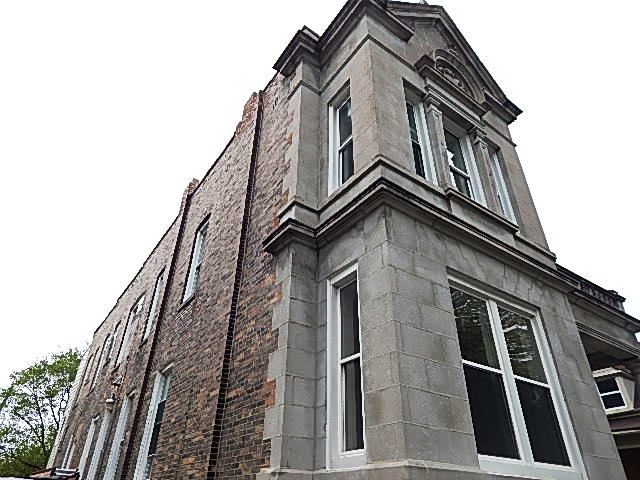
Its iconic water tower, decorated with the blue stripes and red stars of the flag of Chicago, is a landmark of the city’s skyline. And soon the four-story building at 1735 North Ashland will house one of Chicago’s most iconic organizations.

The Night Ministry is moving key portions of its operations to the red-brick building, located just north of the corner of Ashland and Wabansia, in Chicago’s Bucktown neighborhood. It will serve as the home to The Crib, The Night Ministry’s overnight shelter for young adults, as well as its Health Outreach Buses and central administration.

“This move is about enhancing the services we provide as well as supporting efficiency and innovation in our programs, as called for in our strategic plan, Serving in the Next Decade,” said Paul W. Hamann, The Night Ministry’s President & CEO.

The Night Ministry will occupy the first three floors of the building. Working with plans designed by Wheeler Kearns Architects, renovation is underway with a move-in goal of early 2020.

The first floor will house The Crib, along with the offices of the Youth Outreach Team. Outreach & Health Ministry (OHM) and administrative staff, as well as storage for donations and supplies, will be located on the other two floors.
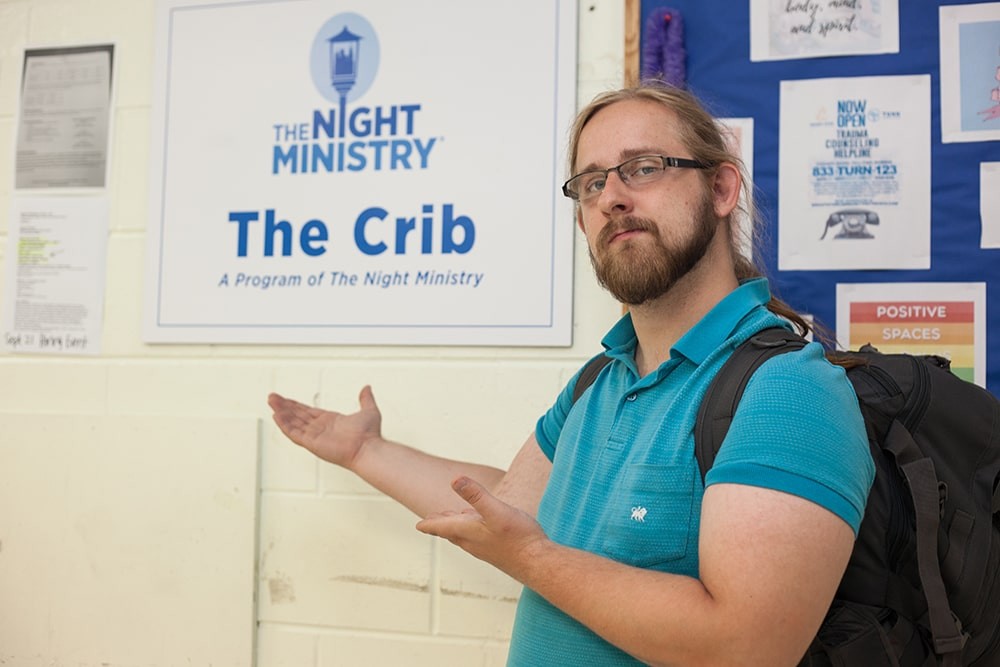
A New Home for The Crib

Every night, The Crib provides safe, supportive shelter for up to 21 young adults experiencing homelessness. The program currently operates in the basement of Lake View Lutheran Church on West Addison.

“Space is tight at The Crib, where guests eat, sleep, and have activities in the same 900-square-foot space,” said Hamann. “They sleep on mats on the floor which must be stored away every morning.”

The three-year strategic plan The Night Ministry launched in 2017 calls for addressing these and other facility challenges faced by the program.

“We won’t be increasing bed capacity but creating a more dignified experience for guests,” Hamann said. “We are designing the layout in the new building, which will more than double the square footage available for services, to optimize the use of space for The Crib’s guests and staff,” he said.

Improvements will include a dorm room with beds, a dining room, an area for programming, private spaces for one-on-one meetings between staff and guests, multiple showers, and gender-neutral washrooms. The facility will also include an indoor waiting room, with Wi-Fi and outlets for charging phones, for guests who arrive before The Crib opens each evening.

LaShaunda Battie, Manager of Youth Engagement Services, said she sees the move as an opportunity to evolve the program.

“We focus on quality of services at The Crib now. I hope that in the new space we can also focus on the quantity of programming we provide,” she said.

“For example, with more space, we will be able to hold different types of groups for our guests simultaneously because we will have separate rooms. It also opens up the possibility of bringing in more volunteers and other partner organizations from the community,” Battie said.

Transportation options for guests include the Ashland Avenue and North Avenue buses as well as the CTA Red Line North and Clybourn stop, which is within walking distance of the building. The Night Ministry will provide transportation to the stop in the morning so guests can ride the train to work, school, and other agencies where they receive services.

The Crib will continue to operate at Lake View Lutheran Church until the property on North Ashland is ready for occupation.
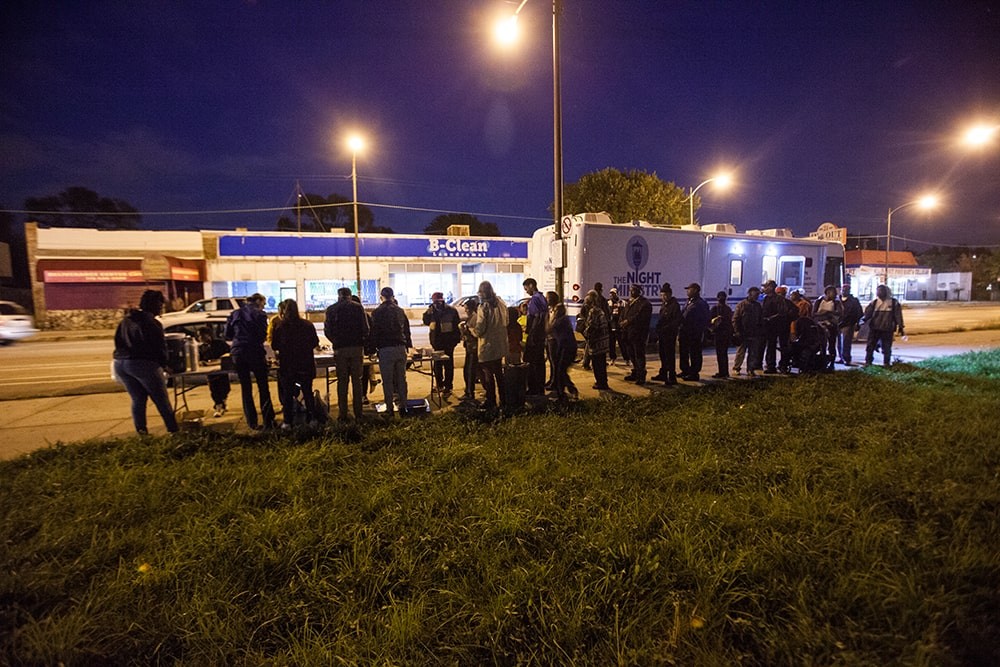
Bringing the Bus Home to Staff

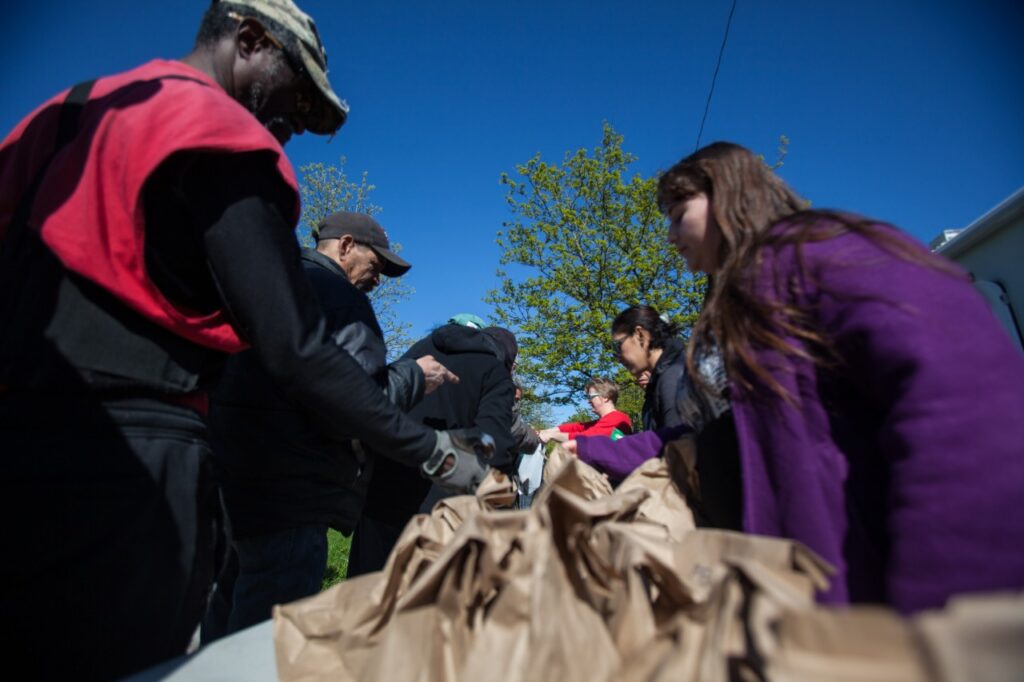
Before the Health Outreach Bus heads out to provide services, OHM staff and volunteers load it up at The Night Ministry headquarters at 4711 North Ravenswood with medical supplies, food, hygiene kits, hot chocolate, and other items that are distributed to the clients the Bus serves.

But before that, an OHM staff member must retrieve the Bus from its overnight parking space, which is located three miles from the Ravenswood facility. And, after the Bus completes its visits at the end of the evening and unloads at the Ravenswood facility, it must be driven back to its overnight spot.

Addressing that challenge is another component in The Night Ministry’s current strategic plan.

“When we started doing an assessment for facilities, we asked our Health Outreach staff what they wanted in a new location,” said Hamann. “They said they wanted to be with their buses.”

1735 North Ashland will have on-site parking for the Bus, as well as for the vehicle that serves as a back-up and OHM’s outreach vans. There will also be a loading dock and enhanced storage space for health care equipment and supplies.

David Wywialowski, Director of OHM, said there’s another advantage to the new location.

“We will be more centrally located to get to all areas of the city we serve, which will be great for both the Bus and Street Medicine programs,” he said.
A New Central Hub for The Night Ministry

The Night Ministry began searching for properties that could address the facility challenges with The Crib and OHM two years ago. The initial search for The Crib centered in Lakeview, but, despite help from local officials and community members, a suitable, affordable spot could not be found in the neighborhood, so the search for the program’s new home widened to other areas of the city.

In the meantime, The Night Ministry learned that the Ravenswood building that houses its headquarters, which it had moved into in 2002, had been sold. With its lease ending on December 31, 2019, The Night Ministry started to consider moving its central office.

Barbara Bolsen, The Night Ministry’s Vice President of Strategic Partnerships & Community Engagement, was leading the property searches when she located the building on North Ashland.

“I realized that we could possibly move all three—The Crib, OHM, and central administration—to this location,” she said.

The new facility will have 15,000 square feet available for Health Outreach and central office staff, up from less than 9,000 square feet in the Ravenswood location. Bolsen said the increase in office space will accommodate expanded operational needs that have come along with growth in The Night Ministry’s programs, completing a third goal of the strategic plan that had originally called for modifying the space at 4711 North Ravenswood.

“We were only operating one shelter when we moved into Ravenswood,” she said. “And now we have five housing programs. OHM was a much smaller program at that time as well. Today it encompasses not only the Health Outreach Bus but Street Medicine and the health care services we provide at partner organizations.”

Office areas on the second and third floors will be arranged flexibly, allowing for greater collaboration among and across departments and positioning the space for additional staff in the future.

Headquartering at 1735 North Ashland also brings The Night Ministry’s administrative office closer to its other facilities—the Response-Ability Pregnant & Parenting Program (RAPPP) in Lakeview; the Open Door Shelter in West Town; and Phoenix Hall in North Lawndale.

How to Support the Move

The Night Ministry estimates the cost of the move and renovation of 1735 North Ashland, for which it has signed a multi-year lease, will be $5.6 million. It also projects an additional need of $1.7 million for capacity building and sustainability for the first three years of operation at the new building, as rent, utility, and occupancy costs will be greater than its current locations for The Crib and administrative offices.

Funding the move is part of a capital campaign The Night Ministry launched earlier this year. For information about supporting the move, contact Christy Prassas, Vice President of Development & External Relations, at 773-506-6023 or christy@thenightministry.org.

Reap the Rewards 2019

On April 4, 2019, The Night Ministry honored 11 employees at our Annual Reap the Rewards of Service Luncheon. Their colleagues, family members, friends, and members of  The Night Ministry’s Board of Directors gathered to celebrate their multiple years with the organization. Honorees were presented with awards by Paul W. Hamann, The Night Ministry’s President & CEO, and Kiantae Bowles, Secretary of The Night Ministry’s Board of Directors.

Honored were:

  • David Wywialowski, Director of Outreach & Health Ministry – 20 years
  • Terry Williams,* Program Specialist, Interim Housing Program – 15 years
  • Kennie Ashley, Accounting Assistant – 10 years
  • Dallas McCall, Maintenance Worker, Youth Programs – 10 years
  • Anthony Monterroso, Case Manager, STEPS Transitional Living Program – 10 years
  • Candace Musick, Youth Development Specialist – 10 years
  • Tedd Peso, Manager, Advocacy & Community Affairs – 10 years
  • Tracey Kyles,* Program Specialist, Response-Ability Pregnant & Parenting Program (RAPPP) – 5 years
  • Erin Ryan, Senior Vice President – 5 years
  • Charnika Williams, On-Call and Weekend Supervisor, Youth Programs – 5 years

Surveys at Youth Housing Programs Help The Night Ministry Better Understand the Needs of Clients

Four times a year, The Night Ministry’s Mission Fulfillment Department visits the organization’s Youth Housing Programs to learn about the young people The Night Ministry serves and to find out how they feel their needs are being met. The results of the anonymous surveys conducted by Mission Fulfillment contribute to a data-driven culture of learning, a goal of the agency’s current strategic plan, Serving in the Next Decade, which help determine how well The Night Ministry is fulfilling its mission and what improvements could be made to its programs.

Mission Fulfillment recently released results from the nearly 140 surveys conducted during a four-quarter period that begun in the 2018 fiscal year.

Here are some highlights: 

What Challenges Are Clients Looking for Help with?

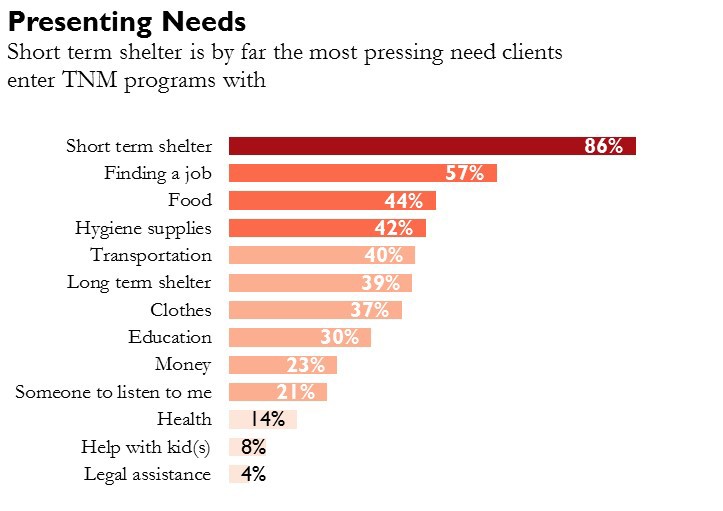
Survey respondents were asked to list all of the reasons they sought to stay with The Night Ministry’s Youth Housing Programs.

“The predominant need identified by clients across all programs has consistently been a need for short term shelter,” said Gregory Gross, Director of Mission Fulfillment, “followed by finding a job.”

“In addition, survey respondents were overwhelmingly likely to report coming to the program with multiple needs. More than a third told us there were six or more needs that they were seeking assistance with.”

There were differences in the types of needs identified by clients, depending on the program they were staying with. Guests at The Crib, The Night Ministry’s emergency overnight shelter, reported a much higher need for basic needs such as food, hygiene supplies, and clothes.

“In comparison, residents of the STEPS Transitional Living Program, which provides up to two years of housing, were significantly more likely to report long-term needs such as employment, continuing education, and long-term housing,” Gross said.

Nearly three out of four respondents reported that their needs were being met by the programs they were staying in.

Where Would Clients Go If The Night Ministry Wasn’t There?

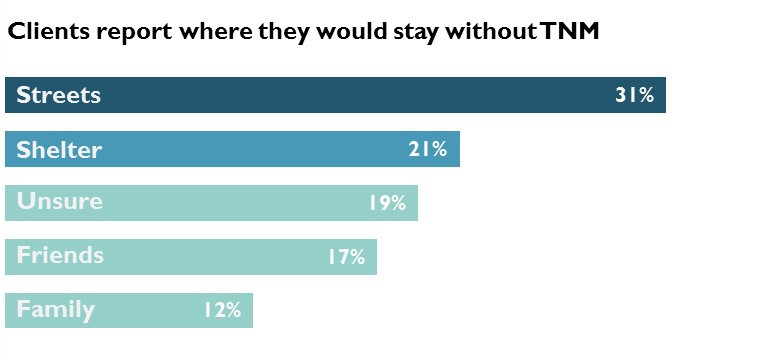
Clients were asked about if they had a safe place to stay if they were not staying with The Night Ministry. Only 16% reported having a safe place to stay, while the remainder—84%—stated they either wouldn’t have a safe place or they were unsure about where they would go.

“This underscores the housing instability The Night Ministry’s youth clients face when entering our programs and the lack of adequate social support many of them experience,” said Gross.

“Additionally, we know from conducting follow up focus groups, that even those who said they had a place to go, a family member or friend, will be unable to identify someone and so we know a portion of those are actually unsure,” Gross said.

When asked where they would go if they were not with The Night Ministry, nearly a third reported they would be on the streets. 29% percent reported they would be doubled-up (“couch-surfing”), staying temporarily with family or friends.

“The lack of safe alternatives for clients to pursue and the high percentages of those who would be living on the streets or in unknown situations speaks to the potential impact The Night Ministry’s Youth Housing Programs have on the lives of those they serve,” said Gross.

How Does Case Management Help?

Case managers at The Night Ministry’s Youth Housing Programs help clients identify and meet their immediate needs and pursue goals related to long-term stability.

“Overall, clients reported that case management is a helpful process for them,” said Gross. “The most commonly mentioned goals they work on with their Case Managers are related to employment and education.”

“Clients also reported working on ‘soft-skills,’ such as communication or stress management, while others received assistance getting connected to medical services, housing, and obtaining important documents such as birth certificates or state IDs,” he said.

The Night Ministry in the News During the Polar Vortex

The Night Ministry’s work serving Chicago’s homeless population during the dangerously cold weather of January 2019 was highlighted by several media organizations. Below you will find links to a number of the stories.

WGN-TV
Colder Temperatures Mean Increased Risk for Chicago’s Homeless Population

WBBM Newsradio
Mobile Assistance Unit Helps Homeless In Dangerous Cold

Chicago Sun-Times
Checking on homeless as subzero temps loom: ‘They like that we just show up’

Newsy
Helping The Homeless In Frigid Weather Goes Beyond Temporary Shelters

Christian Science Monitor
In frigid heartland, an outpouring of warmth

Newsweek
Polar Vortex: Chicago’s Homeless Struggle in the Bitter Cold

Mission Fulfillment Takes Survey Results Back to the Source

Serving in the Next Decade, The Night Ministry’s current strategic plan, calls for growing and sustaining a data-driven culture of learning. Surveying clients across the organization is an important avenue for achieving that goal.

Over the last few years, The Night Ministry began sharing survey results with its clients. Gregory Gross, Director of Mission Fulfillment, said that has led to a more detailed picture of the individuals we serve.

“For example, we had been asking clients at the Health Outreach Bus about housing stability. When we took the results back, we heard in several places that housing was stable but not adequate,” he said. “So we made changes to the survey this year so we could ask not just about stability but also ask more questions about adequacy.”

The results from surveys of Youth Housing residents are brought to members of Youth 4 Truth, The Night Ministry’s leadership and advocacy program for young adults. Gross said the process is similar to focus group research.

“We look at the survey results and ask what would be helpful to know more about,” he said. “For instance, on the youth survey we asked about feelings of safety. We then took the results to Youth 4 Truth and asked, ‘Can you tell us more about what makes you feel safe? Can you give us examples of when you feel safe and when you don’t?'”

Gross said the conversations with Youth 4 Truth members are a forum for young people to identify challenges in The Night Ministry’s Youth Programs that they feel should be addressed.

“These discussions are not just happening in a vacuum,” he said. “We do share feedback with the program staff, and we can make alterations if needed.”

Amber Westbrooks, a Youth 4 Truth member who has participated in the process, said the conversations were empowering.

“I’ve never done something like this where my voice actually mattered. About two to three weeks after we talked, we started to see changes,” she said. “I really believe that The Night Ministry values our opinions.”

Read about the results of the 2018 Outreach and Health Ministry Street Survey, conducted at Health Outreach Bus stops.

Winter Poses Unique Challenges for The Night Ministry’s Clients and Staff

Making it through a winter season of snow and extreme cold can be difficult for all of us. But winter conditions can pose extra challenges for individuals experiencing homelessness as well as The Night Ministry staff members who provide mobile outreach services.

“The conditions of homelessness make recovery from some of the more common winter ailments much more difficult,” said Matthew Sorenson, Medical Director of The Night Ministry’s Outreach and Health Ministry Program (OHM).

“When you have a cold or the flu, you are supposed to stay home and get rest. Let’s say you are staying in a tent along the Dan Ryan Expressway. How are you able to do that? All the things we are supposed to do when we’re sick, it’s far more difficult to do when you are homeless simply because of the situation and environment you are living in.”

Exposure to extreme cold can cause frostbite. But Sorenson said OHM staff often see the consequences of frostbite rather than the condition itself.

“Let’s say you were sleeping on the street and you wake up, you may have some frostbite. By the time we come around, you may have been up and moving and been able to thaw. But we’ll see the skin breakdown,” he said.

“A lot of time what you are seeing with frostbite is tissue destruction. The ice is basically damaging tissue and the crystallization of ice can also cause damage.”

Sorenson said there are other health challenges that exist all year but that present themselves more frequently in the winter because of an increase in risk factors.

For example, arthritic symptoms are more prevalent during the winter because of the increased physiological stress brought on by living outside in the cold.

“If you are staying in Lower Wacker, you are sleeping on a surface that’s not exactly going to be kind to your body, and now let’s make it cold. With that added stress, it’s not uncommon to see more symptomatology for arthritis that we may in the summer or fall,” he said.

Foot care is another year-round challenge for many individuals experiencing homelessness, but Sorenson said it can be particularly acute in cold weather because people are less likely to remove their shoes.

“If the shoes get wet, that moisture gets trapped in the shoes. So you have somebody who could be wearing their shoes nonstop for a period of several days. It gets damp in there and they’re having breakdown of the skin as a result of that.”

Making Ends Meet in the Winter

According to the 2018 OHM Street Survey, more than half of Health Outreach Bus clients are living in apartments or houses. Case Manager, Mirella Rodriguez, said more clients who do have housing ask about rent and utility assistance when the weather turns cold.

“They’re trying to prevent being evicted during the winter months or they need to pay their utilities, so I offer them information about emergency funds or legal resources to prevent eviction,” she said.

When this winter season started, Rodriguez said she also began getting more requests for information about food support resources. “When the weather turned cold, every day that I was at New City or South Shore stops, somebody was asking about food pantries,” she said.

“They may be trying to make rent and utility payments and probably don’t have a lot of money left over for food,” she said. “While some clients haven’t applied for food benefits others are getting such a small amount that they don’t have enough food to last them for a whole month.”

Challenges in Providing Services

Both Sorenson and Rodriguez said winter can complicate how they are able to serve patients and clients.

“This time of year definitely limits the types of health exams we can do, and it often has to do with how many layers of clothing a person is wearing,” Sorenson said. “People are reluctant to get out of all the clothing they are wearing because it takes so long to pull the layers off and get them back on.”

“It really affects our ability to examine an area, to get underneath the layers of clothing to see what’s there and see what the issue is,” he said.

Rodriguez said she does see more requests for shelter from clients when the weather gets cold, which can be a difficult conversation because there are often limited options for immediate placement.

“Many are reluctant to go to a shelter. For example, they’re afraid they’re going to get hurt if they go to certain places. So I ask them if they can stay with family or friends that they can trust.”

“Or I try to locate the closest emergency room or police station where they can go to get warm,” she said, adding that as a last resort she might provide a client with a bus card so they can ride public transportation or a gift card for a restaurant that is open 24 hours.

“I encourage clients when the weather is warmer to start the process of signing up for housing, so they don’t face this situation in the winter,” Rodriguez said. 

Nurse’s Corner: Caring for Patients Is a Privilege for Bethany Hess

Nurse Practitioner Bethany Hess’s philosophy of patient care is rooted in respect for others and acceptance of each person’s unique experience of life.

“I believe in client-centered care. This requires understanding the needs of the people whom we serve, their circumstances, and the challenges they may be facing,” said Hess, who provides free basic medical care on The Night Ministry’s Health Outreach Bus.

Hess said much of her job is listening to clients and answering their questions about their health challenges, which are often exacerbated by poverty.

“Many people have multiple and complex health problems, including trauma, mental illness, and substance use. There are always a lot of questions and uncertainty about their medications and diagnoses, especially within the context of the daily struggles that make it difficult for them to store and take meds, or adhere to treatment plans.”

“Ever present is trauma and its impact on all aspects of clients’ lives,” she added. “Trauma plays a big role in why people become and stay homeless. And the stress of being homeless creates more trauma.”

Hess has worked in the emergency department, inpatient settings and community clinics. She draws on all of these experiences to support her clients.

“One of my goals is to help clients navigate the health care system so it can meet their needs most effectively,” she said.

“This is difficult to attain. Often clients benefit from talking about what they should say and what questions they should ask when seeking medical treatment. So when someone returns to report they were able to get to an appointment, or housing, or get the care they need, I feel like we’ve succeeded.”

Hess also enjoys the connections she makes with the volunteers on the Bus.

“They come from every walk of life, have had a broad range of life experiences, including homelessness and illness, and have now come out on the other side. They inspire me.” 

Volunteering with The Night Ministry Is Personal

Every year, hundreds of volunteers contribute their time, energy, and passion to The Night Ministry’s mission. Many inspired to give back by personal experiences.

Miriam Thompson, who greets clients on the Health Outreach Bus while serving meals and coffee, was drawn to The Night Ministry because she had experienced a period of homelessness.

“I look at the clients, and I know that at one time that was me and could be me again,” she said. “I want to acknowledge them and let them know I care about them, and that there is hope for them.”

Janine Landow-Esser was motivated to volunteer by her encounters with homeless youth on Chicago’s North Side. For more than a dozen years, she and fellow congregation members from Anshe Emet Synagogue have prepared and served meals alongside the Youth Outreach Van on Thursday nights in the Lakeview neighborhood.

Landow-Esser said she resonates with The Night Ministry’s emphasis on acceptance. “I love working with an organization that does so much without judging or pushing an agenda as a condition for receiving help.”

A longtime donor, Henrietta Dombrovskaya started volunteering at The Night Ministry’s Open Door Shelter – West Town after taking a tour of the facility. “Having been through some rough patches in my life, and having three grown children, I thought I could share some wisdom and lots of love with the young people there” she said.

“They took the time to write very precious words wishing me good health and a speedy recovery,” she said. “It was just amazing.”There are plenty of opportunities to volunteer with The Night Ministry. Call (773) 784-9000 ext. 7012 or visit www.thenightministry.org/get-involved for more information.

A Look Back at 2018 Holiday Celebrations

Every year, the generosity of our supporters allows us to celebrate the holidays with the young people and adults we serve across the city. We hold a holiday party for clients of our Youth Programs, which includes a sit-down meal, games, and wrapped presents. Meanwhile clients of our Health Outreach Bus are also treated to holiday celebrations, with wrapped presents for children and gift stockings for adults. Enjoy these photos from the celebrations we held at the Bus’s New City and Pilsen stops.

Stocking Stuffing Is a Seasonal Tradition for Supporters

Every year, The Night Ministry’s generous supporters help make the holiday season a little brighter for the children, youth, and adults we serve by contributing to the celebrations we hold across all of our programs in December.

One of the biggest ways our friends help is through the donation of stockings that are filled with essentials like socks, gloves, tissues, and deodorant for our clients, along with a few fun items like candy and decks of cards. The stockings are donated by individuals, congregations, organizations, and businesses from across the Chicago area.

Catherine Schulte organizes stocking donations from Glencoe Union Church, where she said stocking stuffing has become a holiday tradition.

“Everybody thinks it is super fun. All of the kids look forward to that Sunday in December when we get together to stuff stockings,” she said.

Schulte said the process is also an opportunity for congregants to learn about the day-to-day realities of the individuals who will receive the stockings.

“It creates conversations about why things like lip balm and socks are needed and why the stockings aren’t filled with tons of candy.”

JR Clark had been a supporter and volunteer with The Night Ministry before he suggested to his colleagues at the American Bar Association, where he is Director of Accreditation Administration, that they come together to stuff stockings a few years ago.

Everyone in his office who wants to participate is welcome, he said, even if they haven’t been able to purchase items or donate money.

“My colleagues who cannot give are sometimes the ones that definitely make sure they are there to help stuff the stockings,” Clark said.

Clark also said his coworkers appreciate the opportunity to give back during the holiday season.

“Being reminded of those that don’t have as much and to be able to, even in a small way, do something that hopefully brings some joy into others’ lives, I think that’s very important.”

Who Are We Serving at the Health Outreach Bus?

Digging into the 2018 Outreach and Health Ministry Street Survey Results

Creating a data-driven culture of learning is one of the goals of Serving in the Next Decade, The Night Ministry’s current strategic plan. Gregory Gross, Director of Mission Fulfillment, says surveys conducted with The Night Ministry’s clients play key roles in building that culture.

“All of the answers and results we get on surveys are data we use to learn about how well we are fulfilling our mission and how we can make improvements to our services,” Gross said.

The Night Ministry recently released the results of its annual Outreach and Health Ministry (OHM) Street Survey, conducted earlier this year at six of the Health Outreach Bus stops.

“The Street Survey is meant to find out more about the individuals whom the Bus is serving and their current circumstances as well as to assess how well the services we are providing meet their needs,” Gross said.

This year Mission Fulfillment, along with a number of trained, dedicated volunteers, conducted surveys with 371 clients, the highest number in the OHM Street Survey’s six-year history, collecting more than 23,000 data points.

“There is much need in all communities which the Health Outreach Bus visits,” said Gross. “Many folks are ‘house poor,’ meaning they have housing but nearly all resources go to pay for it. Thus, there is little left for health care, food, and other essentials. This underscores the importance of all of the services the Bus provides.”

Here are some highlights:

Satisfaction with Services

Surveyed clients report high levels of satisfaction with the services offered at The Health Outreach Bus, with 92% saying they are either satisfied or very satisfied, indicating that the Bus staff is meeting the expectations of the clients whom they serve. 

Housing

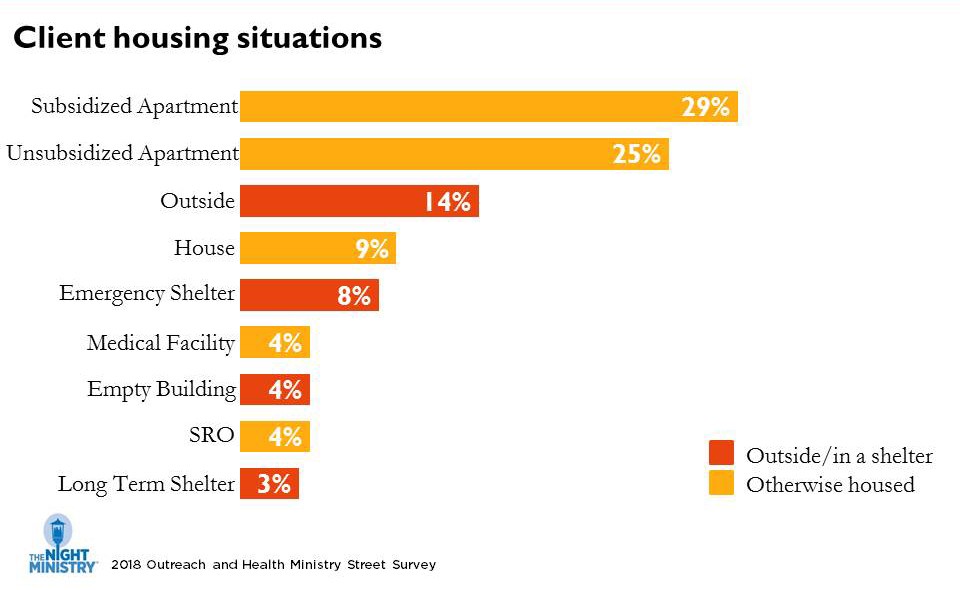
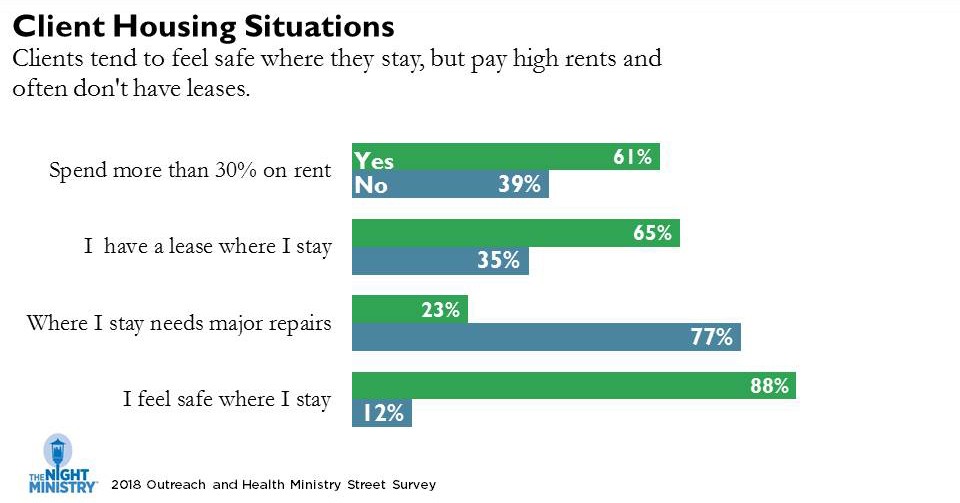
Clients of the Health Outreach Bus live in a diverse and precarious array of housing situations. On average, clients report having some type of housing, from unsubsidized apartments and homes to subsidized apartments, SRO, or medical facility. However, they are likely to be living in an unstable situation such an apartment without a lease or they are paying more for rent than is generally considered affordable. Meanwhile, nearly a third of clients are homeless, living on the streets, in an abandoned building, or in a shelter.

Health Care

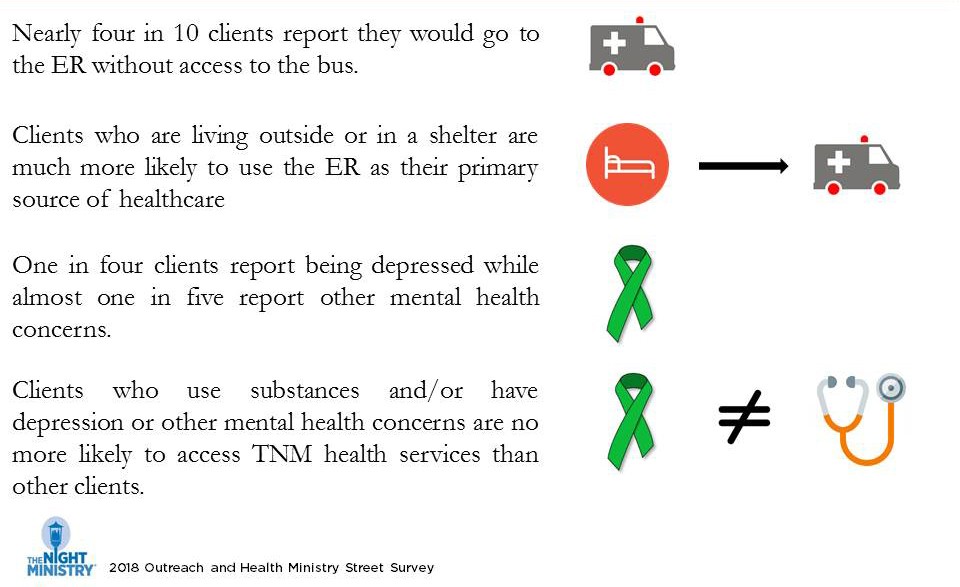
Nearly 40% of clients reported that they would visit an emergency room for health care if they could not access the services at the Health Outreach Bus. Last year, The Night Ministry was able to prevent 201 such visits by delivering health care services on the Bus, saving the public health system nearly $186,000.

Human Connection 

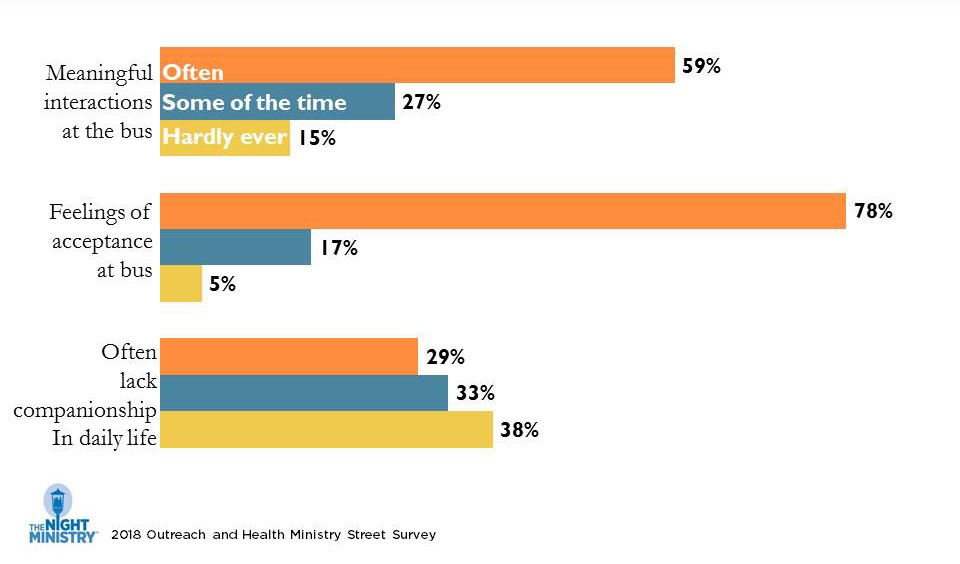
Large majorities of survey respondents report often having meaningful interactions with people at the Health Outreach Bus and feel accepted for who they are. “Across the board, there is a lot of client trust with the Bus staff,” said Gross, “which is really encouraging and helpful for the staff to see that, even though there are some significant needs, there is a large amount of trust and community being built at the Bus stops.”

Hunger

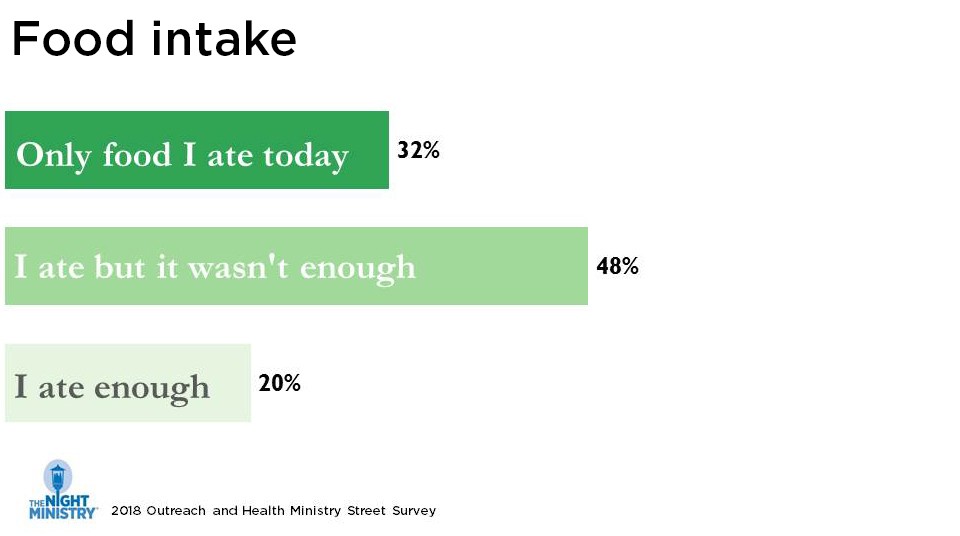
Hunger is a persistent problem across all neighborhoods visited by the Health Outreach Bus. 80% of clients report not having any or enough food before coming to the bus, with nearly one-third having not eaten at all.

“This speaks to the need for volunteers to provide a hot meal alongside the bus,” said Gross. (Click here to sign up to provide meals at the Health Outreach Bus stops.) 

Communities of Highest Need

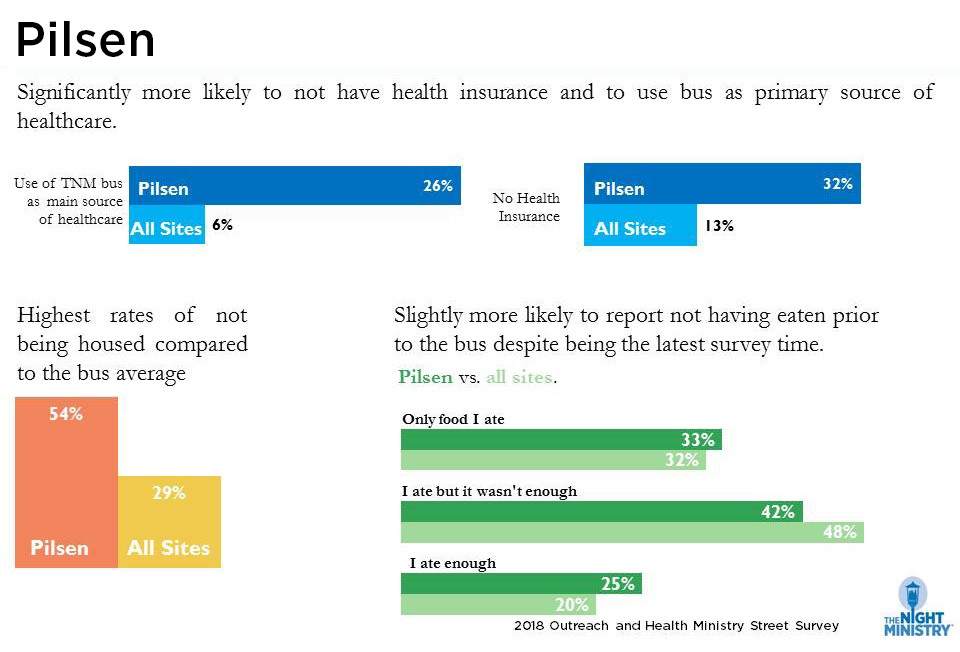
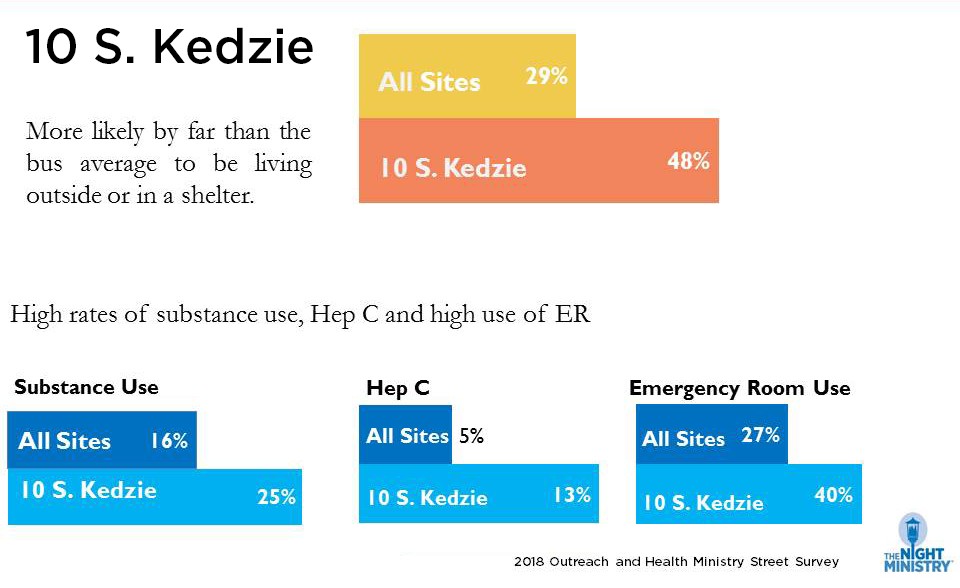
Survey results from the Health Outreach Bus stops in Pilsen and at 10 S. Kedzie in East Garfield Park underscore the need for The Night Ministry’s services in those neighborhoods.

“The results In Pilsen reinforce what we’ve seen year over year, that there is a large population of folks who visit the Bus in that neighborhood who are literally homeless, living on the streets or living in shelters,” Gross said.

Clients in Pilsen are also significantly more likely to not have health insurance and are more likely to use the Bus as their primary source of health care. 

At 10 S. Kedzie, where clients are far more likely to be experiencing homelessness than other stops, health services are also critical.

“A lot of the folks said that they go to the emergency room for their primary source of health care,” Gross said. “That, along with high rates of substance use and hepatitis C infection, speaks to the need of bringing the Bus there.”

Having Benefited from The Night Ministry, Craig Echols is Helping Other Youth Find Their Way

By Helen Grove

Craig Echols discovered The Night Ministry at a crossroads in his life. At 19 years old, he had recently been released from Cook County Jail and was living in a rehabilitation facility that brought about its own set of challenges, including hostile tenants that made the facility an unsettling place to live. Recognizing that the rehab facility was not a long-term option, Craig left and was facing homelessness when his case manager suggested The Night Ministry. Today, he is using his experience to help others like him find their way. And he has a message for other young people experiencing hardship: “Whatever it is that you do – do it with love.”

With a referral from a social services case manager, Craig moved into The Night Ministry’s Interim Housing Program in West Town. Over the course of his two years with The Night Ministry, Craig participated in the organization’s Interim Housing Program and its STEPS Transitional Living Program. While he was there, he worked hard to utilize all of the resources available, including financial literacy training and assistance obtaining a grant to attend school. “The model is to get you prepared for the world,” he said. “The program softens the blow for what the world has to offer.”

Having experienced firsthand the challenges on the other side of The Night Ministry, Craig is dedicating his life to helping other young people find the right resources and support to navigate everything that life throws at them. He is engaged with the National Network for Youth, a non-profit public education and policy advocacy organization that is dedicated to preventing and eradicating youth homelessness. Through this and other professional organizations, Craig is working to help others navigate the complex network of services and offerings to help them face tough challenges. Simultaneously, he is working to raise awareness and pass legislation in order to pave an easier path for others than the one he himself has encountered.

Craig encourages other youth experiencing hard times to embrace those experiences. “Hard times are a necessity for growth,” he says. “Times can be tough, but they will always get better. The hard times make you who you are and they define your character.That’s an understanding that I have built from being a youth that has come up through programs and different shelters and urban life. They will make you a stronger person in the end.” 

In My Own Words: What Inspires You To Live Life?

​By Malika Tate, a member of Youth 4 Truth, The Night Ministry’s leadership and advocacy group for young people.

When I first wake up in the morning normally I do not want to get up. But reminding myself of my purpose and goals in life helps me get up every day. They inspire me to live life.

As human beings, we have purposes here on earth, whether they are helping others heal from open wounds or helping a sister learn how to read.One of mine is to heal from the wounds I experienced when I was growing up. The challenges I face from my trauma have made me the person I am today. I am a strong, well-educated, and wise soul ready to teach.

Being a wise soul teaches you a lot. Two advantages of being a wise soul are empathy and lived experiences.Through empathy I am able to feel the energy of others, whether they are sad, happy, or mad. As for experience, I have lots with break-ups, emotional abuse, trauma, and abandonment. I understand every situation anyone might have. I am able to put myself in their shoes and find a solution to their problem.

I can say that healing myself and being a wise soul are my purposes in life. But my goals are putting those in motion.

One of my goals is to inspire others through my creative writing. I have been writing since I was 9 years old. When I first started writing it was to entertain; now I write to express my feelings about people, things, situations, and nature as well as to educate. I want my creative writing talent to be the inspiration for others to keep moving. While writing is a way for me to express my feelings, I hope others can learn from my writing and be inspired to start a new chapter by expressing themselves.

Another one of my goals is to help others heal. I love helping others heal, but sometimes it can be painful. I love helping because I can motive them to strive for more in life and to not settle for less because they feel it is not worth it or something is too challenging. But helping others is hard because you never know if they will take your advice or want to better themselves. Sometimes the ones you help will hurt you more in the long run because they are not fully ready to take that next step towards their destiny in life.

To sum up, I have learned to find my purpose and go after my goals. Though I experience so much in life I am always seeking more. Experience teaches me to keep moving even when obstacles are thrown my way. I am a natural born healer and teacher for all human beings. I might be young, but I have been here before and it’s only fair to use my talent to help those around me move forward on their path in life.

Meet Board Member Suzanne Hoyes

Suzanne Hoyes was looking for a way to meaningfully participate in the Chicago community when she moved here in 2014. She found a way to do that by joining The Night Ministry’s Board of Directors. We asked Hoyes, who is Vice President, Compliance for Capri Capital Partners, LLC, a real estate investment management firm, about her experience as a Board Member.

How does your professional experience lend itself to serving on the Board?

With both public service and private sector experience, I have come to understand the complex range of needs that are necessary in the effective operation of an organization, from supporting staff in the direct service of clients, so that they have what they need to do their best work, to the very real constraints of limited resources and maximizing these resources.

What interests and principles have guided your professional career?

I have always approached my work with the intention of doing my very best and to actually help others. I’m guided by the core principles of integrity, honesty, and a sense of fairness and justice, whether it was when I served clients as a social worker in child welfare or now by reinforcing a strong culture of ethical conduct and compliance in financial services.

In your opinion, what are the characteristics of a successful nonprofit board of directors and how does The Night Ministry’s Board demonstrate those traits?

A successful nonprofit board of directors requires each director to fundamentally believe and be dedicated to the mission of the organization. This proves to be critical because this dedication is palpable in the director’s advocacy on behalf of the organization. The diversity that each director brings to the board is equally important as her dedication. The Night Ministry’s Board of Directors is a deeply dedicated group of individuals, and the Board continuously works to cultivate a body of directors that represents varying experiences and perspectives.

What would you say to someone who is considering supporting The Night Ministry?

The Night Ministry is an extraordinarily impactful organization. It is a principled organization that protects the most vulnerable segments of the population in a time when people who need the most help seem to be under attack. And it is an organization that is not afraid to evolve based on the actual needs of clients. 

On the Road with the Street Medicine Team

By Sam Ritchey
The Associate Board

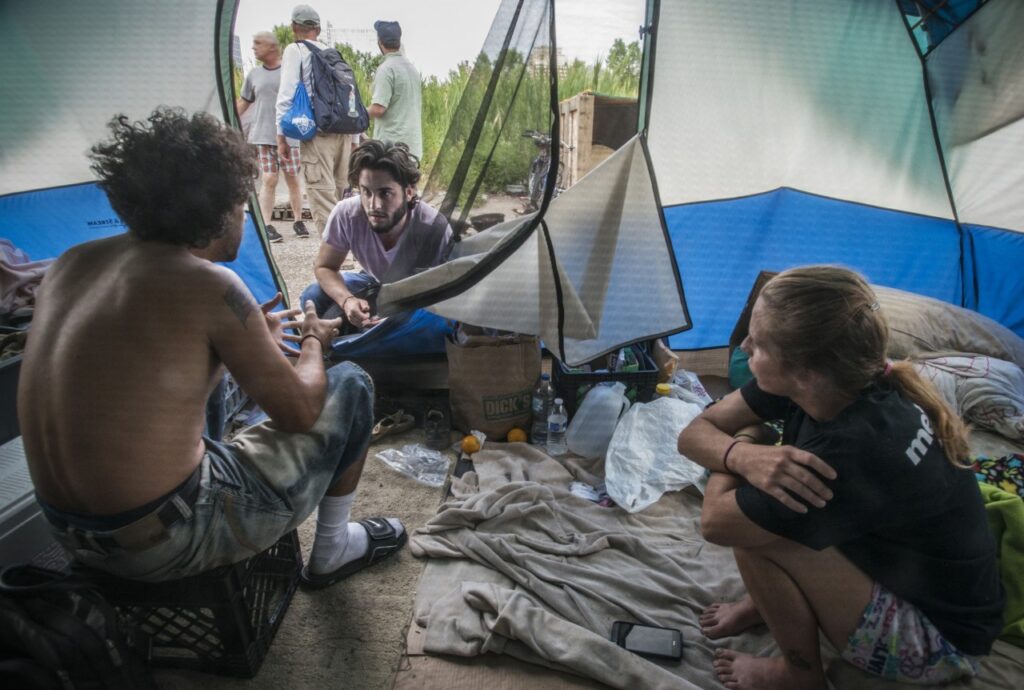
It’s already pushing 80 degrees early on a humid, mid-August Saturday morning when the Street Medicine van pulls up outside The Night Ministry’s Ravenswood headquarters.

Outreach Professional Milton Alvarez jumps out. A pair of volunteers wait for him at the front door, ready to load food, water, clothing, and hygiene kits (dental care, deodorant, soap, and the like) into the van. Water will be especially important today, with the heat index pushing into dangerous territory.

At The Night Ministry office, Dr. Ralph Ryan, a veteran cardiologist and volunteer, preps a medical supply bag for the day, not knowing exactly what needs he’ll encounter among his patients. He can make a fair bet that he will have to provide care for wounds and the infections that sometimes accompany them. Asthma, hypertension, and a suite of aches and pains are also likely to be reported by clients who would not otherwise have such convenient access to medical care.

Living outside or in precarious housing is, understandably, hard on the human body. As Dr. Ryan succinctly puts it, “eyes, feet, and skin.” These are what suffer first and the hardest when pitted against the elements. Shoes and socks are among the most important items given out by the Street Medicine van.

Opioid addiction is a dimension of homelessness in Chicago that requires medical treatment and prevention efforts. And so while Dr. Ryan completes his work, Milton readies harm reduction kits.

These kits include clean syringes–often referred to as “rigs” on the street–and the associated supplies that allow for safe and sterile intravenous injection. Separate kits include doses of Narcan (naloxone), an injectable medication which blocks the effects of opioids, and can potentially save a life in the event of an overdose.

*****

The January 2017 Point-in-Time Count and Survey Report conducted by the the City of Chicago’s Department of Family and Support Services found that 5,657 Chicagoans were homeless, with 1,561 persons designated as unsheltered.

As one might expect, unsheltered persons are often the most difficult to locate, and they are often in greatest relative need of health care and social services.

The Night Ministry launched Street Medicine as a pilot project in 2015, recognizing the potential value of a highly mobile team of professionals–social workers and health care providers–who could identify homeless communities and build relationships with them over time. These relationships would then have the possibility of enduring as communities moved in response to a variety of factors.

In 2018, Street Medicine became a permanent part of The Night Ministry’s Outreach and Health Ministry Program. The van typically heads out 5 times a week, to visit both known communities and to identify new ones in need.

*****

As noon approaches, the Street Medicine van rolls to a stop near the Eisenhower Expressway, where a pocket of shaded green space amid the bustle of cars would surprise a first-time visitor.

The established community here is familiar with the Street Medicine program, and several residents respond to the team’s greetings with a warm welcome.

Food, water, hygiene kits, and socks are widely distributed. Outreach Professional Milton Alvarez chats with a client about how he can obtain a state-issued identification by using The Night Ministry HQ as his mailing address. That ID is often essential for gaining access to benefits and work opportunities.

Dr. Ryan examines a resident who was injured in a bicycle accident and is recovering from a significant surgery that left dozens of stitches in his upper chest. Another client, who suffers from asthma, is given a brief physical exam. He accepts an inhaler. There is antifungal cream for a case of athlete’s foot. And ibuprofen for back pain. And there are band-aids and alcohol wipes for everyday scrapes.

Amid the care and counsel, there is conversation and storytelling. And after nearly half an hour, handshakes and farewells.

The crew climbs into the van. Time to get back on the street.

Caribbean HIV Educator and Advocate Observes The Night Ministry’s Health Outreach Program

Michael Thomas has seen the effects of stigmatization on HIV testing and education in his home country of Grenada.

“There’s a lot of stigma that prevents people from being comfortable and being able to go to the clinics to be tested,” Thomas said.

“We have situations where people in the communities that we work with are afraid to get tested,” he said. “What if the nurse finds out that I am gay? What if the nurse finds out that I am a sex worker? Because the community is so small and everybody knows everybody, someone is going to find out.”

Thomas is a Liaison and Advisor to the Board of Directors of GrenCHAP, the only organization in the Caribbean nation that focuses on the sexual health of marginalized populations, including individuals who identify as LGBTQ and sex workers. He has spent the past month in Chicago as a fellow in the U.S. State Department’s Youth Leaders of America Initiative (YLAI), hosted by WorldChicago. He has spent much of that time visiting The Night Ministry’s Outreach and Health Ministry and Youth Housing Programs and meeting with our partner organizations to learn about health outreach to the LGBTQ community in Chicago.

“One of the main reasons I applied to YLAI was to find effective ways of linking members of the LGBTQ community to care without having to worry about what people think or what they say,” he said.

Thomas said accompanying The Night Ministry staff on outreach efforts in Chicago has been eye-opening.

“I was able to get a one-on-one insight into the struggles that homeless people go through in Chicago,” he said. “It really hit home to me that certain things happen to people, and they are not in control of the situation. But because of how society perceives them, it’s difficult for them to get out of the situation.”

Thomas said much of GrenCHAP’s work involves encouraging individuals in at-risk populations to get tested for HIV and sexually transmitted infections.

“What we are really doing is trying to show individuals that we understand your fears and concerns, but the health care system is very confidential, and you should not be afraid to actually go and get tested,” he said.

“If you don’t want to go get tested on your own,” he added, “we’ll be more than happy to go with you.”

Thomas said GrenCHAP also educates members of at-risk communities on ways to protect themselves from infection. Education happens through direct consultation with clients and through public health campaigns.

“My job as a sexual reproductive health rights advocate is to ensure that you have the necessary information that you need to ensure that you do not contract HIV or any other STIs,” he said.

Thomas said battling discrimination in Grenada is an important part of combating the spread of HIV and STIs.

“My organization works to ensure that people within the LGBTQ community and the sex worker community are not only taken care of health-wise, but are respected within the country,” he said.

“We are trying to push, ‘Live and let live.’ You may not want to accept something, but you can at least be tolerant of people living in the same country, or being in the same space as you.”Through its participation in YLAI, The Night Ministry may have the opportunity to send a staff member to Grenada for a reciprocal experience in the future.

New Zealand Free Clinic Director Visits The Night Ministry

We had a special visitor at the Health Outreach Bus earlier this month — all the way from New Zealand!

Beth Stitely, director of a free health care clinic in New Zealand, was in the Chicago area as a guest of the Illinois Association of Free and Charitable Clinics. On Wednesday, October 10, Stitely visited CommunityHealth’s clinic and The Night Ministry’s Health Outreach Bus.

“I saw the great work that your team is doing with The Night Ministry,’ she said. “The people I met were so grateful for the help they were receiving, and I can see that the Night Ministry is making a positive impact on people’s lives.”

We asked Stitely to tell us about her visit and the work she performs back home.

Can you tell me about your clinic?

Our clinic was started by two doctors and a midwife who saw the need for free care and were inspired to open a clinic that operated through volunteers and charged no fees. Our clinic, Servants Health Centre, opened its doors in January 2010. We’re the only free clinic on the South Island of New Zealand. We serve a high-needs population, and criteria for enrollment is based on financial need. The demand for our free services is high and we always have people on our wait list, but we’re seeing positive results and people’s lives are being changed for the better because of our free service and care.

What was your impression of the community health providers you visited in Chicago?

I’m very impressed with the clinics and the work that’s being done to help people here in Chicago. The volunteers and workers I spoke with were so caring and compassionate. I could see that the clinics are well resourced and can provide much needed services to those without medical insurance. The clients I spoke with were very grateful for the free services they were receiving.

What insights or information will you be taking back with you to New Zealand?

I’m looking forward to sharing my experience when I return to New Zealand. I found it interesting to learn that there’s a need for navigators who help people access and understand the medical market place. That’s not something we would need in New Zealand’s government funded system. The clinics I saw in Chicago provide group health education classes, and I think that’s something I’d like to replicate at our clinic as well. Overall, I’ve had a great experience here in Chicago and have learned so much. I’m very thankful for everyone who took time out of their busy schedules to meet with me and share with me their work and mission. 

Peer Outreach Professionals Help The Night Ministry Engage Homeless Youth

Sometimes there is wisdom in knowing that you don’t know it all.

The Night Ministry’s Youth Outreach Team makes contact with homeless young people across the city, connecting them with housing, education, vocational, and physical resources as well as providing compassionate support along their journeys to stability. But a few years ago, the Team’s Youth Outreach Professionals began to realize that there were young people experiencing homelessness on the streets of Chicago that weren’t being reached.

“They are really hard to find because they work really hard at not looking homeless,” said Erin Ryan, Senior Vice President at The Night Ministry. “They work really hard at blending in and looking like any other teenager or young adult.”

Ryan said Team members began talking about having youth accompany them on their outreach efforts to connect with the individuals they were missing.

The first group of youth to accompany the Outreach Team were members of Youth 4 Truth, the advocacy and leadership group for clients of The Night Ministry’s Youth Programs, who helped identify places where the Outreach Team could find homeless youth and incorporate new ways to engage them.

Those early efforts resulted in the creation of a new position on the Outreach Team, the Peer Outreach Professional, to bolster the agency’s engagement with young people on the streets.

The first hire for the position was Sharday Hamilton, who had been a client of The Night Ministry. LaShaunda Battie, Manager of Youth Engagement Services, said bringing Hamilton onto the Youth Outreach Team has produced results.

“Sharday has been able to give us a ticket into her world in terms of where youth are gathering and what is going on with social media. She has given us access to areas that we may not have known about,” Battie said. “And we’ve definitely seen an increase in our engagement with youth.”

Hamilton said she knows she is making a difference.

“Being in the same age range, I am able to communicate with young people more. They respect me because I have been through some of the same experiences and can share my story.”

The position, which can run from six months to a year, was conceived in a way to help both the agency and the Peer Outreach Professional.

“What we wanted was a job that would give young people a real paycheck and real experience,” Ryan said. “It is an opportunity for our Youth Outreach Professionals to coach and mentor and help young people learn what it’s like to be in a professional job.”

In the first months at the job, Hamilton was paired with a Youth Outreach Professional but is now conducting outreach on her own and training the newest hire in the position, who started earlier this month.

Hamilton is featured in Truth + Dare, a video produced by the Chicago Foundation for Women celebrating the accomplishments of four Chicago Women. You can watch the video here.

Meet Board Member Ike Hong

Ike Hong, a member of The Night Ministry’s Board of Directors, is helping drive our 2018 Golf Outing. We talked with Hong, an engineer who runs his own construction management and real estate development business, about his engagement with The Night Ministry, which began nearly a decade ago.

What attracted you to The Night Ministry?

The mission. Once I got to know the organization better, I realized that the organization itself is very efficient. A majority of the funds go to the programs. That really is what galvanized my interest in joining the Board of The Night Ministry.

What have you learned during your involvement with The Night Ministry?

I think most people, including myself, when you see someone who is homeless you have a certain preconception about who they are and why they are there. Once I got involved, I realized it’s much more complicated. People don’t choose to be homeless. I also realized that we–me and a lot of my family members and friends—have a support system. Many of the people in the streets don’t. And I was shocked at how many youth are homeless, not because they choose to be but what happens in their families. That breaks my heart more than anything.

You are on the committee responsible for The Night Ministry 2018 Golf Outing. What can players expect?

Kemper Lakes Golf Club hosted the 1989 PGA Championship where Payne Stewart won his first major and this year hosted the KPMG Women’s PGA Championship. In preparation for the tournament, Kemper Lakes made major renovations to the course. So players will get the benefit of all those improvements.

We’re not out there showing off the golf course. We’re trying to bring awareness and fundraise for The Night Ministry, but we just happen to be doing it at a course that many people want to play and otherwise wouldn’t get the opportunity to do because it is a private club.

The Night Ministry 2018 Golf Outing is Monday, September 24, at Kemper Lakes Golf Club in Kildeer, Illinois. Click here to purchase foursomes, individual tickets, and sponsorships. Don’t play golf but want to support the Outing? You can purchase a hole sponsorship to promote your company, honor a loved one, or celebrate a personal milestone.

Clients Face Barriers to Hepatitis C Treatment

According to the Centers for Disease Control and Prevention, new cases of hepatitis C (hep C), a deadly viral infection that affects the liver, have nearly tripled in the United States over the course of the decade. Risk factors for contracting the virus include having HIV, using intravenous drugs, and being part of the baby boomer generation, characteristics that are common among clients of The Night Ministry.

Last year, Outreach and Health Ministry staff administered more than 180 rapid tests for the hep C antibody.John Werning, HIV Testing Coordinator, has had to deliver the unfortunate news of a positive test result to a number of clients. And while an effective treatment is available, Werning said Illinois state policies mean it is out of reach for many.

“Most of our clients who have health insurance have coverage through Medicaid. And if they aren’t in late stages of liver damage or if they are using drugs, they won’t get medication.”

The Night Ministry refers clients who test positive to service partners like The Hepatitis C Community Alliance to Test and Treat (HepCCATT). Maggie Kaufmann, HepCCATT Case Management Program Director at the University of Illinois at Chicago, said there are reasons for clients to seek medical attention even if Medicaid won’t pay for their medication.

“We try to work every angle we can to access treatment for them. We assist health care providers to pursue other avenues such as patient assistance programs,” she said. “We also emphasize that continued engagement with their provider is important as they should be evaluated yearly for progression of liver disease.”

Werning said many clients express frustration about receiving a positive test result with no clear path toward treatment. But, he added, “Knowledge is power. You can protect your loved ones from exposure to hep C. And you still have the option to make lifestyle choices—changes in diet and not using drugs or alcohol, for example—that can mitigate damage to your liver.” 

Volunteering with The Night Ministry Pays Off with Huge Dividends

By George Martin

Four years ago I heard about The Crib, one of the Youth Housing Programs run by The Night Ministry. At the time, the organization I had been volunteering with was shutting down. With my decades of experience as a volunteer coach with young people from different neighborhoods throughout Chicago and my involvement in feeding homeless individuals, I thought The Night Ministry might be a good fit for me. And it has been.

I’ve done everything from serve meals alongside the Health Outreach Bus and volunteer at The Crib to paint the Open Door Shelter in West Town and outreach with the Street Medicine Team. I’ve brought resources like a fridge and television to The Crib and water, tents, and socks to clients of the Street Medicine Program. I stay engaged with The Night Ministry because I see firsthand the impact its services have on the clients whom we serve.

In my professional life I have been able to generate support for the mission of The Night Ministry from my colleagues. While it is rare that I can truly capture in words exactly what the organization’s services mean for our clients, I do assure my colleagues of the extraordinary work The Night Ministry is doing on the streets of Chicago every day.

Some of those efforts pay off by changing the trajectory of someone’s life. Other times we may just be able to give someone a moment of peace. One evening I was providing meals with the Health Outreach Bus in the Back of the Yards neighborhood. A young woman, perhaps 15 or 16 years old, with a thousand-mile stare, approached us. When I asked her if she would like something to eat, I got no reply. I did my best to assure her she could take her meal and walk away, with no strings attached. It took a little while, but she finally took some food. She didn’t smile, but her eyes had a less heavy look as she walked away.

George Martin is Senior Vice President at Penserra Securities LLC. To learn about volunteer opportunities, visit www.thenightministry.org/getinvolved or email volunteering@thenightministry.org.

Illinois’ Free and Charitable Clinics Weave a Safety Net for Uninsured and Underinsured

By Paul W. Hamann,  MA, MNA
President & CEO

The Affordable Care Act (ACA) has increased health care coverage to approximately 670,000 low- and moderate-income Illinoisans through the expansion of Medicaid and 400,000 more through the marketplace. Yet significant gaps in health care access remain. Barriers such as affordability, transition between jobs, immigration status, enrollment period cutoffs, and a shortage of Medicaid providers outside of metropolitan areas prevent many Illinois residents from obtaining quality health care services.

Despite the increase in the number of insured, Illinois has the eighth highest uninsured population in the country. An estimated 1,120,000 Illinois residents were uninsured in 2017. More than half are employed, and 22% are unemployed. This is just one way that Illinoisans can fall through the gaps of our health care system.

Even when a family has insurance, the healthcare system can be difficult to navigate. Only 12% of adults have proficient health literacy, meaning 9 out of 10 adults may not understand information crucial to managing their health. This is a particular challenge for patients managing chronic conditions such as hypertension and diabetes.

Unfortunately, on July 19, the Centers for Medicare & Medicaid Services dramatically cut funding for the ACA Navigator program to $10 million for all 34 participating states, bringing funding for the program 80% below the 2016 funding level. Navigators help people learn about their health insurance options and assist them with enrollment in their state marketplace. This is yet another way that people may fall through the gaps, unable to use the insurance they have.

August is Free and Charitable Clinics Month in Illinois, when we celebrate and support the clinics, like The Night Ministry, that help bridge these gaps by providing a safety net for those who have difficulty accessing the mainstream medical system, for any reason. The Night Ministry’s Outreach and Health Ministry Program provides basic health care in several underserved Chicago neighborhoods via a customized mobile health unit, staffed by nurse practitioners, HIV testers, case managers, and specialized outreach workers. Additionally, we provide mobile health care on foot via our street medicine team at several dozen additional locations throughout the city including under viaducts and in encampments where people experiencing homelessness build makeshift communities.

Every year, Illinois’ 48 free and charitable clinics provide comprehensive primary care and chronic disease management to around 100,000 patients who otherwise have no access to quality medical care. The Night Ministry’s Outreach and Health Program provided healthcare to 1,430 patients in fiscal year 2018. With thousands of uninsured individuals in Chicago, The Night Ministry’s outreach and health services are important to those who have difficulty accessing traditional health services. Many of our patients find it challenging to seek services elsewhere.

Funding cuts to Medicaid and Medicare, and further threats to the provisions within the Affordable Care Act put tremendous pressure on our health care system, and especially free and charitable clinics, by leaving more of our neighbors without access to insurance, preventive care, important treatment for illnesses, and ultimately sicker. In short, we are moving backward and leaving more of our fellow Illinois residents behind in our mission toward stronger, healthier communities.

What can you do? Find your local free and charitable clinic and support them! Free and charitable clinics rely on a mix of funding sources, primarily private, in order to keep their services free to patients. We also rely on thousands of hours of volunteer support and in-kind donations to keep our doors open. For more information, visit www.illinoisfreeclinics.org.

Beyond Phoenix Hall: The Night Ministry Provides Other Supports in North Lawndale

With summer coming to a close, residents of Phoenix Hall are among the hundreds of thousands of Chicago Public Schools students gearing up for the new school year.

The Night Ministry opened Phoenix Hall last August to provide students from North Lawndale College Prep High School (NLCP) who are experiencing homelessness with stable housing and services that support their educational goals. NLCP estimates that as many as 10% of its students are homeless. Young people without a high school education are at higher risk of experiencing homelessness, making programs that support the obtainment of a diploma crucial for ending the cycle of homelessness.

But according to Jenny Merritt, Community Engagement Manager at The Night Ministry, Phoenix Hall isn’t the only resource available for NLCP students in need of housing-related assistance.

“We’ve had students stay at our Interim Housing Program,” said Merritt. “If a student is in crisis and they just need somewhere to go, not necessarily longer term like Phoenix Hall, the Interim Program, which provides short-term, supportive housing at our Open Door Shelter – West Town, is a good option,” said Merritt.

An incoming freshman who came to register at NLCP earlier this year stayed temporarily at the Interim Program while his mother searched for an apartment. Merritt said the parent and student are now reunited in a new apartment.

“That speaks to how West Town is able to meet that emergency need and help keep a family together in the long run so the student wouldn’t need Phoenix Hall,” she added.

Referrals for housing support for NLCP students are brought to The Night Ministry through the on-campus offices of Youth Outreach Services (YOS), an agency that works to divert minors from entering into the care of the Illinois Department of Children and Family Services. In addition to providing case management for students living at Phoenix Hall, YOS works with an average of 10 NLCP students a month who are in need of housing-related assistance but are not residing at Phoenix Hall.

YOS case manager Yolanda Robles said those services sometimes include helping families in conflict find a way to reconcile, a process that could bring a youth back into the home when appropriate.

“I’ll talk with the families personally, but I will also recommend outside counseling services. Or, if the youth is looking for counseling, YOS has a professional who provides counseling at school,” she said.

Merritt said it is not just current NLCP students who have benefitted from The Night Ministry presence in the community.

“When we opened Phoenix Hall, we noticed there were quite a few students that needed housing that had graduated—recent graduates who may be in community college or working and didn’t have a place to stay but wouldn’t qualify for Phoenix Hall, since they were no longer high school students,” she said.

“One young person who is parenting came to stay at RAPPP [The Night Ministry’s Response-Ability Pregnant and Parenting Program]. We connected another student with Mercy Housing because they were in their 20’s and needed a longer-term place to stay.”

But, Robles said, Phoenix Hall is the right fit for some NLCP students facing housing challenges.

“Phoenix Hall plays a really great role in providing a safe environment and also helping families with resources,” she said.

Robles said one student is staying at Phoenix Hall following a house fire. Her father is searching for a new apartment but encountering roadblocks such as high security deposit and income requirements.

“Phoenix Hall worked out great for her because she doesn’t have to worry about where she is going to lay her head at night,” Robles said.

Click here for more information about the Interim Housing Program, RAPPP, and The Night Ministry’s other Youth Housing Programs.

Youth Outreach Evolves with the Times

You’ll find The Night Ministry’s Youth Outreach Van at the corner of Belmont and Halsted in Chicago every Thursday night, but the work of the Youth Outreach Team happens throughout the week.

Many young people experiencing homelessness are drawn to the Lakeview neighborhood for services like safe space drop-in centers. But, said Youth Outreach Professional Brooke Thomas, “Most of them don’t actually stay here. That’s why it is so important to branch out and go other places.”

Thomas and the other members of the Youth Outreach Team visit places across the city such as libraries, court houses, and open-mic performance spaces where they can establish connections with homeless youth. Once they do, they stay in touch with clients via cell phone and social media and meet in person.

LaShaunda Battie, Manager of Youth Engagement Services, said outreach has evolved to stay current. “Young people want to call you and sit down with you. They want to chat with you on Facebook or Instagram.”

One development is the hiring of a Peer Outreach Professional, Sharday Hamilton, who is also a former client of The Night Ministry. “Because I am still in the youth age range, it’s easier for me to hang out with them and let them know about the services we provide,” Hamilton said.

Adventure Club, another engagement effort, is a twice monthly event that Michelle Thomas, also a Youth Outreach Professional, said exposes young people to activities that build confidence and trust such as rock climbing and kayaking.

“A lot of people automatically think they can’t do something because they haven’t done it before. And then, once they have, it’s not so scary,” she said. “Or they get through it because their peer helped them out.”

No matter how outreach is done, for Brooke Thomas it still comes down to the relationship. “The last four letters spell ship. It brings you from one place to another, and that is my goal,” she said.

The Associate Board Preps for Night Lights 2018

The Night Ministry’s Associate Board is once again preparing for the annual Night Lights Gala, our biggest event of the year that raises funds in support of The Night Ministry’s work providing housing, healthcare, critical outreach, and other social services to Chicago’s most vulnerable populations.

This year, we’re setting our most ambitious fundraising goal yet. With help from our volunteers, donors, sponsors, and auction supporters, we plan to raise $125,000. Last year, we raised a total of $100,000 at Night Lights – the most we’ve raised since our first Night Lights eventfive years ago.

The 2017 Night Lights Gala was held on Thursday, November 9th at River Roast Chicago and was attended by 250 guests. Having grown The Night Ministry’s network of supporters throughout Chicago, Northwestern Medicine was one of our Spotlight Sponsors, along with our Board of Directors, and our silent auction included great packages from Koval Distillery, Comedy Sportz Chicago, Virgin Hotels Chicago, Lady Gregory’s, and others.

Like every year, we had an amazing time enjoying good food and drinks, great company, and looking back on how much our organization has positively affected our community. The most important part of the night however were the funds raised that benefited programs like The Night Ministry’s Response-Ability Pregnant and Parenting Program (RAPPP), which received more than 40% of the funds from the event. Exceeding our expectations, the donations we collected made a huge impact on the lives of people experiencing homelessness in Chicago, including the young mothers served by RAPPP. 

RAPPP, one of our many programs targeted to a specific underserved group, provides homeless women from the ages of 14-21 and their small children stable, short-term housing for 120 days. RAPPP gives these young women more than just a roof over their heads, providing a supportive and judgment free environment that focuses on personal growth, positive parenting skills, job training, and independence.

In Chicago, RAPPP plays a crucial role in supporting young mothers who more often than not have nowhere to go. In Chicago and Cook County, a third of young women experiencing homelessness are either expecting or parenting, and The Night Ministry’s RAPPP is the only shelter in Chicago that reserves beds for teenage girls as young as 14. In the 2017 fiscal year, RAPPP provided housing for 42 homeless young women and 36 of their children. That’s help that many of these women would not have otherwise received, but there is always more to do and more people to help.

For our 2018 Night Lights Gala, we aim to raise $125,000 to continue supporting our fellow Chicagoans, as well as improve and expand our much-needed services. If you would like to sponsor, attend, or donate to Night Lights, click here.

Learn more about The Night Ministry and our work serving the forgotten members of our community. 

In My Own Words: The Night Ministry Was That Helping Hand

By Darrick S.

After a successful career as a celebrity photojournalist, I retired and started my own limousine company. Business was thriving when, in November of 2011, I got a phone call that something was wrong with my mother. On investigating, I found that she’d been living in the dark for nine days in our family home. We soon learned that she had dementia.

I immediately took the reins. I moved back into the family home to care for her. I was with her 24 hours a day, seven days a week.

Eventually it was decided, against my will, that it was best for my mother to live in a nursing home. To help pay for her care, I put the family home up for sale. I spent all of my money fixing up the house. But all of the money from the sale went into a trust to care for my mother, and I was unable to recoup any of my costs.

Meanwhile, in between caring for my mother and attending to her affairs, I was not able to keep up my business. I went from making over $70,000 a year to having zero income. And, unknown to me at the time, this was taking a toll on my health. In 2013 I had a stroke.

After the sale of my family’s house, I found myself homeless, living on a couch in the Back of the Yards neighborhood.I took a job at Home Depot but became disabled when a five-foot-wide steel shelf fell on my head.

One day someone told me about a bus around the corner from the house that helps people out. So I took a chance and I went out there. I met people from The Night Ministry like Sylvester, Faith and Caleb and others who greeted me and made me feel welcome. Every Tuesday and Thursday I would rush to get there before they left. They made sure I had gloves and a coat when it got cold and a meal when I was hungry. When I had surgeries for my injuries, they stood by me, prayed for me, and even called to check on me.

I started meeting with the case manager, Mirella, who helped me to apply for CHA senior housing. Because of the efforts of The Night Ministry, I recently moved into my own studio apartment. It’s a little small, but it’s mine, and it’s nobody’s couch.

I am currently in job training and trying to get back into the workplace. I have so much to give and finally now I have a chance to show who I am and start all over again. I am so grateful for The Night Ministry for being that helping hand that was there when no one, not even my family, was extending theirs.

Thank you so much to everybody involved with The Night Ministry.

Health Outreach Bus Rolls into the Loop

The Health Outreach Bus will make a special stop next week.

Six days a week, the Bus brings free basic medical care, food, hygiene supplies, clothing, case management, and a sense of community to seven underserved neighborhoods across Chicago. On Friday, July 27, it will pull into the heart of the city for a visit to Daley Plaza during lunchtime.

The Night Ministry’s nationally recognized Outreach and Health Ministry Program (OHM) began 30 years ago with a mobile home outfitted to bring free health care directly to individuals unable to access traditional services because of challenges like a scarcity of facilities in their neighborhood, an inability to pay for care, or confidentiality concerns.

The newest Health Outreach Bus, a customized 38-foot vehicle, will open its doors for tours in Daley Plaza, between Dearborn, Washington, and Clark Streets in the Loop, from 11 am to 3 pm.

“This is a rare opportunity to get a behind-the-scenes look at the Health Outreach Bus,” said David Wywialowski, OHM Director. “When the Bus is in service at its stops, for confidentially, we limit individuals on board to patients seeing our Nurse Practitioner or individuals meeting with the Case Manager or an Outreach Professional.”

“In Daley Plaza, visitors can climb on board to tour the Nurse’s office and see the spaces in which our staff gets to know and support our clients. They can also meet the people who provide services on the Bus, like the Nurse Practitioner, and learn more about The Night Ministry’s other programs, such as confidential HIV and STI testing and housing for young people experiencing homelessness.”

Staff will be on hand to discuss volunteer opportunities and multiple ways to support the mission of The Night Ministry. Visitors can also learn about how to get involved with the Associate Board, whose members engage the community through volunteering, fundraising, networking, and advocacy opportunities targeted towards young professionals, and about upcoming events like The Night Ministry 2018 Golf Outing.

The Bus visit to Daley Plaza coincides with the City of Chicago’s Food Truck Fest, so visitors can grab lunch before or after stopping by the Bus for a tour.

The Night Ministry Receives Cook County State’s Attorney’s Pride Award

The Cook County State’s Attorney’s Office and its LGBT+ Employee Resource Group honored The Night Ministry with a Pride Award for its leadership and commitment to the LGBTQ community.

Paul W. Hamann, The Night Ministry’s President & CEO, accepted the award during a ceremony on June 26 at the Center on Halsted. Also honored that evening were Cook County Circuit Court Judge Mary Colleen Roberts and Julio Rodriguez, Board President for the Association of Latinxs Motivating Action.

2018 Lighting Up the Night

​The Night Ministry focused on the ways it addresses the complexity of homelessness during Lighting Up the Night, its Annual Awards Dinner & Auction, held June 12, 2018.

“At The Night Ministry, we recognize that there is no single cause of homelessness, that it instead results from the intersection of several factors, such as affordable housing, physical and mental health, unemployment, and discrimination,” said Paul W. Hamann, President and CEO of The Night Ministry. “We respond to this complex web on an individual basis, as we deliver compassionate care to each youth, adult, and child whom we serve.”

During the event, Hamann spoke about several of the challenges faced by individuals experiencing homelessness and the ways The Night Ministry’s Health Outreach Bus, Street Medicine Program, and five Youth Housing Programs support more than 5,300 adults and young people a year. Attendees also heard from one of The Night Ministry’s clients, who discussed the conditions in his life that led to homelessness and the role The Night Ministry played in his obtainment of stable housing.

Rush University Medical Center was honored with the 2018 Lamplighter Award for partnering with The Night Ministry to provide mental health services to residents of The Night Ministry’s Youth Housing Programs.

More than 470 guests attended the Lighting Up the Night, which was held at Loews Chicago Hotel and chaired by Sanjay Shah, Founder and CEO of Vistex. Retired WGN News Anchor and Night Ministry Board Member Emeritus Bob Jordan was the emcee.

The event, which also included live and silent auctions, raised nearly $500,000 for The Night Ministry. Proceeds will support its mission to provide housing, health care, and human connection to members of the Chicago community struggling with homelessness or poverty.

Thank you to our event sponsors, supporters, attendees, and volunteers who made 2018 Lighting Up the Night a big success!

The Night Ministry Intervenes at the Intersectionality of Homelessness

The Intersectionality of Homelessness

More than 82,000 people experience homelessness in Chicago each year. For each and every one of these individuals, homelessness did not just happen. It was the result of a matrix of social, systemic, and personal factors such as economic inequality, discrimination, physical and mental health, job insecurity, and sexual orientation.

This is called the intersectionality of homelessness.

Intersectionality shapes the experience of homelessness—what it looks and feels like is different for each and every one of these community members. For some, it may mean literally sleeping on the streets; for others, it may mean couch-surfing—bouncing from one temporary living situation to another.

And just as there are no simple explanations for homelessness nor uniform experiences of it, there are no easy, one-size-fits-all solutions. This is where The Night Ministry comes in, addressing the unique circumstances of each individual we serve as we support them on their journeys to greater stability.

Let’s look at just a few of the factors that contribute to homelessness.

Health and Homelessness

We know that housing and health care are closely related. Conditions like diabetes, depression, and HIV/AIDS are found at disproportionately high rates among individuals experiencing homelessness.

An acute health crisis can bring higher medical expenses or the loss of work that, coupled with other factors, can push an individual or a family out onto the streets. A chronic health condition can lead to a disability which makes it impossible to maintain stable housing.

Meanwhile, the conditions of homelessness—unsanitary environments, exposure to the elements, malnutrition, to name just a few—can make existing health conditions worse or cause new ones.

And, if you are homeless, how do you access health care? Without health insurance, you may be at the mercy of overburdened clinics, often located miles away from where you are staying.

The Night Ministry intervenes at the intersection of health and homelessness, bringing free basic medical care to those who cannot access it through the Health Outreach Bus, which visits seven Chicago neighborhoods six days a week, and the Street Medicine Team, who make contact with individuals in more than 30 sites across the city.

Housing, Income, and Homelessness

There are only 35 units of affordable housing available for every 100 Americans living at or below the poverty line. Because of this affordable housing shortage, nearly 11 million low-income households spend at least half of their income on housing.

Under these conditions, they walk a razor-thin line between having a roof of their head and being on the streets. The loss of a part-time job they rely on to supplement their income; a prescription they pay full price for because their employer doesn’t offer health insurance; or an emergency car repair that results in mounting debt from a high-interest payday loan are all-too-common scenarios that trigger a chain of events that put housing in jeopardy for our fellow Chicagoans who live paycheck to paycheck.

The Night Ministry steps in when many hit this intersection, meeting their needs for food, hygiene supplies, clothing, and other essentials when money is tight, and linking them with housing and employment resources while providing ongoing support. 

Race, Discrimination, and Homelessness

Much of Chicago’s lower cost housing stock is located in the South and West Sides of the city, in largely African American neighborhoods lacking economic development. These areas are often far from the types of job opportunities that would allow households to create a safety net, and where disproportionately low graduation rates and high incarceration rates have birthed generations with limited access to the resources that would help them build happy, productive lives. This is where centuries of discriminatory housing, employment, education, and criminal justice policies and practices intersect with homelessness.

The link between discrimination and homelessness is underscored when looking closer at the breakdown of poverty and homelessness by race. The proportion of African Americans experiencing homelessness far exceeds their representation among Americans living in poverty.

Through its newest housing program, The Night Ministry is working at this intersection in Chicago’s North Lawndale neighborhood. Phoenix Hall provides homeless students from North Lawndale College Prep High School a stable living environment that supports them as they pursue their high school diploma, which significantly reduces their risk of experiencing homelessness in the future. 

Youth Pregnancy and Homelessness

Becoming pregnant while a teen or young adult significantly increases the chances of becoming homeless. In Chicago and suburban Cook County, a third of homeless young women are expecting or parenting.

Some young women are forced to move out of the home when news of their pregnancy arrives; others are kicked out when other household members tire of the needs of a newborn. Once homeless, the mother and her child become vulnerable at a time when material and emotional support are vital to both of their well-beings.

The Night Ministry is in action at the intersection of youth pregnancy and homelessness. Four of our five Youth Housing Programs serve pregnant and parenting young women and their children. One, the Response-Ability Pregnant and Parenting Program (RAPPP), works specifically with pregnant and parenting young women and their children, offering safe housing that fosters stability and positive parenting skills.

Sexual Orientation, Gender Identity, and Youth Homelessness

Adolescents and young adults who identify as lesbian, gay, bisexual, transgender, and queer (LGBTQ) are more than twice as likely to experience homelessness or housing instability. Relationships with parents, caretakers, or other adults in a household may deteriorate when a young person comes out of the closet. This, compounded by other issues in the home, can result in a youth being out of the home on their own.

And once on the streets, LGBTQ youth are at greater risk of experiencing trauma, including physical harm and sexual assault, and die early at a rate twice as high as homeless youth in general.

The Night Ministry is there for young people at the intersection of homelessness, gender identity, and sexual orientation. The Crib, our emergency overnight shelter for young adults, operates as a safe haven for many LGBTQ youth experiencing homelessness, and the Youth Outreach Team creates a strong, supportive community among the same population on the streets of Chicago’s Lakeview neighborhood.

The Night Ministry at the Intersections

Every year, The Night Ministry meets more than 5,300 of our fellow Chicagoans who find themselves at these intersections.

With your support, 1,207 homeless and medically vulnerable individuals received medical care, HIV/STI testing, and case management at the Health Outreach Bus. Together we housed nearly 400 homeless young people and 43 of their children. Our volunteers brought 88,275 nourishing meals to the hungry.

We hope you will continue to stand with us at the intersections as we compassionately provide housing, health care, and human connection.

To join us, visit thenightministry.org/support-us or www.thenightministry.org/get-involved.

Phoenix Hall Supports Educational Success by Stabilizing Housing

The school year is wrapping up for residents of Phoenix Hall, The Night Ministry’s housing program for North Lawndale College Prep High School (NLCP) students experiencing homelessness or housing instability. This was Phoenix Hall’s inaugural year, having opened last August in time for the 2017-18 academic year. Its first year was capped by the graduation of one of the residents, who plans to attend college in the fall.

Chicago’s public school system serves more than 18,000 homeless students a year, and NLCP estimates that between 8 and 10% of its students experience homelessness. Young people without a high school education are more than three times as likely to experience homelessness as their stably housed peers, making stable housing that supports academic success a critical component in breaking the cycle of homelessness.

Erin Ryan, The Night Ministry’s Senior Vice President, has written an article for Social Innovations Journal about how Phoenix Hall is supporting educational achievement. You can find the article on the Social Innovations Journal website.

The Night Ministry Takes Home the Henry Schein Gold

The Night Ministry’s commitment to providing health care to Chicago’s most vulnerable communities has been recognized by Henry Schein, a leading medical supply company.

Henry Schein awarded The Night Ministry the Gold Henry Schein Cares Medal for excellence in expanding access to health care to underserved populations.

The Night Ministry was honored for its innovative programs that bring free basic health care to its clients, like the Health Outreach Bus, which provides children and adults living in communities throughout Chicago with testing and prevention services, including physical health assessments, treatment for infectious and chronic diseases, prevention education, wound treatment, and referrals to primary medical care and housing.

In addition to the Health Outreach Bus, The Night Ministry deploys its Nurse Practitioners to provide health care services to the young people in its Youth Housing Programs, and operates a Street Medicine Program to reach and provide care for homeless populations who have the most trouble gaining access to health care.

“Since 1976, we have been driven by the belief that every person is important and has value, and that supportive relationships can build dignity, confidence, and a foundation for self-empowerment,” said Paul W. Hamann, President & Chief Executive Officer, The Night Ministry. “We are inspired by the work of our fellow medalists and empowered by their efforts to serve people in need in innovative ways. We thank Henry Schein and the Henry Schein Cares Foundation for this recognition, and look forward to continuing our work on behalf of the Chicago community with their support.”

An independent panel of judges selected The Night Ministry as this year’s gold medalist from a field that also included silver medalist Care 2 Communities (St. Paul, Minnesota) and bronze medalist Community Volunteers in Medicine, Inc., (West Chester, Pennsylvania). Each medalist receives a cash award in the following amounts: $15,000 for gold, $10,000 for silver, and $5,000 for bronze, through the support of the Henry Schein Cares Foundation. In addition to the cash awards, each medalist is receiving $10,000 worth of product from Henry Schein.

Paul spoke with Henry Schein’s Vice President of Corporate and Social Responsibility, Jennifer Kim Field, about The Night Ministry’s innovative approach to addressing the physical, emotional, and social needs of the people we serve and the unique ways we engage our supporters in our mission. You can watch their conversation below.

New Chicago City ID Program Gets Input from The Night Ministry and Its Clients

How often do you use your driver’s license or state ID to prove your identity? Would you be able to get a job, enroll in school, or find a home without one?

Yet, for individuals experiencing homelessness, the process of obtaining identification required to find work, secure stable housing, and access public services is often complex and confusing.

For almost two years, The Night Ministry has been participating with partners from the Illinois Coalition for Immigrant and Refugee Rights to ensure that Chicago’s new optional municipal ID program is accessible for all Chicago residents who struggle to obtain photo identification. City Clerk Anna Valencia has announced that the program, called CityKey, will launch this spring.

“We have been encouraged by the community-centered process that Clerk Valencia has implemented to develop this ID program and appreciate that she spent an afternoon at The Night Ministry discussing the program with young adults experiencing homelessness and our staff,” said Tedd Peso, Manager of Advocacy and Community Affairs at The Night Ministry.

“Young people often arrive at our programs without the paperwork they need to obtain a state ID and, often, it takes time to gather that official paperwork—time which they could instead be using to look for and start employment or pursue other goals,” said Peso.

Youth leaders from The Night Ministry’s Youth 4 Truth advocacy group told Valencia about the challenges of not having an ID. For example, they cannot access food pantries because they didn’t have an ID, and the ID’s they might have, like ones issued by a school, have expired. Others shared concerns about being stigmatized if they had to list a shelter address on their ID or not feeling safe revealing their address.

The CityKey regulations announced by Valencia do address many of the issues individuals experiencing homelessness face when trying to obtain government-issued identification. For example, a very broad list of documents can be used in order to prove identity and residency, including an expired photo ID from a school. In addition, individuals who are living in a shelter program can opt to not have an address listed on the ID. Applicants can also self-select their gender, choose a non-binary option, or elect to have a gender marker left off.

“We plan to continue the discussion with her office as the CityKey program rolls out, to make sure that this is a program that helps homeless individuals access identification and begin to take the first steps toward independence,” said Peso.

Reap the Rewards of Service 2018

Earlier this month The Night Ministry honored 16 employees at our annual Reap the Rewards of Service luncheon. Their colleagues, members of our Board of Directors, and supporters of The Night Ministry gathered to celebrate their multiple years with the organization. Honorees were presented with awards by Paul W. Hamann, The Night Ministry’s President & CEO, and Alicia Pond, Chair of The Night Ministry’s Board of Directors.

Honored were:

  • ​Diane Williams, Administrative Receptionist – 25 years
  • Barb Bolsen, Vice President, Strategic Partnerships and Community Engagement – 20 years
  • Norma Henderson, Youth Worker, Interim Housing Program – 20 years
  • David Baumgartner, Youth Worker II, Interim Housing Program – 15 years
  • Gail Bernoff, Manager, Volunteering, Community, and Congregational Relations – 15 years
  • Paul W. Hamann, President & CEO -15 years
  • Christy Prassas, Vice President, Development & External Relations – 15 years
  • Nieal Marie Ross, Manager, Youth Supportive Services – 15 years
  • Jerome Boyce, Independent Living Coach, STEPS Transitional Living Program – 10 years
  • Phyllis Graham, Acting Youth Worker Supervisor, Response-Ability Pregnant & Parenting Program (RAPPP) – 10 years
  • Faith Miller, Outreach Services Manager, Outreach & Health Ministry – 10 years
  • Tiffany Moore, Youth Worker, The Crib – 5 years
  • Naima Normand, Youth Worker II, RAPPP – 5 years
  • Devin Redmond, Residential Services and Training Coordinator – 5 Years
  • Bridget Thomas Housing Stabilization Specialist – 5 years​
  • Malari Tilford, Youth Worker, Interim Housing Program – 5 years​

The Associate Board: Passion, Diversity, and Service

It’s really easy to be passionate about The Night Ministry, isn’t it? Look at the incomparable work we are doing, the communities we are serving, and the incredible staff members who inspire so many of us on a daily basis. But what really puts it over the top for me is serving alongside an unbelievably passionate, diverse, and committed group of Associate Board members who work tirelessly to make have a positive impact on The Night Ministry’s clients and the organization’s ability to fulfill its mission.

The Associate Board began in 2012, and, through the leadership of past Presidents Michael Baran, Lindsay Zimmerman, and Ellen Rosenwinkel, we currently stand 30 members strong. Our membership reflects one of my favorite things of Chicago—its diversity. We are diverse in demographic makeup, diverse in personality, and diverse in how we engage with and give back to The Night Ministry. Whether it is organizing school supply drives and the annual warmth initiative, participating in Chicago’s Pride Parade, or working to onboard and welcome new members, we have an incredibly driven and committed group of members who find a way to plug in.

But do you want to know what has excited me the most? This group of volunteers raised more than $100,000 in 2017. In just five years, the Associate Board has gone from raising around $10,000 a year to over $100,000 in support of The Night Ministry’s work. That sort of money doesn’t come from just having a bigger group. It comes from a passionate, committed group of people who are making a difference.

So, just as much as anything else, in 2018 I’m incredibly excited to continue recruiting passionate Associate Board members to help us serve the individuals who benefit from the work of The Night Ministry. I would love to talk to you if you would like to join our group or if you know of someone who might be. Email me at associateboard.tnm@gmail.com or visit the Associate Board’s page on The Night Ministry’s website for more information.

Vistex Founder Sanjay Shah Talks with CS about His Support for The Night Ministry

Sanjay Shah, Founder and CEO of Vistex, recently spoke with CS magazine about his involvement with The Night Ministry. 

“The Night Ministry is one of the few organizations I have had the opportunity to work with that brings services directly to the most needy people in the most challenging places,” he said.

Shah is chairing this year’s Lighting Up the Night, The Night Ministry’s Annual Awards Dinner & Auction, which takes place Tuesday, June 12, at Loews Chicago Hotel. 

You can find his interview with CS here. More information about Lighting Up the Night is available on The Night Ministry’s website.

Nurse’s Corner: Meet Sandra Collins, Firefighter and Nurse Practitioner

Sandra Collins’s job as a Nurse Practitioner with The Night Ministry’s Street Medicine Program dovetails with her work as a firefighter with the City of Chicago. “Both careers put me in the position to help people in times of distress,” Collins said. “At the firehouse, I am also a paramedic and see some of the same health issues and even some of the same people.”

Collins is part of a team that also includes a Case Manager and Outreach Professional. Together, they travel the city, visiting individuals living in encampments. Collins provides immediate medical care for such health issues as asthma, sinus and skin infections, and body aches. “We also educate people on proper hand hygiene and use of medication,” she said, “and we talk about signs of worsening illnesses such as fever or difficulty breathing.”

According to Collins, there is no typical day for the Street Medicine Team. “We get calls throughout the day from clients letting us know if they need medical care or even supplies, and we change our route,” she said. “We also sometimes have to take people to the emergency room.”

“We even have days where clients have relocated,” she said, “and we look for them based on what other people tell us. We also search for new encampments based on word of mouth or things each of us has seen on our off days.”

Collins said she has developed trusting relationships with the clients she encounters on a regular basis. “We discuss how and why they got to where they are today. We discuss family life and talk about the last time they called their parents or loved ones to let them know they are okay.”

“Several people have even called and talked to their loved ones on our phones,” she added.

Street Medicine began as a pilot project in 2016 and is now a permanent part of The Night Ministry’s Outreach and Health Ministry Program.

Youth Programs Respond to Mental Health Needs of Clients

Nearly 70% of young people experiencing homelessness face mental health issues, according to the report “Missed Opportunities: Youth Homelessness in America,” released by Chapin Hall at the University of Chicago late last year. Helping young people addresses these challenges is part of the comprehensive continuum of care provided by The Night Ministry’s Youth Housing Programs.

“All of our youth deal with trauma. Even if there hasn’t been any specific trauma in the past, becoming homeless is traumatizing in itself,” said Nieal Marie Ross, Manager of Supportive Services, Youth Programs, at The Night Ministry. “That trauma can manifest in ways such as depression and anxiety.”

Ross said mental health issues can also be contributing factors in youth homelessness. “Many times family members are uninformed about mental illness, and they view symptoms as defiance, anger issues, or laziness, so they kick the young person out of the house.”

Through a partnership with Rush University Medical Center, residents of the Interim Housing and the STEPS Transitional Living Programs at The Night Ministry’s Open Door Shelter – West Town have access to in-house mental health services, including evaluations by a psychiatrist, medication management, and counseling with post-doctorate fellows, who are available three days a week.

Anthony Monterroso, Case Manager at STEPS, said scheduling and transportation issues have been barriers to youth connecting to mental health services. “Now they don’t have to travel very far—it’s just a trip down the elevator.”

West Town staff said the services offered with Rush, which are expandingto The Night Ministry’s Response-Ability Pregnant and Parenting Program (RAPPP), have resulted in a decrease in symptoms and an increase in motivation.

A STEPS resident who sees a counselor regularly said she finds it beneficial. “The therapist I work with has been understanding, and the additional services have been more than helpful.”

Anne Rufa, an Assistant Professor of Psychiatry at Rush who coordinates the program, says the post-doc fellows appreciate the environment at West Town. “The youth are pretty no-nonsense. It is an authentic way of approaching treatment.”

Staff with The Night Ministry’s Youth Programs are acquiring additional resources to assist residents with their immediate mental health needs. Monterroso and Ross are leading trainings in Mental Health First Aid, which Monterroso said is designed to help staff recognize signs of a mental health issue and provide initial help to a young person experiencing one.

“If we can identify the symptoms early, then we may be able to avoid a full-blown mental health crisis,” he said. “The more aware people are of what effective supports and treatments exist, the more young people will get the appropriate help that they need.”

Mental Health First Aid training will eventually be offered to staff throughout The Night Ministry.

Mobile Pet Care at the Health Outreach Bus

When Stacy Lempka pulls up in her red van next to The Night Ministry’s Health Outreach Bus, she receives a warm welcome from guests, including the four-legged kind.

“They come and greet me as soon as I get to the sidewalk,” said Lempka, a veterinarian who provides free basic health care for the dogs and cats of Bus guests in Humboldt Park. From the back of her van, she performs wellness exams, administers vaccinations, and offers preventive medicines and treatments.

It’s estimated that 5 to 10 percent of Americans experiencing homelessness have an animal companion. For many, their pet is a main source of physical, emotional, and social support, providing protection, unconditional love, and another life to care for.

Lempka witnessed this bond firsthand when she was asked to see the dog belonging to one of The Night Ministry’s clients six years ago.

“It was evident how much the owner loved his dog. He was willing to put the health and well-being of his pet over his own,” she said. “I knew how important it was, from a social, psychological, and physiological stand point, to keep this pet healthy.”

In Humboldt Park, many guests bring their pets back to Lempka for follow-up visits. “That has allowed me to get to know the specific needs of not only the pet, but of the owner as well,” she said.

“I have learned how they acquired their pet, why they have given them specific names, and the tricks they have taught them. And I’ve heard personal accounts of how their pet helped them through some difficult times,” she added.

“These clients face different challenges than those I see in an office, but their level of attachment and commitment to their pets is just as strong,” she said.

Lempka currently relies on her own resources and the generosity of friends to provide her services alongside the Health Outreach Bus. If you would like to support her work, contact Christy Prassas, Vice President of Development & External Relations, at (773) 506-6023 or christy@thenightministry.org.

Night Lights: Thursday, November 9th, 6-9pm – River Roast, 315 N. LaSalle Drive, Chicago

Join The Night Ministry’s Associate Board on Thursday, November 9th for Night Lights, an evening of philanthropy and fun! Enjoy tasty hors d’oeuvres, an open bar (wine and beer), and mingling with Associate Board members and other Night Ministry supporters. Try your luck in the Silent Auction, Grab Bag, and Wine Toss. All proceeds from Night Lights benefit The Night Ministry. Sponsorship opportunities are available. Tickets are $75 and may be purchased here.

Meet Board of Directors Vice Chair Mark Warren

For Mark Warren, serving as Vice Chair of The Night Ministry’s Board of Directors allows him to play an active, ongoing role in providing hope, compassion, and encouragement to individuals experiencing homelessness and poverty in Chicago. We asked Mark, a management consultant at Point B, to share what drives his engagement with The Night Ministry.

How did you first learn about The Night Ministry?

I first became aware of The Night Ministry by seeing the Health Outreach Bus in Wicker Park years ago. I ended up taking a deeper look into the organization and volunteered, packing hygiene kits, and then, a few years later I was introduced to the Board through a working relationship that my firm had with [former Board Chair] Laurie Neu.

How would you describe The Night Ministry’s Board?

It’s a very active board that is passionate about the mission of The Night Ministry. Each Board member comes with different skills and different strengths. There are a lot of strategic thinkers who understand the importance of getting the job done.

What is the one thing that has made you feel most proud about serving on The Night Ministry’s Board?

It’s really my association with an agency that has an amazing staff. For example, I had the opportunity to participate in our recent strategic planning efforts [for youth programs] and was extremely impressed by the ability of The Night Ministry staff to find the right balance between innovation and practicality.

What would you tell someone who is thinking about supporting The Night Ministry?

Addressing the Factors in Youth Homelessness on a Daily Basis

1 in 10 young adults ages 18 to 25 and 1 in 30 adolescents experience homelessness over the course of a year in America. That’s about 4.2 million people.

These sobering statistics come from the first comprehensive national study on the prevalence of youth homelessness in the United States.

The report, “Missed Opportunities: Youth Homelessness in America,” was issued as part of the Voices of Youth Count, an initiative led by Chapin Hall at The University of Chicago.

It tells us that single parenting or pregnant young women are twice as likely to experience homelessness; young people who identify as LGBTQ have a 120% higher risk of being homeless; and young adults without a high school diploma or GED are more than three times as likely to be homeless.

“The research points to the benefits of addressing the specific needs of young people in these populations,” said Paul W. Hamann, CEO and President of The Night Ministry. “At The Night Ministry, we are doing just that on a daily basis through our Youth Housing and Outreach Programs.”

Keep reading to find out how The Night Ministry offers a lifeline to teens and young adults identified as being disproportionately at risk of experiencing homelessness.

RAPPP

According to the Voices of Youth Count, a third of homeless young women in Chicago and suburban Cook County are pregnant or parenting. Three of The Night Ministry’s five Youth Housing Programs welcome such young people, with the Response-Ability Pregnant and Parenting Program (RAPPP) dedicated solely to pregnant and parenting young mothers and their infants and toddlers. The only shelter in the city of Chicago that reserves beds for homeless parenting and pregnant mothers as young as 14, RAPPP provides 120 days of housing as well as a safe and nurturing environment that fosters stability and positive parenting skills.
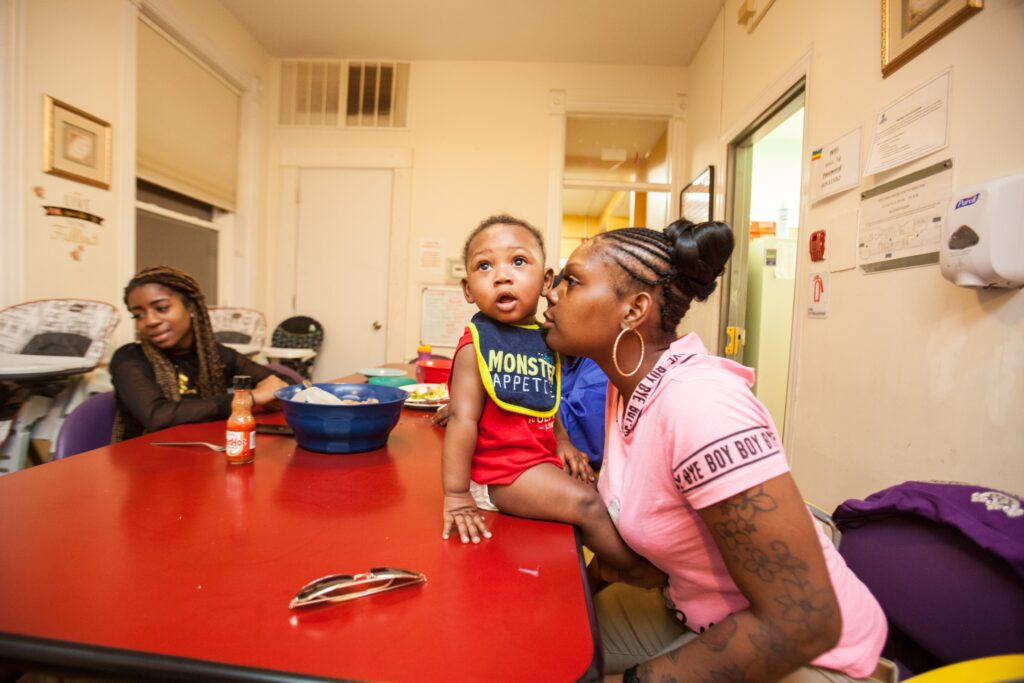

Youth Outreach and The Crib

In Cook County, a quarter of homeless youth identify as LGBTQ. All of The Night Ministry’s youth programs affirm the gender identities and sexual orientations of those we serve. Our Youth Outreach Team connects with LGBTQ youth on the streets of Chicago, offering nonjudgmental support and identifying those who are at-risk of becoming homeless. In 2011, we opened The Crib, Chicago’s first emergency overnight shelter for young adults ages 18 to 24. The Crib operates as a safe haven for many homeless LGBTQ youth, and today it is held up as a model for its LGBTQ-competent services.

Phoenix Hall

More than a third of young adults ages 18 to 25 experiencing homelessness in Cook County lack a high school diploma or GED. And while homelessness and housing instability create barriers to academic achievement, we know that providing the space and resources that assist in the achievement of an education can help break the cycle of homelessness. Earlier this year, we opened the doors of a groundbreaking youth housing program. Phoenix Hall provides homeless students from Chicago’s North Lawndale College Prep High School with a safe, stable residence while they pursue their academic goals. Residents can stay until they graduate, and they receive the supportive services in school, at Phoenix Hall, and in the community that help them obtain their high school diploma.

Serving on a Daily Basis

“Chapin Hall’s research represents a significant step forward in understanding the scope and experience of youth homelessness in America,” said Hamann. “At The Night Ministry, we continually examine the data we gather from our programs and listen to the young people we serve. It is in this way that we can meet homeless youth where they are at while offering them support to improve their lives on a daily basis.”

______________________________________________

You can find the report “Missed Opportunities: Youth Homelessness in America” at http://voicesofyouthcount.org/brief/national-estimates-of-youth-homelessness/?utm_source=November+2017+enewsletter&utm_campaign=November+2017+enewsletter&utm_medium=email

Street Medicine Team Offers Mobile Health Care and Compassion

With winter in full effect, The Night Ministry’s Street Medicine Team is offering cold-weather support to individuals living in encampments across Chicago, with news about impending weather-related emergencies, referrals to shelters and warming centers, blankets, coats, warm socks, and gloves, as well as information about hypothermia.

Consisting of Nurse Practitioner Sandra Collins, Case Manager Safiyyah Hassan, and an Outreach Professional, the team travels throughout the city four days a week, regularly visiting individuals in as many as 30 makeshift street camps. They offer free health care, case management, hygiene supplies, and a friendly presence to those whom they meet.

David Wywialowski, the Director of The Night Ministry’s Outreach and Health Ministry Program, says that the team continues to find new locations.

“Since the program is mobile, we can easily follow those individuals with whom we have developed a relationship when they move from place to place. However, when people move, the team discovers new communities. As we grow the program’s financial support, our team will be able to increase the amount of time that they spend on the street and serve more communities,” said Wywialowski.

Launched as pilot project in 2015, Street Medicine will become a permanent part of our Outreach and Health Ministry Program this year.